
European Trip Planning
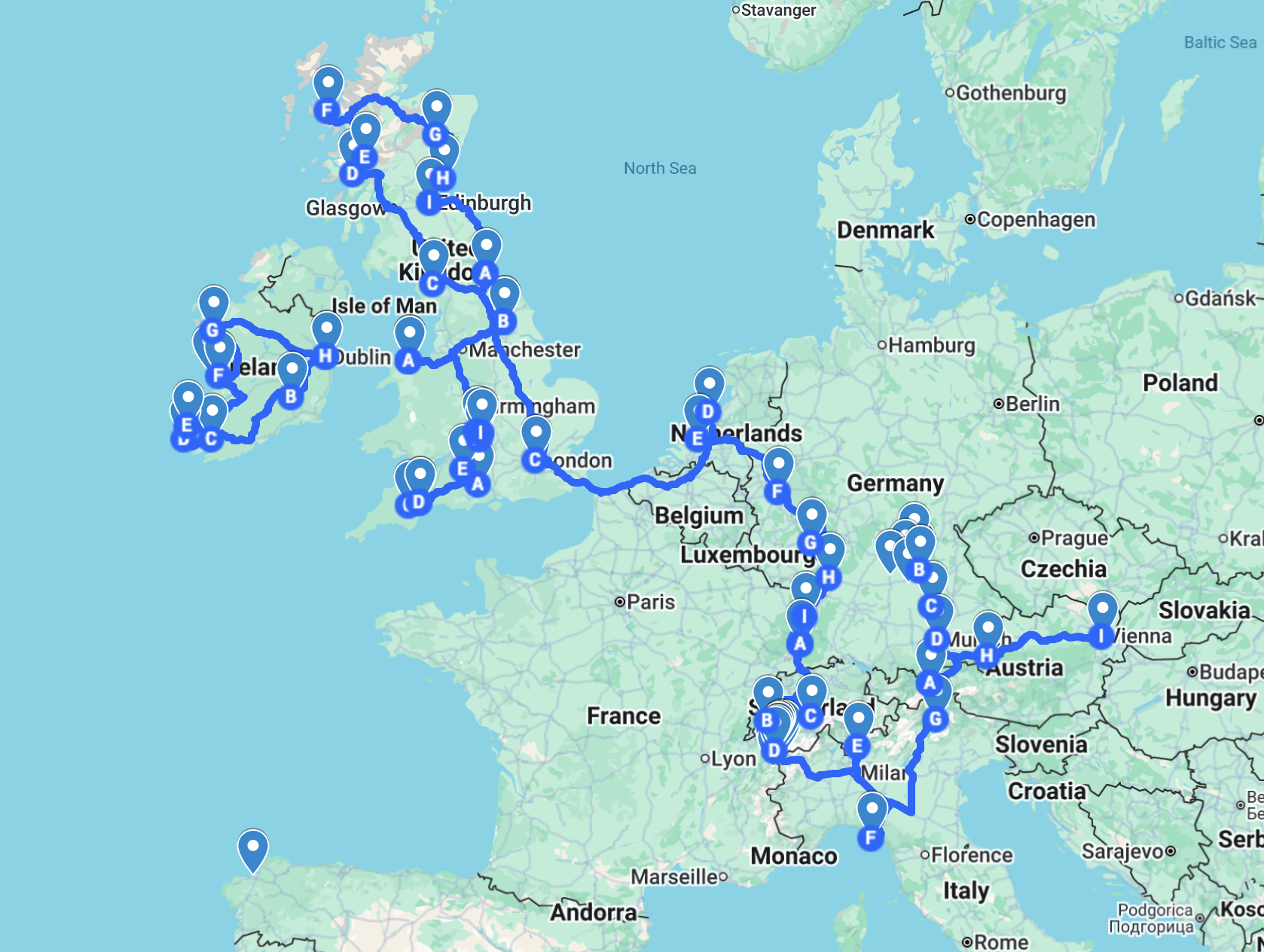
We made a post a couple of years ago about how we plan our long trips (Trip Planning). However, those trips were with a camper van or RV, traveling around the United States and Canada. Planning our six to seven month trip to Europe in 2025 was a lot different and much more involved. We’re sharing our process in hopes that it might help you plan your trips.
The major steps that we took in our planning process were very similar to the steps we’ve done before. But the devil was in the details. Each step was slightly different, with a lot more logistics to consider and more options to pursue, taking a lot more time to complete. We’ll go through the same fifteen steps and explain how planning for Europe differed for that step.
Step One: Come up with an overarching theme or main goal for the trip
Step Two: Decide on a rough route
Step Three: Make a wish list of things to see and do in each country
Step Four: Make a Google My Maps of your wish list
Step Five: Identify the order of items per country
Step Six: Start an itinerary list in a spreadsheet
Step Seven: Refine the itinerary by looking at the time it takes to travel between locations
Step Eight: Start setting dates for each stop
Step Nine: Find places to stay at each location
Step Ten: Research when reservations open for lodging
Step Eleven: Set calendar reminders for when reservations open
Step Twelve: Make lodging and transportation reservations when possible
Step Thirteen: Consider reservations for excursions and attractions
Step Fourteen: Plan laundry stops
Step Fifteen: Add info to the spreadsheet as needed
Step One: Come up with an overarching theme or main goal for the trip

Well, our overarching theme was Europe, which is a rather large theme. The whole trip was sparked by Keith wanting to go back to Oktoberfest for our big wedding anniversary coming up. Ann doesn’t like to fly, especially overnight, so she wanted to make it a long trip. We lived in Germany from 1989 to 1991, so visiting Oktoberfest was a nostalgic request, as we went there several times while we lived over there. The main goal for the rest of the trip was a mixture of revisiting places we loved along with exploring new places we’ve never been before. We emphasized experiences over just seeing touristy sights. Experiences were activities like hiking and cycling or connecting with the local culture like a cooking class. In true Backroad Buddies fashion, we wanted to minimize visiting large cities and spend more time in smaller towns, villages, and national parks.
Step Two: Decide on a rough route
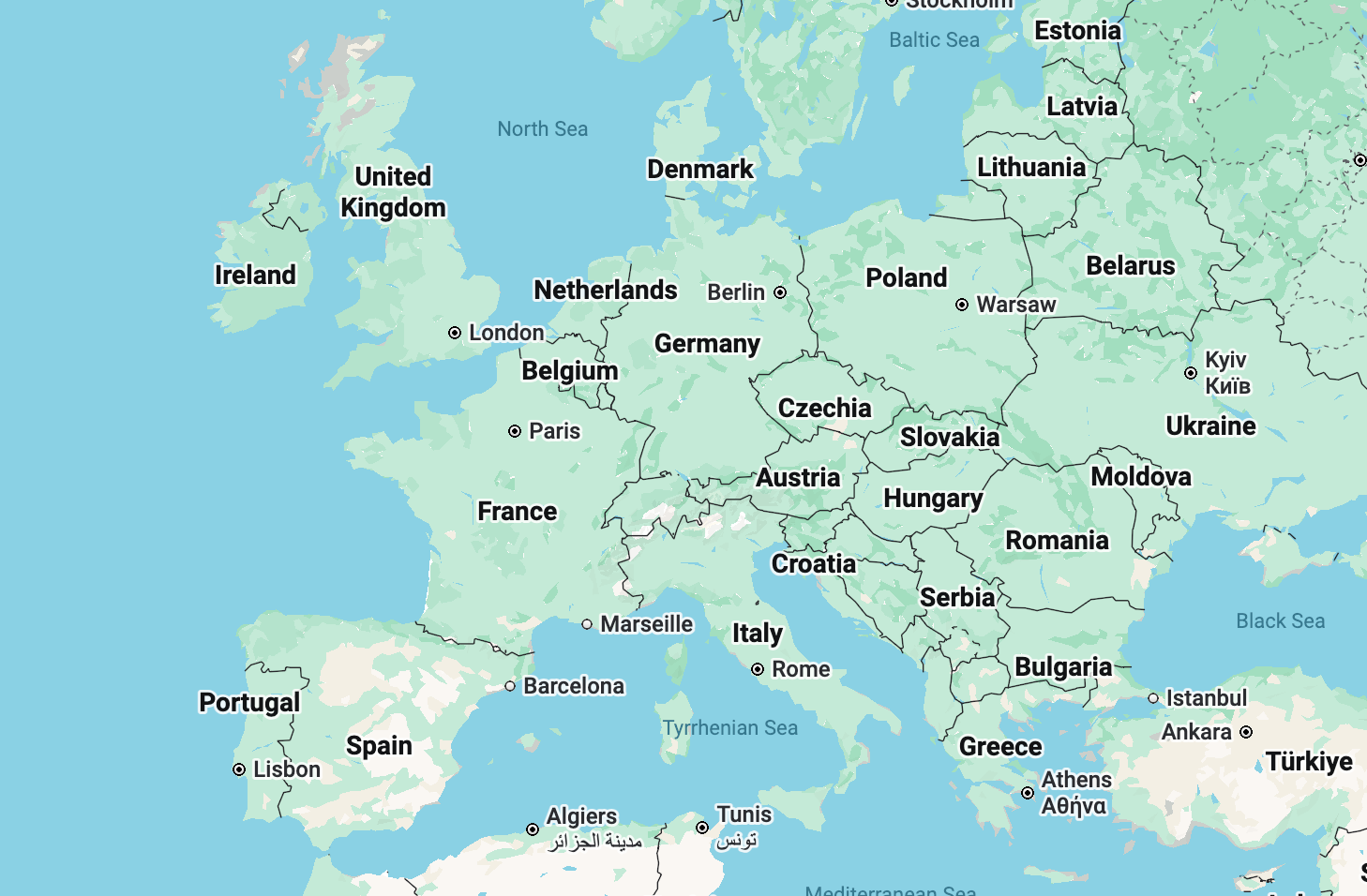
Planning a rough route was a little harder than driving around the States. Normally we would make a loop, starting and ending at our house. For Europe, we could start and end at two different locations. Oktoberfest occurs in September, so Munich Germany was our ending point from where we would fly home. We normally travel for about six months, which seems like a long time until you start laying it out. Some of the countries we had not spent any or much time in were Spain, Portugal, England, Scotland, Ireland, Wales, and Northern Ireland. We also knew we wanted to spend some time in the Alps, so France, Italy, Switzerland, and Austria were on the table. As we started to research these countries, we learned that most of the EU is in what is called the Schengen Area. American citizens (as with some other non-EU citizens) are only allowed to stay within the Schengen Area without a Visa for up to 90 days within a 180 day sliding window. England, Scotland, Wales, and Ireland are not part of the Schengen Area (even though Ireland is in the EU), but the rest of the countries on our list were (even though Switzerland is not part of the EU). So we eliminated Spain and Portugal and decided to start out with three months in the United Kingdom and Ireland, then moving down to the Alps and ending up in Munich.
Step Three: Make a wish list of things to see and do in each country

For trips around the States and Canada, this step was done per state or province, but for Europe, we did it per country. Our research for each country was a little different, as we relied heavily on Rick Steves’ travel books. This was very time consuming, as we read through each of Rick Steves’ books for each of the countries we were interested in, highlighting the things and places that sounded interesting to us. We also took inspiration from YouTube travel videos. Some large items entered the list here, like a hiking and biking tour of the Cotswolds in England, a narrow boat canal cruise also in England, a Rhine River cruise, and hiking the Tour du Mont Blanc, a 100 mile long distance trail through France, Italy, and Switzerland.
Step Four: Make a Google My Maps of your wish list
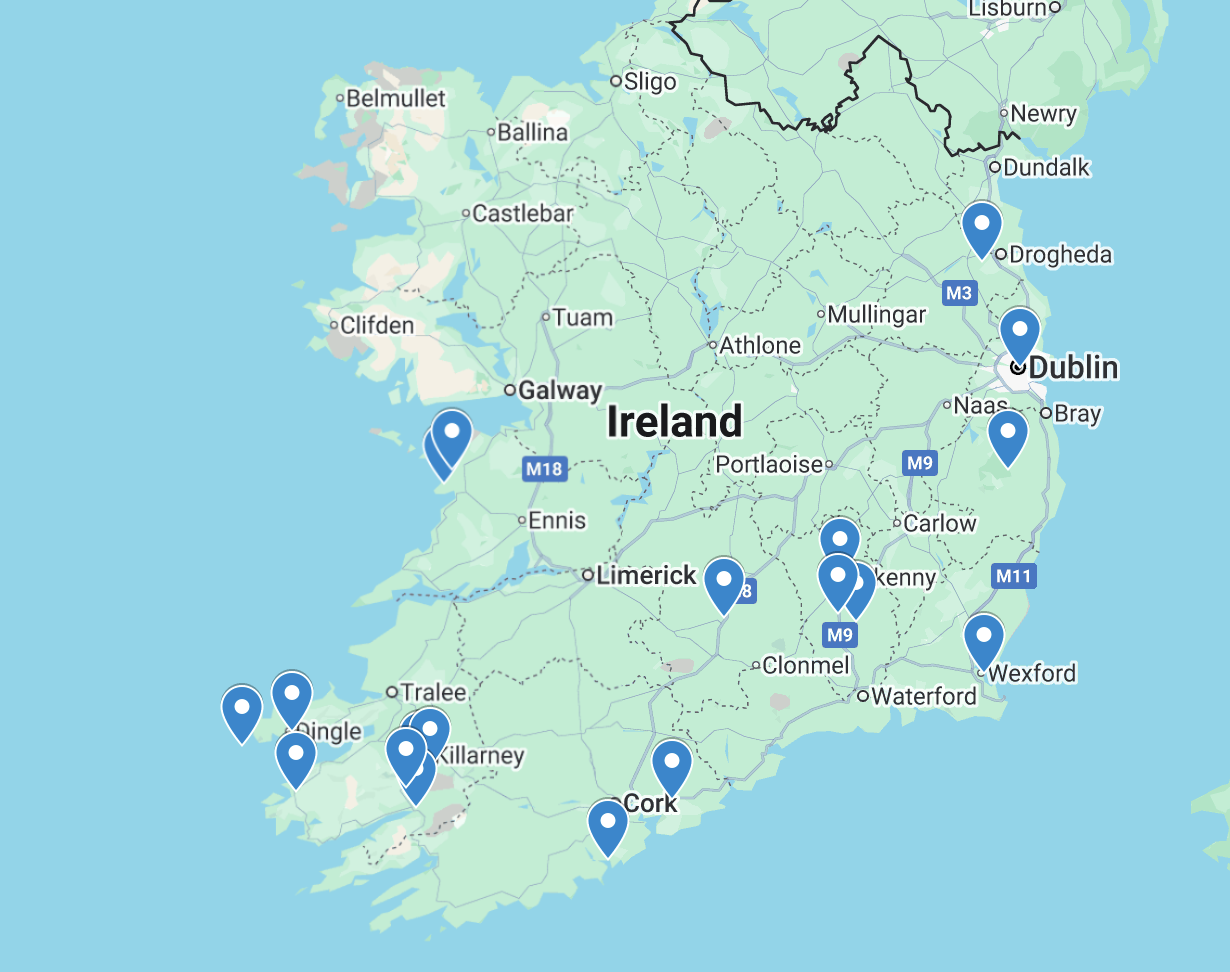
If you put your wish list of locations in a spreadsheet, you can easily import them into a Google My Maps. Seeing all of the locations on a map makes it easier to visualize. There wasn’t much of a difference with this step for Europe versus traveling in the States.
Step Five: Identify the order of items per country
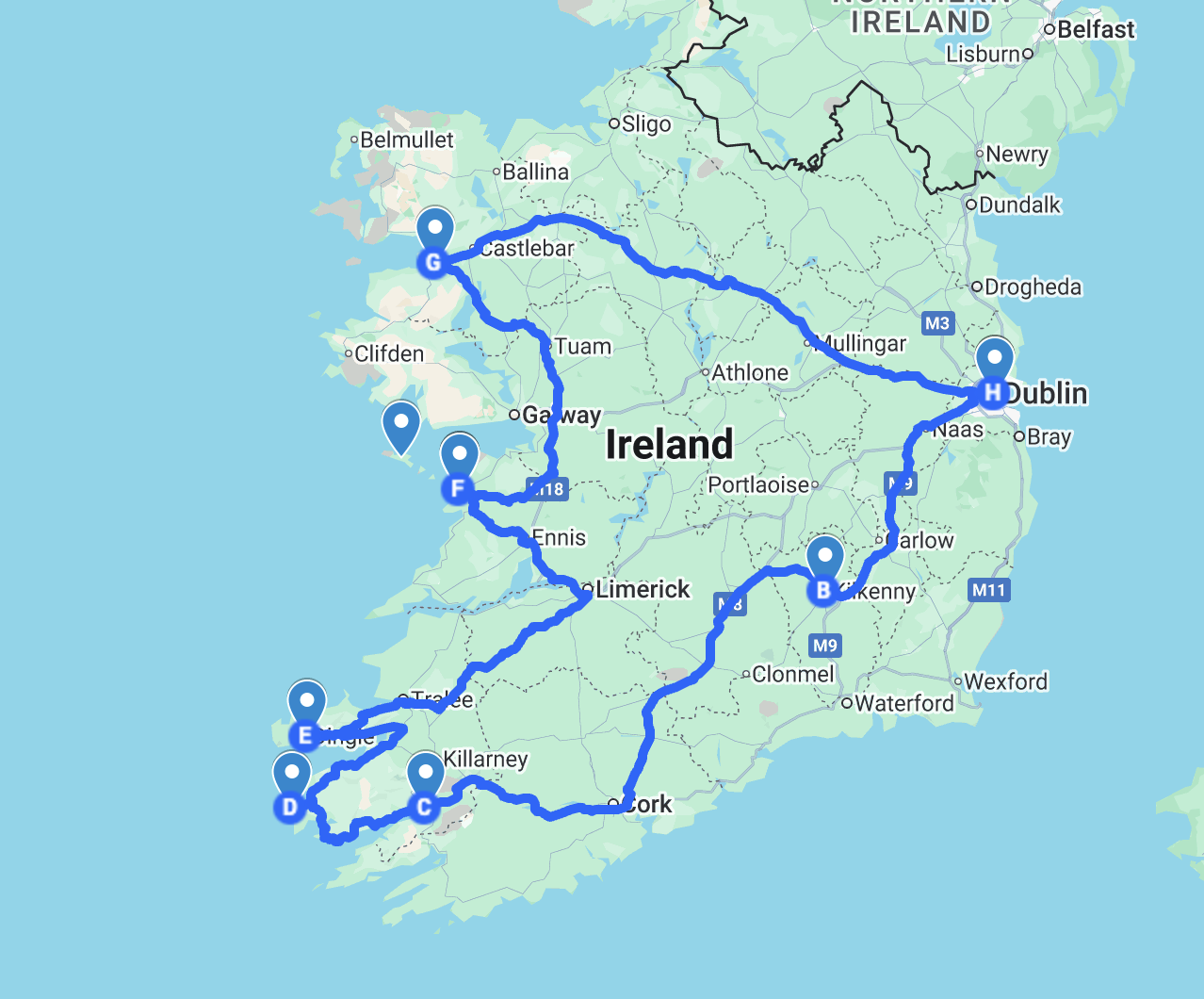
Again, for Europe, we did this step per country instead of by state or province. Identifying the order was a little more involved than just trying to make a loop. When traveling in the States in our camper van or RV, we knew what our mode of transportation was and all we needed to do was connect the locations by roads. In Europe, we had to determine what our mode of transportation was between locations and, for the case of trains or boats, what the frequency and length of those connections were. You can fly around Europe pretty inexpensively, but we don’t like to fly. So, for example, getting to and from Ireland would mean taking a ferry over from England or Wales. The only ferry that allowed pedestrian passengers was the one from Holyhead Wales to Dublin Ireland. So that meant our loop around Ireland would start and end in Dublin. It is during this step that some items from the wish list may be left off, because they may be too far out of the way for how much that item interests us.
Step Six: Start an itinerary list in a spreadsheet
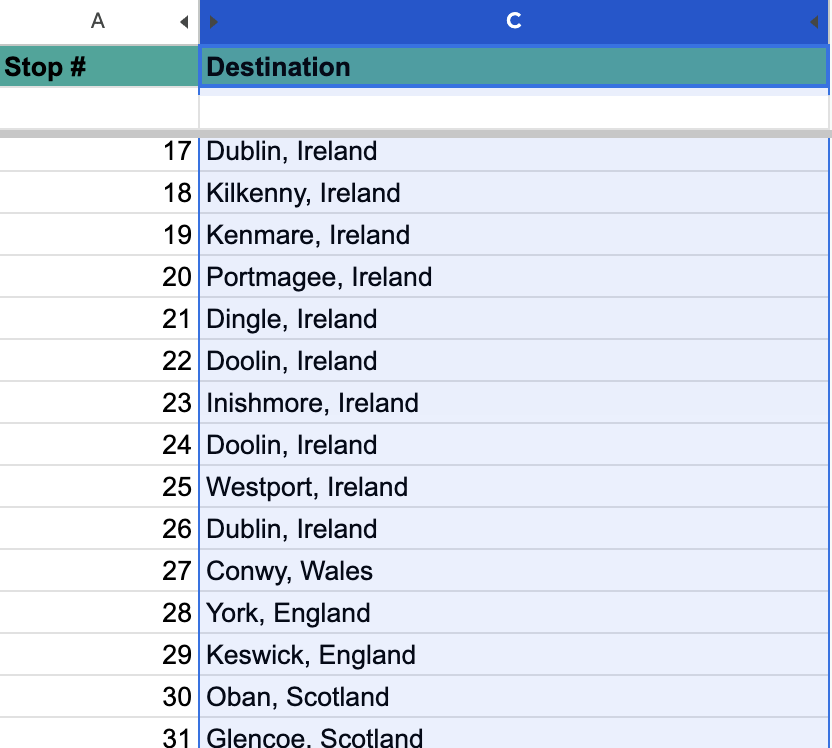
We could not plan these long trips without a spreadsheet. The spreadsheet becomes our bible for the trip. Each location from our modified wish list becomes one line in the spreadsheet, in the order that we determined in Step Five, connecting all of the items from each country together in one big list.
Step Seven: Refine the itinerary by looking at the time it takes to travel between locations
In our previous spreadsheets for the States and Canada, we use scripts to automatically calculate the distance and driving time between locations. For Europe, distance and driving time are not the important metrics, since we will not be driving most of the time. So, again, this step took much longer as we determined what the means of transportation would be, whether it was by train, boat, bus, and/or car. After we determined what type of transportation we would be using, then we could determine how much time it would take to travel between the locations. We normally don’t like long travel days, but there were times during our Europe trip that it seemed like the best option, due to difficult train connections.
Step Eight: Start setting dates for each stop
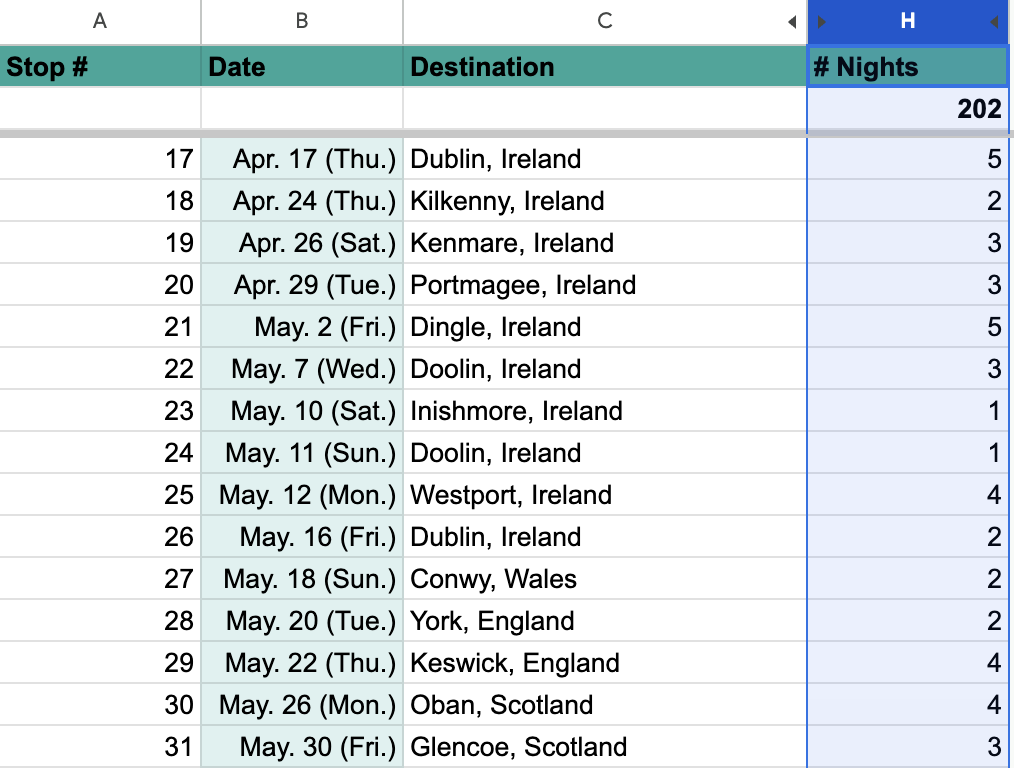
Setting the dates for each stop for Europe was pretty similar to our previous travels. We’ve found that our sweet spot is staying about four nights in each location. If there doesn’t seem like there is a lot to do in an area or we need to shorten it to solve a scheduling issue, we’ll cut it back to three nights. If a location has many things we want to see or do, especially if there is a long excursion from that location, we’ll extend our stay to five nights or more. On a couple of occasions, we added a location just to break up a long travel day, so we shortened the stay to only two nights. For example, we stopped in Conwy Wales for two nights just to get us in a good position to catch the ferry of to Dublin. But then we stayed another two nights in Conwy on our way back through from Ireland.
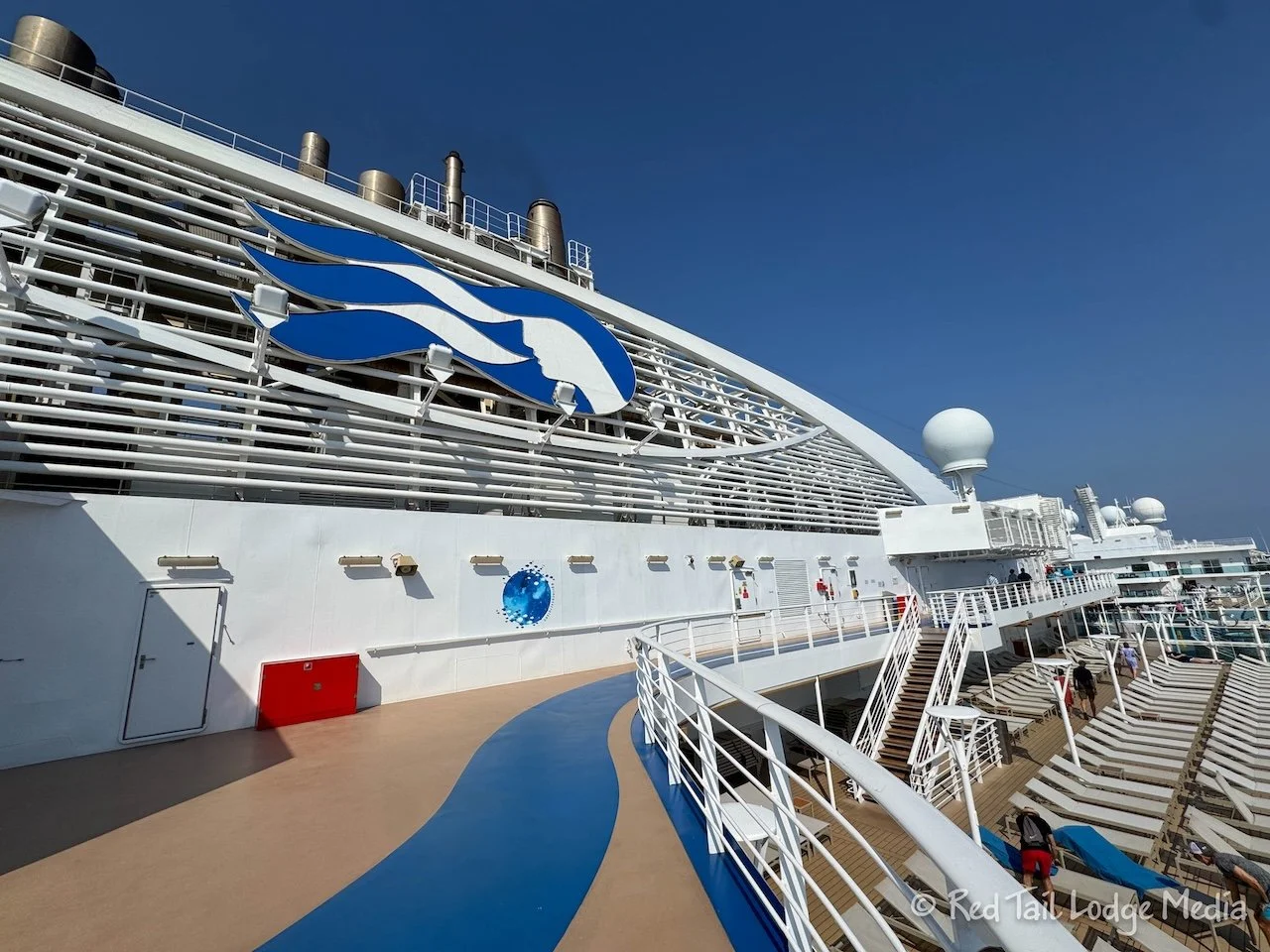
It was about at this point that we decided not to fly over to Europe, but take a transatlantic cruise from Fort Lauderdale Florida to South Hampton England. The one we picked out was offered by Princess Cruise Line , but there is only one per year, so that determined our start date. We also reserved the cruise early, over a year in advance, even though we knew the probability of it selling out was pretty low. However, making sure that start date was set meant that we wouldn’t have to scramble to change all the other dates if we had to change the cruise date, as it would have a ripple effect all the way down our itinerary.
Step Nine: Find places to stay at each location
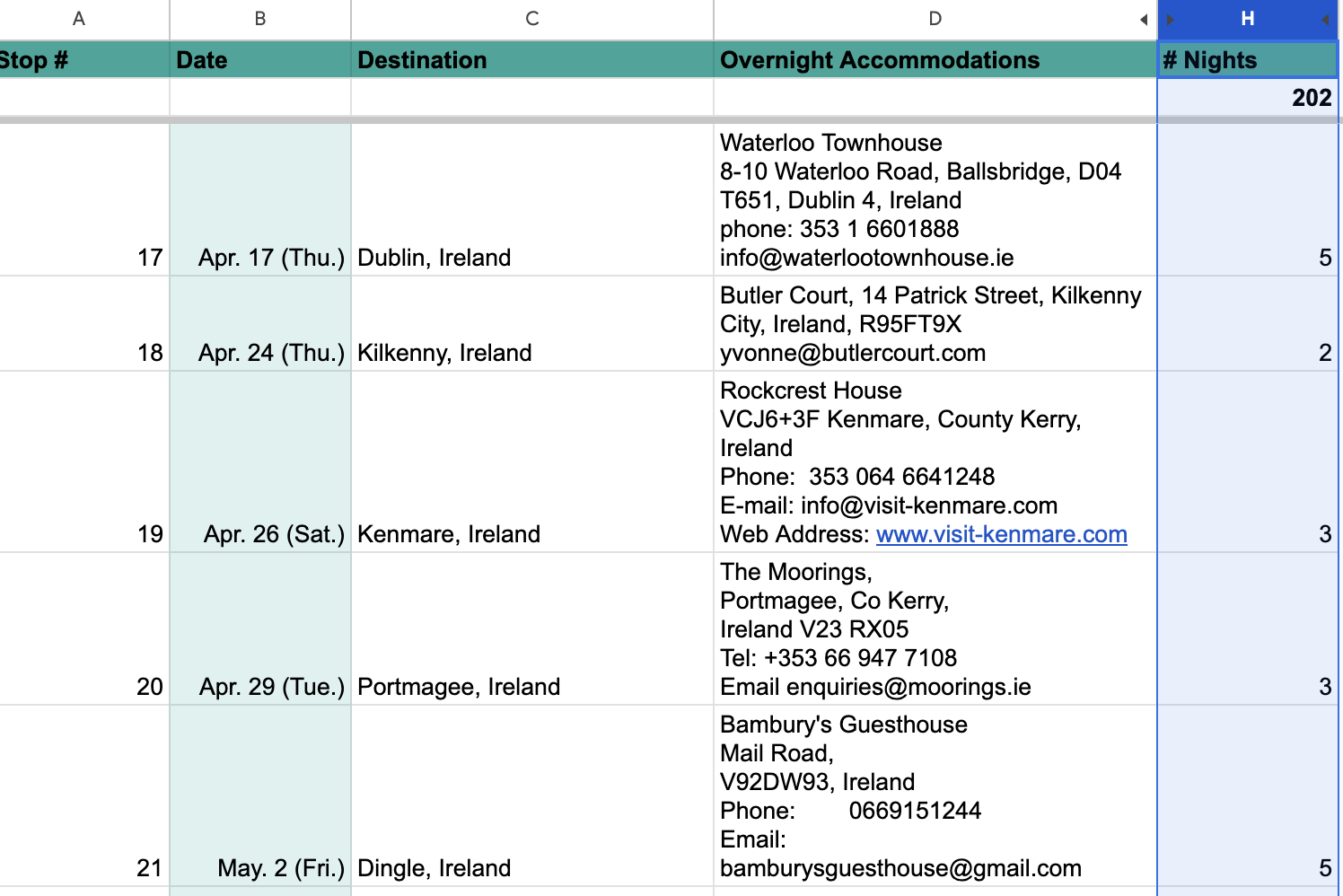
Back in the States, we would mainly use Campendium to find campgrounds at our desired locations. For Europe, we generally stayed at B&B’s or small family run hotels. We tried to stay away from large hotels and chains. Again, we heavily relied on Rick Steves’ recommendations for lodging, but we also used Google Maps searches, Vrbo and Airbnb on occasion. There were a couple of stretches in the itinerary where we did not arrange the lodging ourselves, such as for the narrow boat cruise, the hike and bike tour, the Rhein River cruise, and the bike tour in Germany where the lodging was provided as part of the package. Since we were emphasizing experiences, we tried to mix up our types of lodging. On the Isle of Skye in Scotland, we booked a “pod”, a self-catering glamping cabin. In Amsterdam, we stayed on a house boat docked on one of the canals. Along the Tour du Mont Blanc (TMB), we often reserved mountain huts (called rifugios, refuge, or gite) for either a private room or in a dormitory. But planning the TMB section of our trip was a whole different animal. We’ll cover the details of our TMB planning in a separate post.
Step Ten: Research when reservations open for lodging
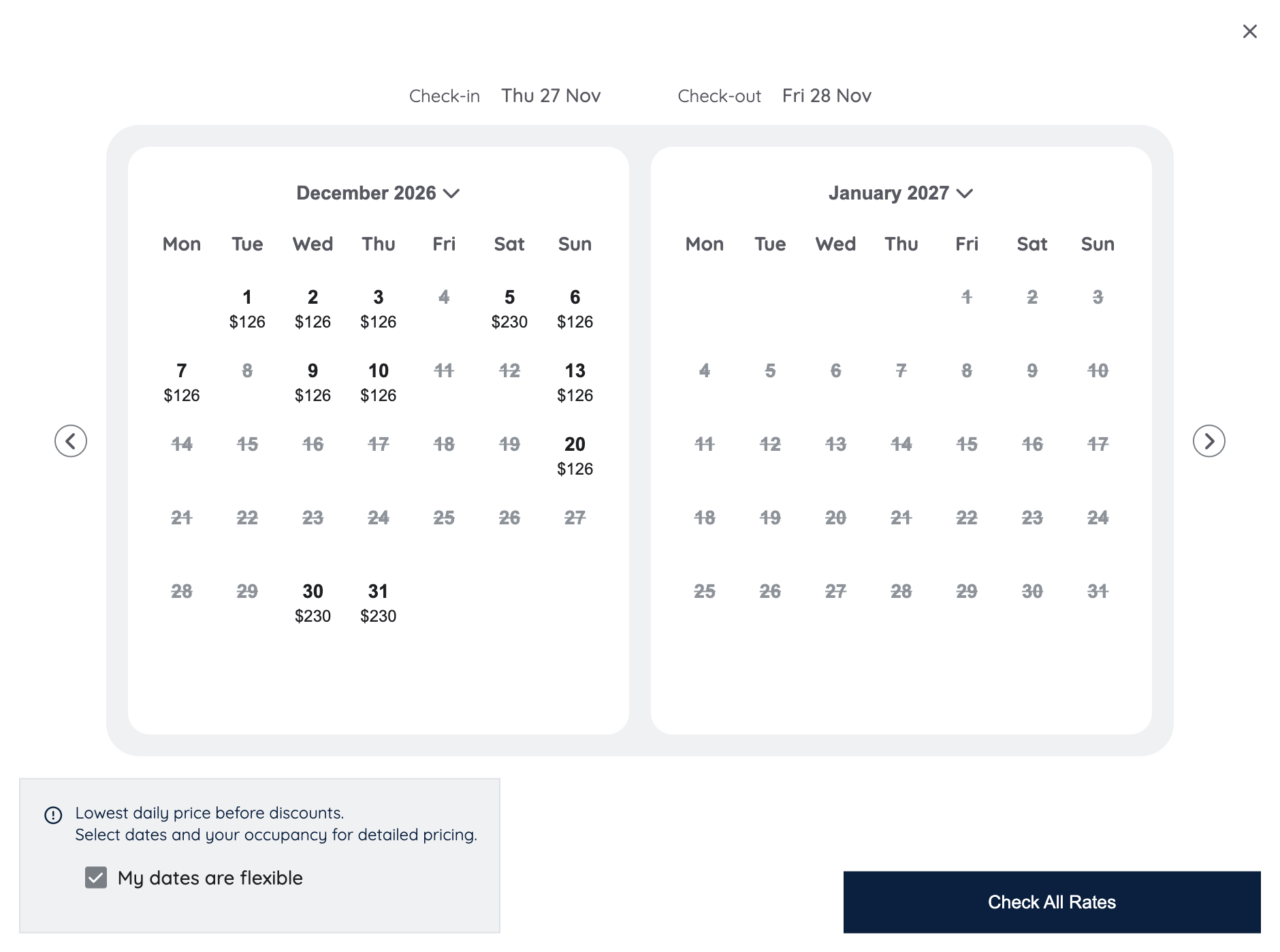
Surprise, surprise, this step was more involved for Europe. Unlike many state park, provincial park, and federal campgrounds, the lodging in Europe did not advertise the exact date and time that they would start taking reservations. For most places, we would just try to book and look how far out their booking calendar went. For some places, this was confusing because it might just say that there are not rooms available for our desired dates, but it wasn’t clear if all of the rooms were already booked or they hadn’t been released yet that far in advance. Some places we had to fill out forms, email or call to book or find out availability. A couple of small places were closed during the winter or off-season and wouldn’t even consider taking a reservation until less than a month before we wanted to visit. In those cases, we just looked around for another place that would take reservations sooner.
Step Eleven: Set calendar reminders for when reservations open
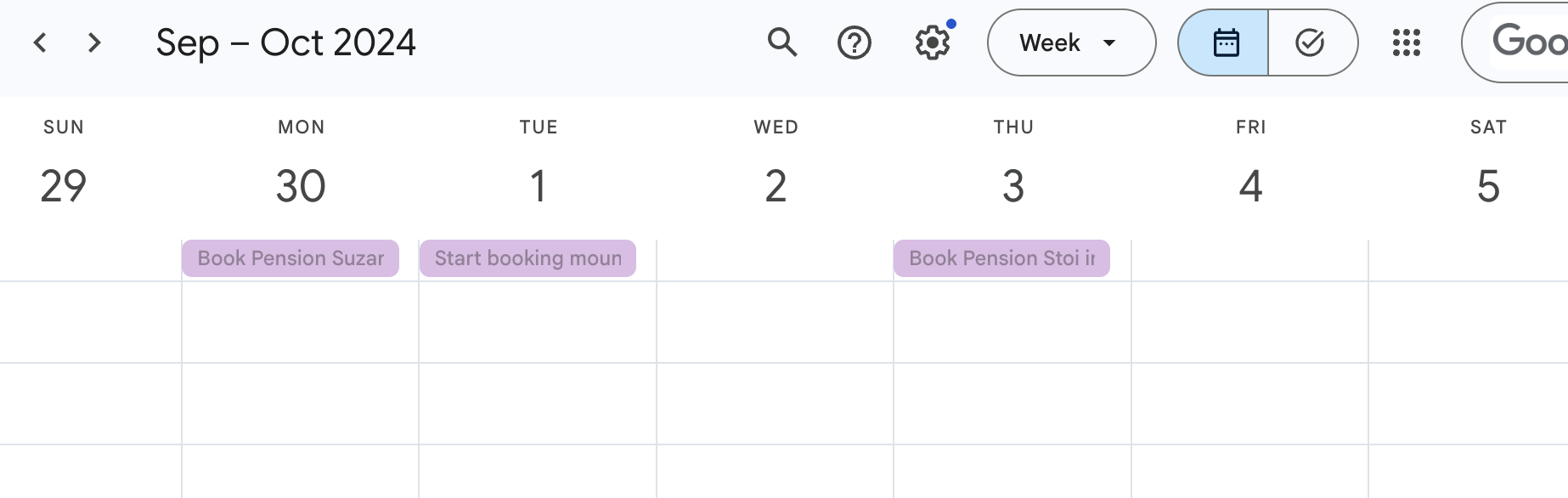
For the lodging locations that we could determine when their reservations became available, we set calendar reminders. For others, we set calendar reminders to check them again. Then, if they still weren’t taking reservations, we would set another reminder for a little later to check them again. Yes, you guessed it. This became very time consuming.
Step Twelve: Make lodging and transportation reservations when possible
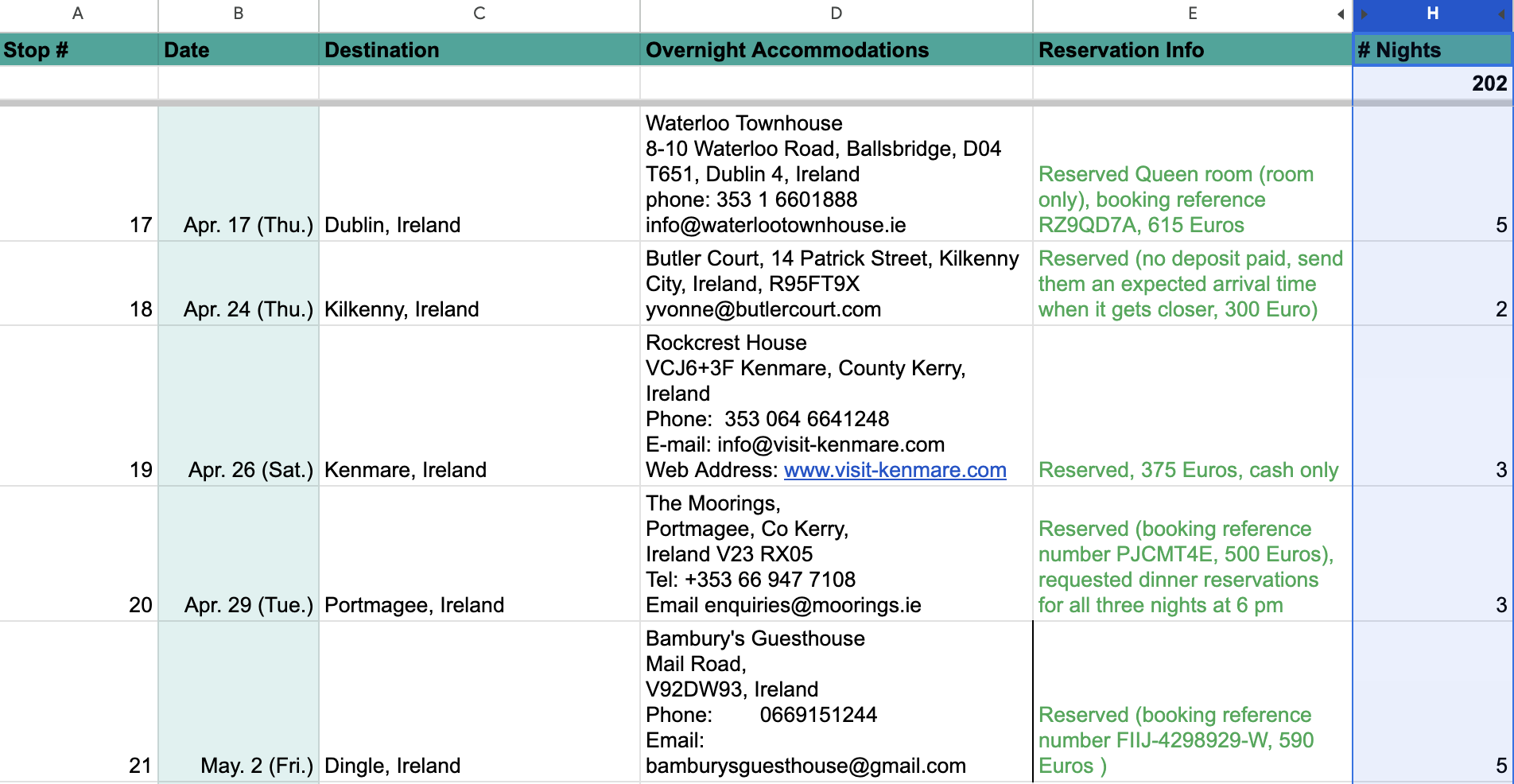
We don’t like to spend much time while we are traveling trying to book our lodging. We prefer to reserve as much lodging as possible before we start our trip. This was true not just for Europe, but for our domestic traveling as well. Since we were mainly booking with small lodging places, we tried to book directly with them, instead of going through a service like Expedia or Booking.com. That way these small operations were not paying for the third party services and all of the revenue went to them directly.
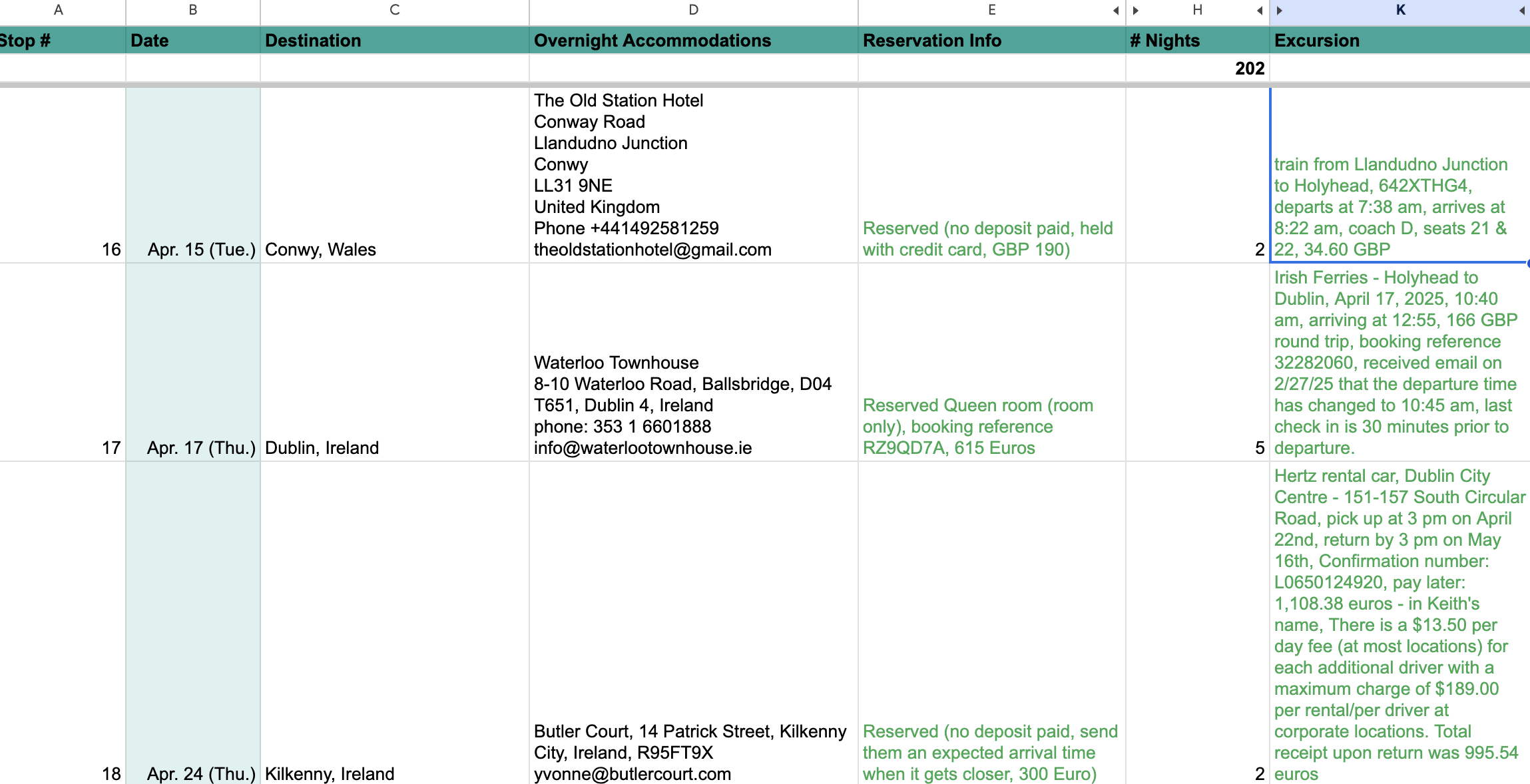
For Europe, we had the addition of arranging transportation. Transportation reservations included several car rentals, ferry boats, trains, and rail passes. Research was needed to determine which type of transportation was the best for the given travel day, which type of reservation was the best (anytime vs. specific train), and which rail passes made the most sense (Swiss Travel Pass or Eurrail vs. individual tickets). Not only did we need to consider the main mode of transportation, but also how we would get to and from our lodging to the train station or car rental office. Was it close enough to walk? Was there a bus, tram, or subway available? Are there Uber or taxi services available?
Step Thirteen: Consider reservations for excursions and attractions
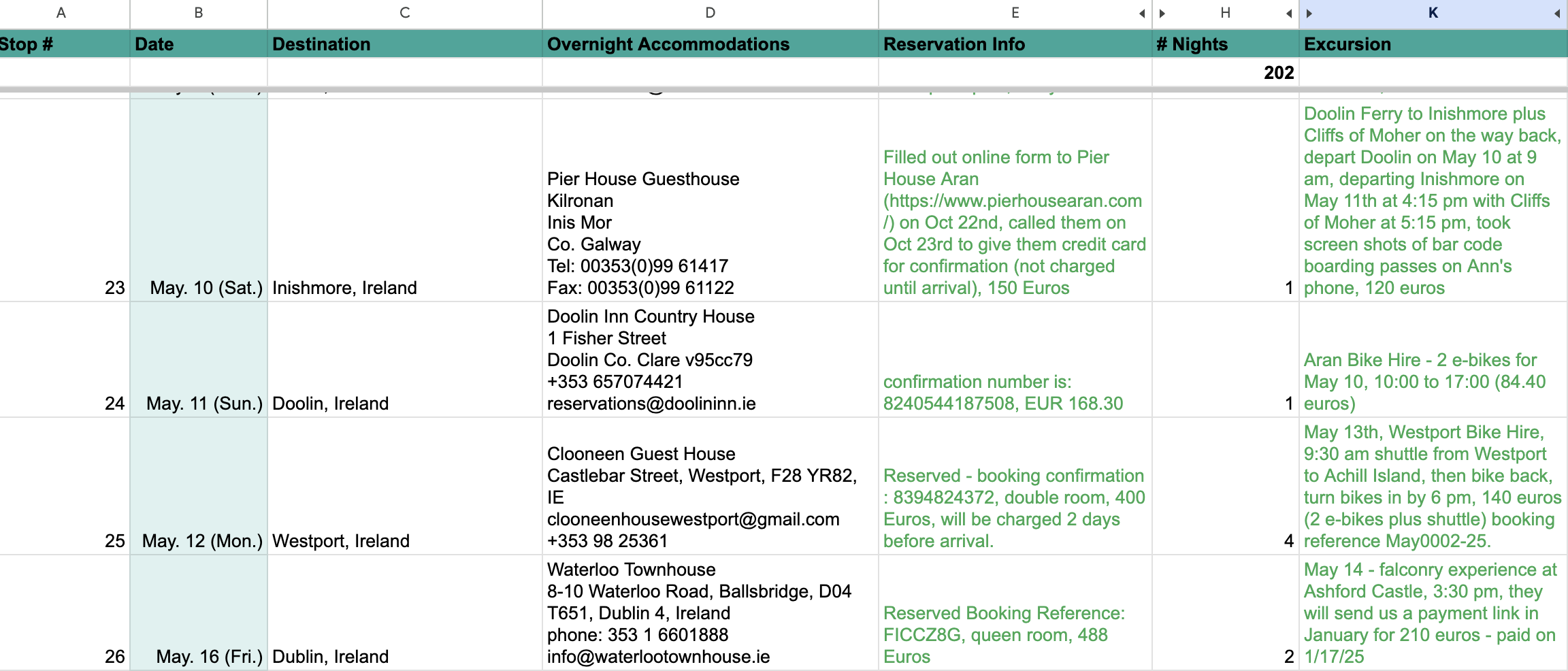
On all of our long trips, we usually don’t plan ahead for exactly what we will be doing or seeing. However, if we know there is something we are really interested in, we research whether advance reservations are necessary or recommended. So we booked things in advance like the Hawk Walk with the Ireland’s School Falconry at Ashford Castle in Ireland, the excursion from Oban Scotland out to Lunga Island to walk among the puffins, and the Lion King Musical in London.
Step Fourteen: Plan laundry stops

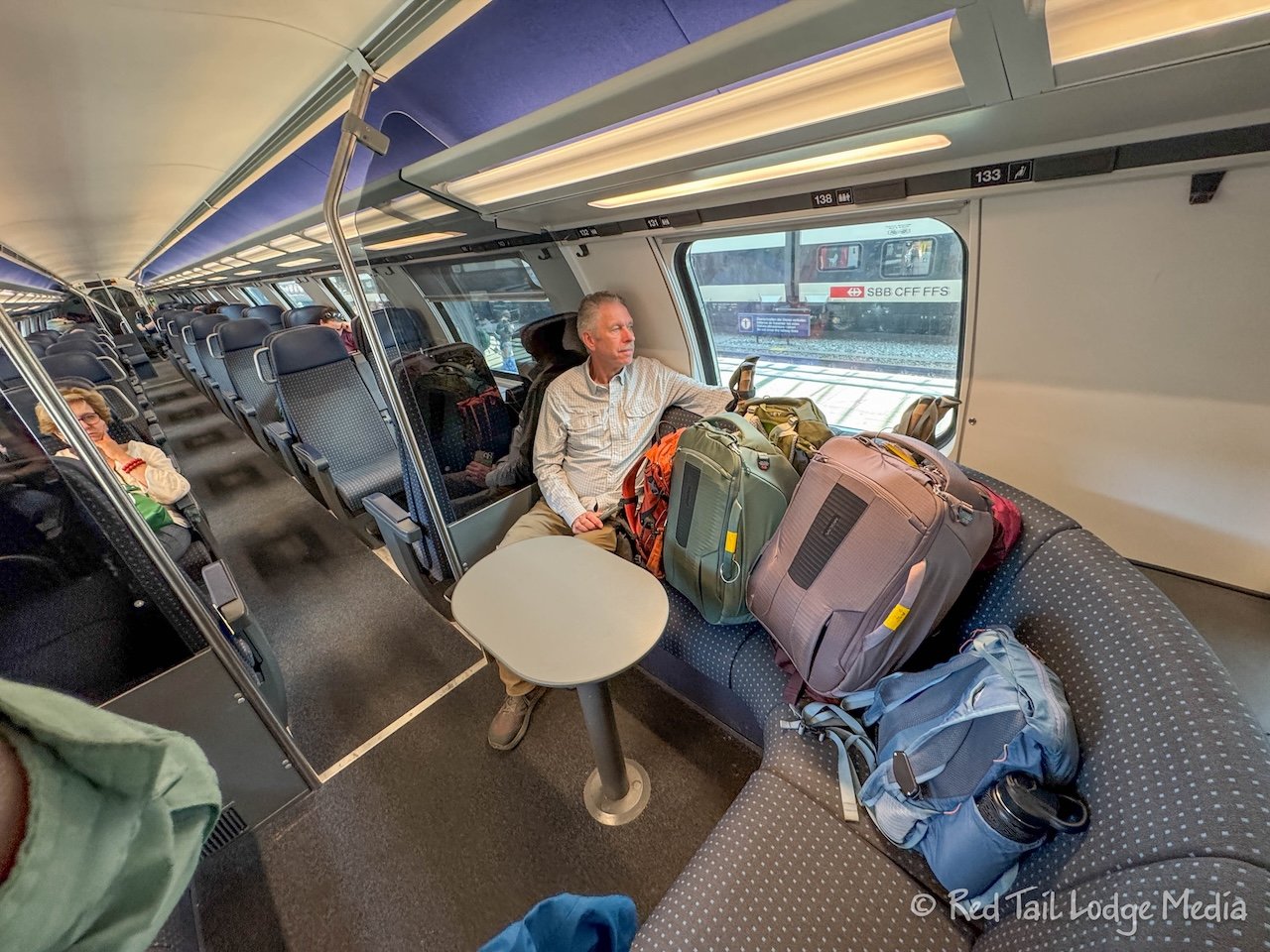
We actually skipped this step for Europe. In the States, we normally like to make sure we are near a laundromat or a campground with laundry services available every seven to fourteen days (so we know how many pairs of underwear we need to pack for the travel season). For Europe, we traveled light. Our plan was to hand wash a set of clothes every evening at our lodging, so we never need to go to a laundromat. Even though that got old after six or seven months, we felt it was way better to spend ten minutes every evening than to spend an hour or two at a laundromat every week or so. Traveling light also had the added benefit of allowing us to carry everything on our backs, making hopping on and off trains easier and making it possible to walk a mile to the train station or car rental office. To see exactly what we packed for our Europe Trip, check out our previous post: Packing for Europe.
Step Fifteen: Add info to the spreadsheet as needed
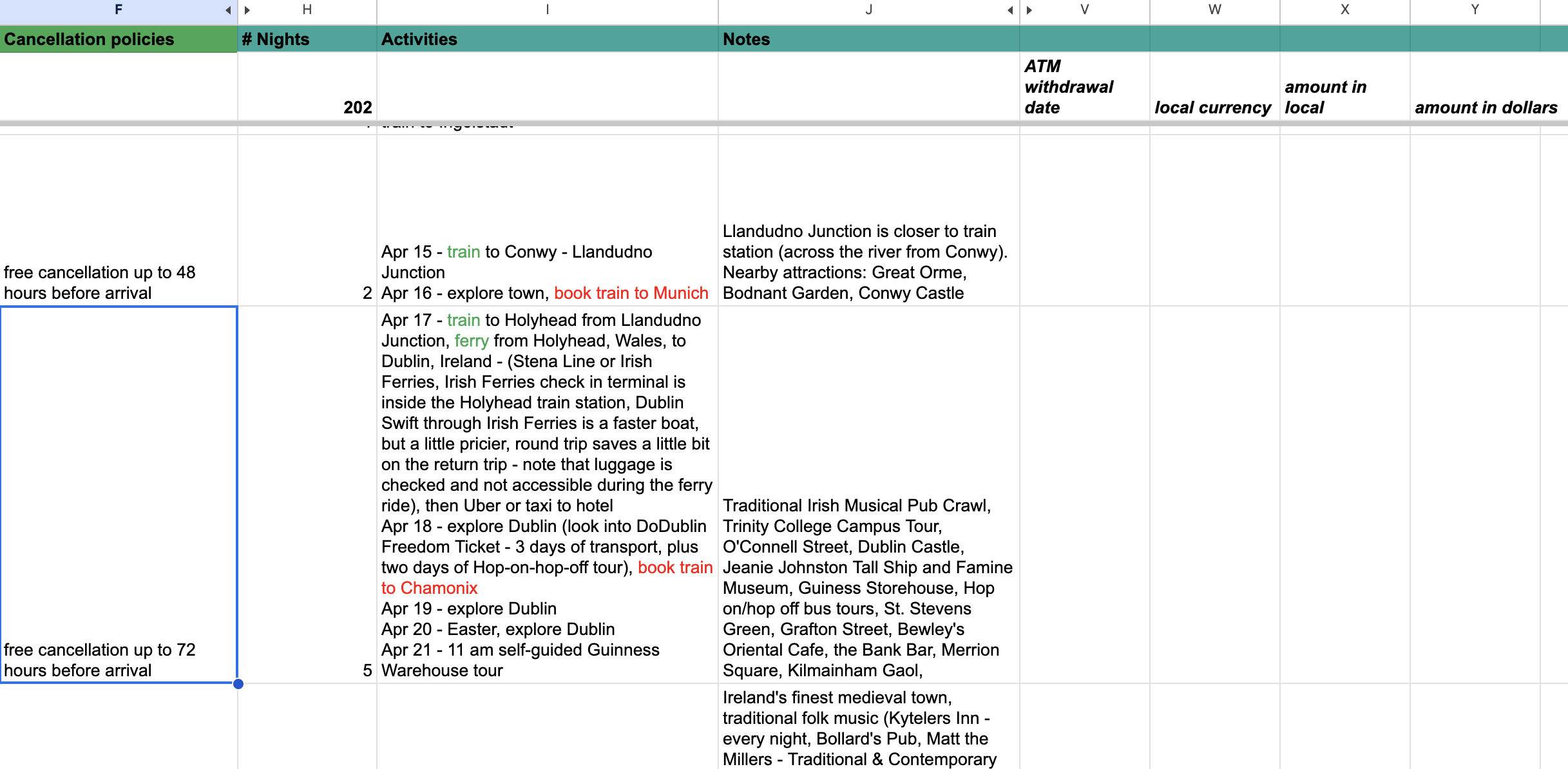
For Europe, we packed more information into our spreadsheet than ever before. There were notes for local transportation, reminders to get more local cash, counting the days we were in the Schengen Area (we had three days to spare!), keeping track of which days we were using our Eurrail Passes, what attractions we wanted to see, what lodging was already paid for and which ones we still owed a balance, and how much cash we were taking out of ATM’s along with when and where. We even noted cancellation policies for our reservations, just in case we needed to change plans along the way. If there was something about the trip that we wanted to track or remember, we added it to the spreadsheet. Similar to our previous trips, we used color coding to help us. If we’ve already paid for something, the amount would be in green. If there was something we needed to pay special attention to, like remembering to make a reservation or a balance that needed to be paid, it would be in red.
Additional European Considerations
Europe had its own special things that needed to be handled that we didn’t need to do for traveling in the States. Besides knowing how long we were allowed to be in each country, we needed to research what special items couldn’t be brought into or out of a country, travel and health insurance, changing travel restrictions, cell phone plans that work in Europe, credit cards and ATM cards that don’t incur foreign transaction fees, notifying credit cards and banks of travel plans so they don’t block charges or withdrawals, and documentation needed for border crossings and car rentals.
We found out that the United Kingdom has strict knife laws, so we downsized the pocket knives we carry in our backpacks. Most US health insurance won’t cover you outside the country. Most travel insurance won’t cover you longer than three months. In order to waive the extra damage insurance for a rental car in Ireland, you need a Letter of Coverage from your insurance (in our case, from our Chase credit card which gave us coverage) that verifies you are covered in Ireland. We also obtained International Drivers Licenses from AAA. Most European countries require an International Drivers License (which is basically a translation of your U.S. driver’s license into several different languages), but the car rental agencies did not verify that we had one.
We registered with the U.S. embassies in each of the different countries through STEP (Smart Traveller Enrollment Program) so we would be alerted about any health, weather, safety or security issues in those countries. The Schengen Area has been talking about starting to require an ETIAS (European Travel Information and Authorisation System) for American citizens (and citizens from other Visa-exempt non-EU countries), but they kept pushing back the start date. However, we needed to keep checking on it to make sure it didn’t start before our trip. ETIAS will be a permission for entry into the Schengen Area which should be valid for up to three years. In the meantime, the United Kingdom did implement their version, called the ETA (Electronic Travel Authorisation), before our trip started, which we did need to apply for.
Conclusion
As you can see, planning for our Europe trip took a lot more time and research, with a lot more moving parts. But the basic process was pretty much the same. Hopefully all of this information will help you plan your trips.
Check out our related video: European Trip Planning
(Ann)