
Munich & Oktoberfest, Germany - September 16th to 24th, 2025
Munich was our last destination on our European trip for Season Seven. Oktoberfest was Keith’s request and was the inspiration for the whole trip. We’ve been to Munich and the Oktoberfest quite a few times before, when we lived in Germany thirty five years ago, so it was a bit nostalgic to help celebrate our milestone wedding anniversary. This time, our son was joining us in Munich and a few other relatives joined us a few days later to enjoy Oktoberfest together.
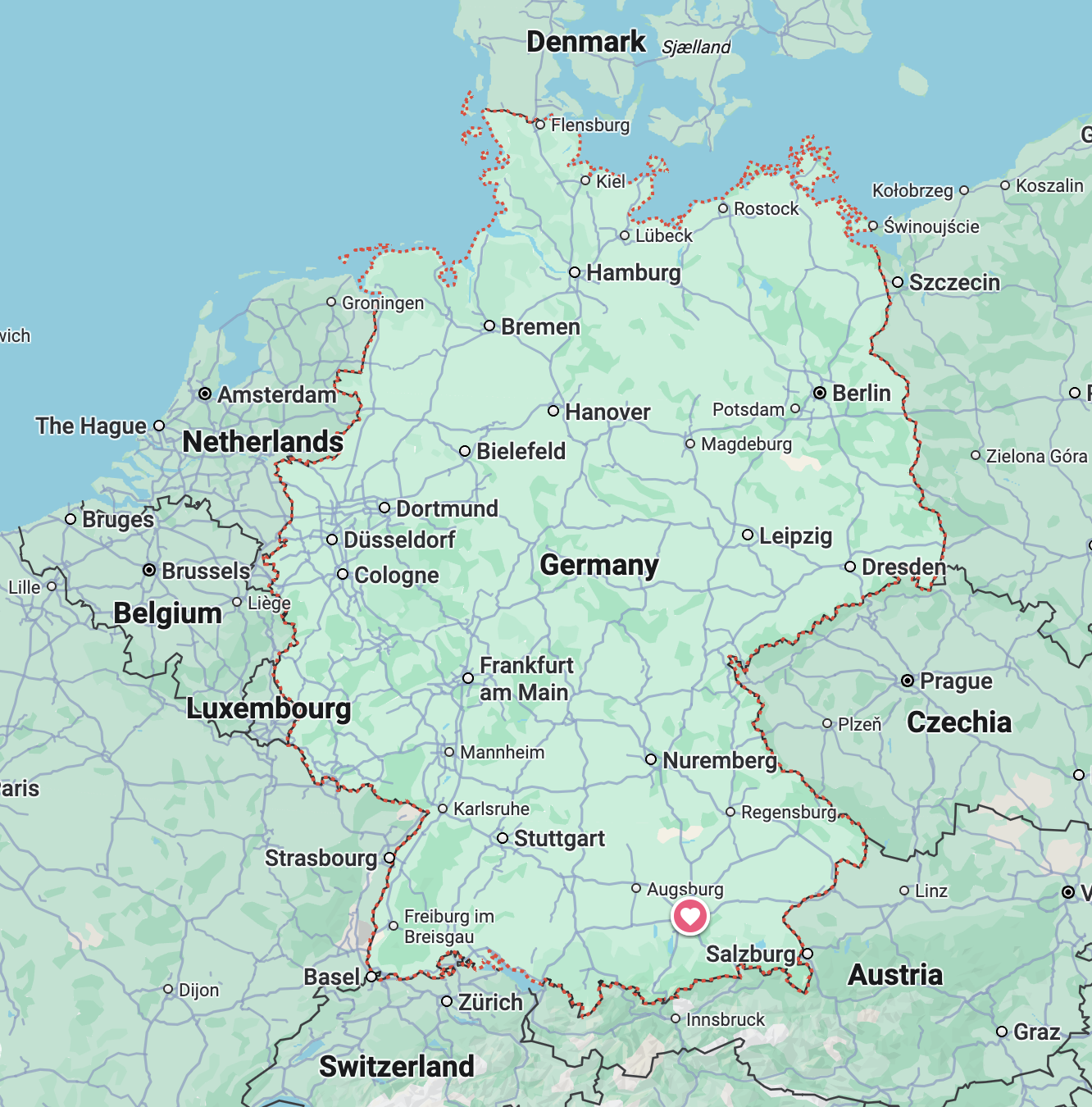
Tuesday was a travel day from Ingolstadt to München (Munich). It was only a 39 minute train ride and our train was not scheduled to depart until 10:06 am. So we were able to have a leisurely breakfast at Hotel Bauer Garni before checking out and walking the 20 minutes to the train station.
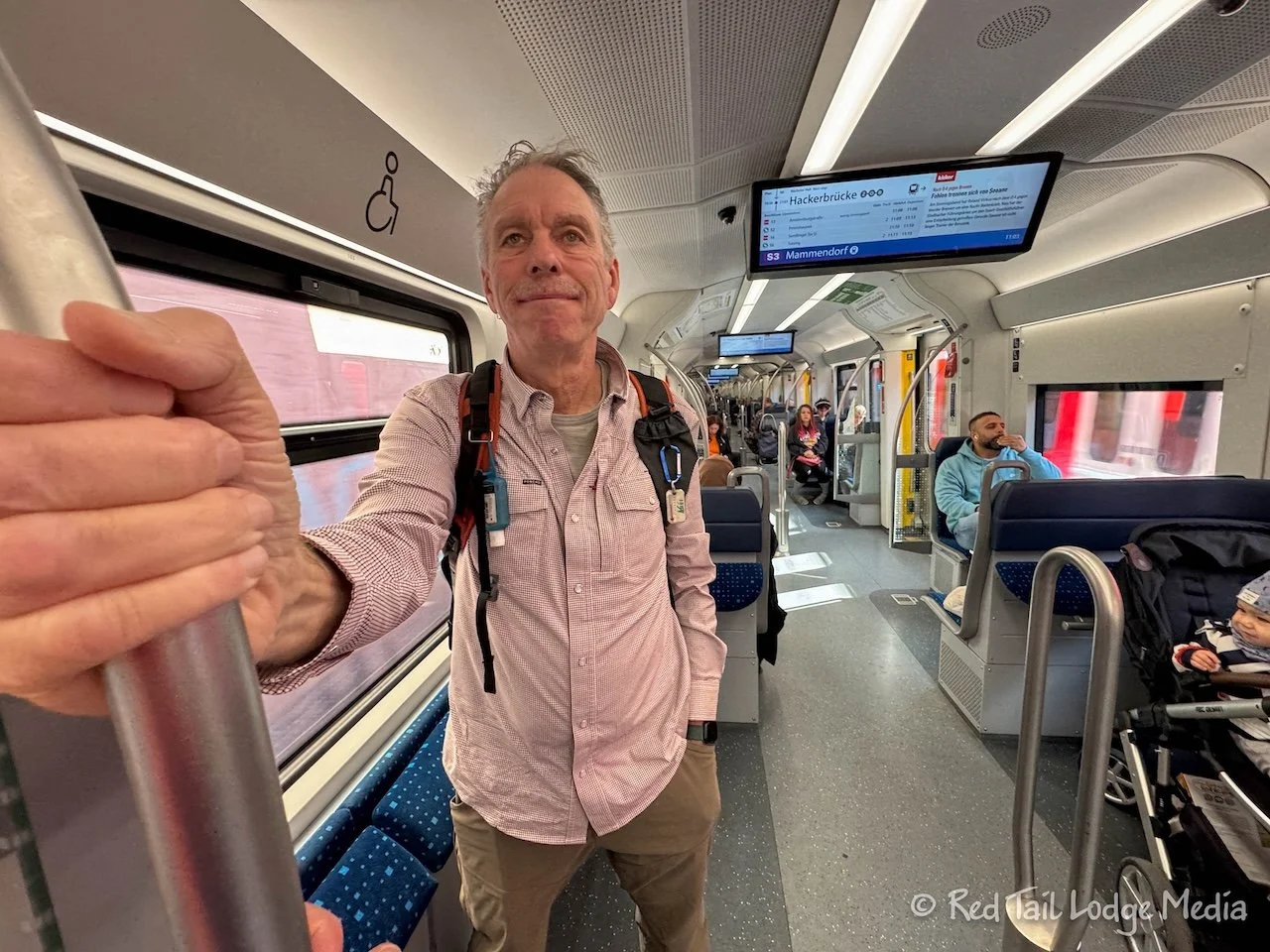
It was a pretty uneventful ride to München. When we arrived, we hopped on the S-Bahn (Stadtschnellbahn - city rapid railway) to reach the Laim S-Bahn station. We bought two single trip tickets for the 10 minute ride. An S-Bahn came every 5 minutes, so we were at the Laim station in no time.
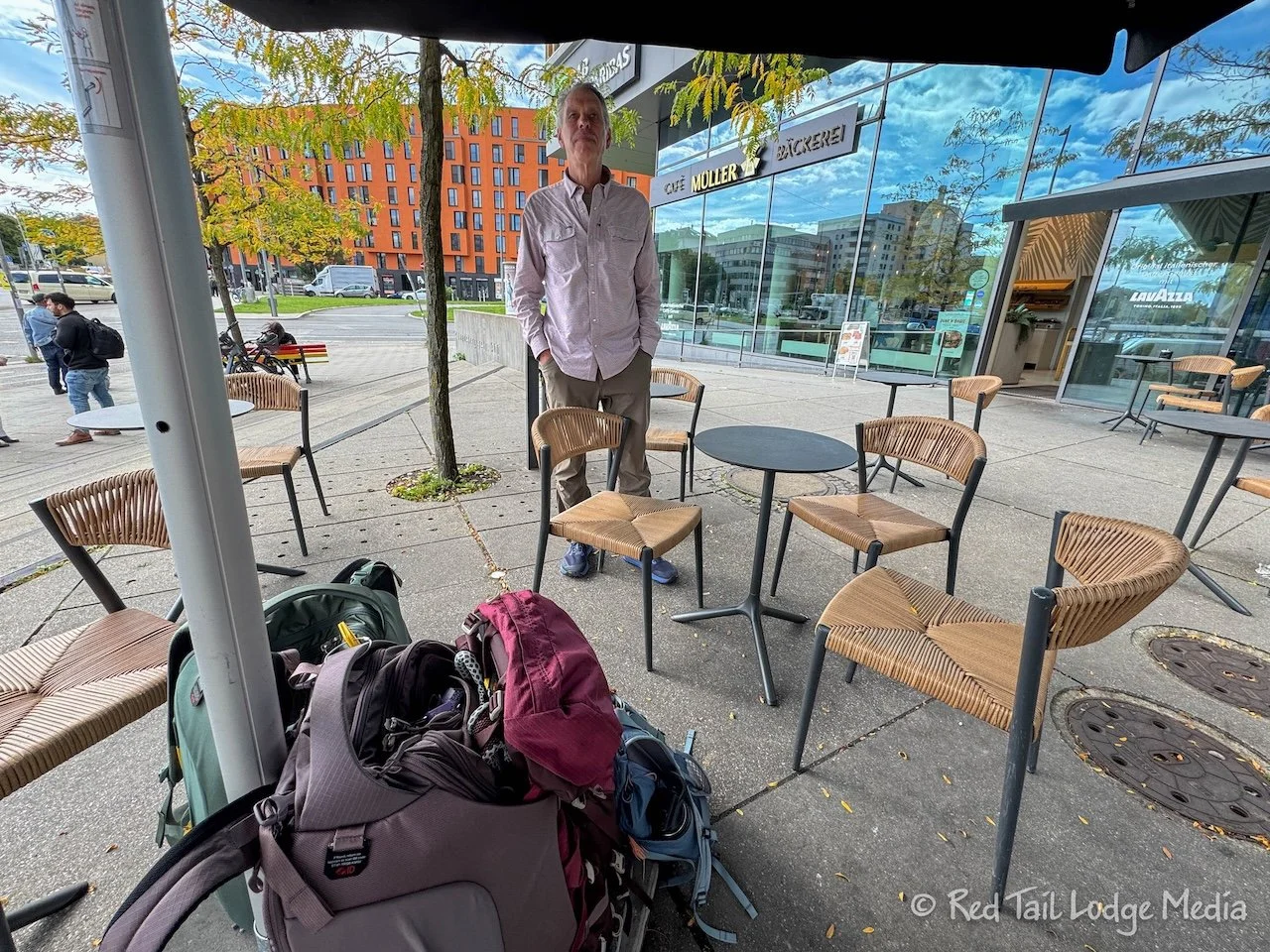
Our son had flown over to meet us in München. His plane had already landed and he was taking the 40 minute S-Bahn ride from the airport to the Laim station, where we had agreed to meet. There was a café and bakery, called Müller, right outside the station, which was our meeting spot. We grabbed an outside table and had a couple of drinks while we waited for our son to arrive. It had been over 6 months since we last saw him, so we were excited as we saw him come out of the station.
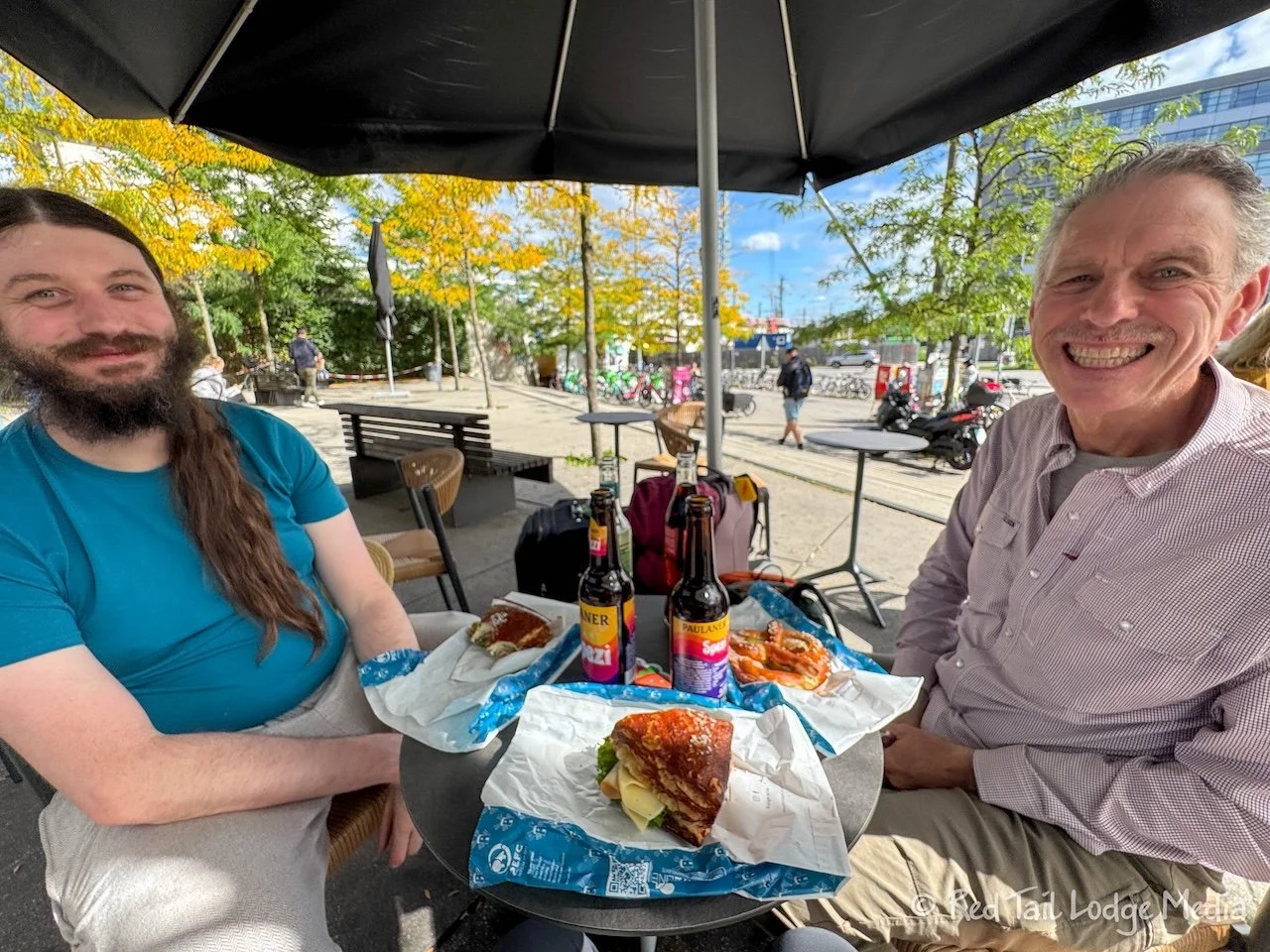
After our hugs, we bought some sandwiches from the café. While we ate our lunch, we had a lovely conversation with each other.
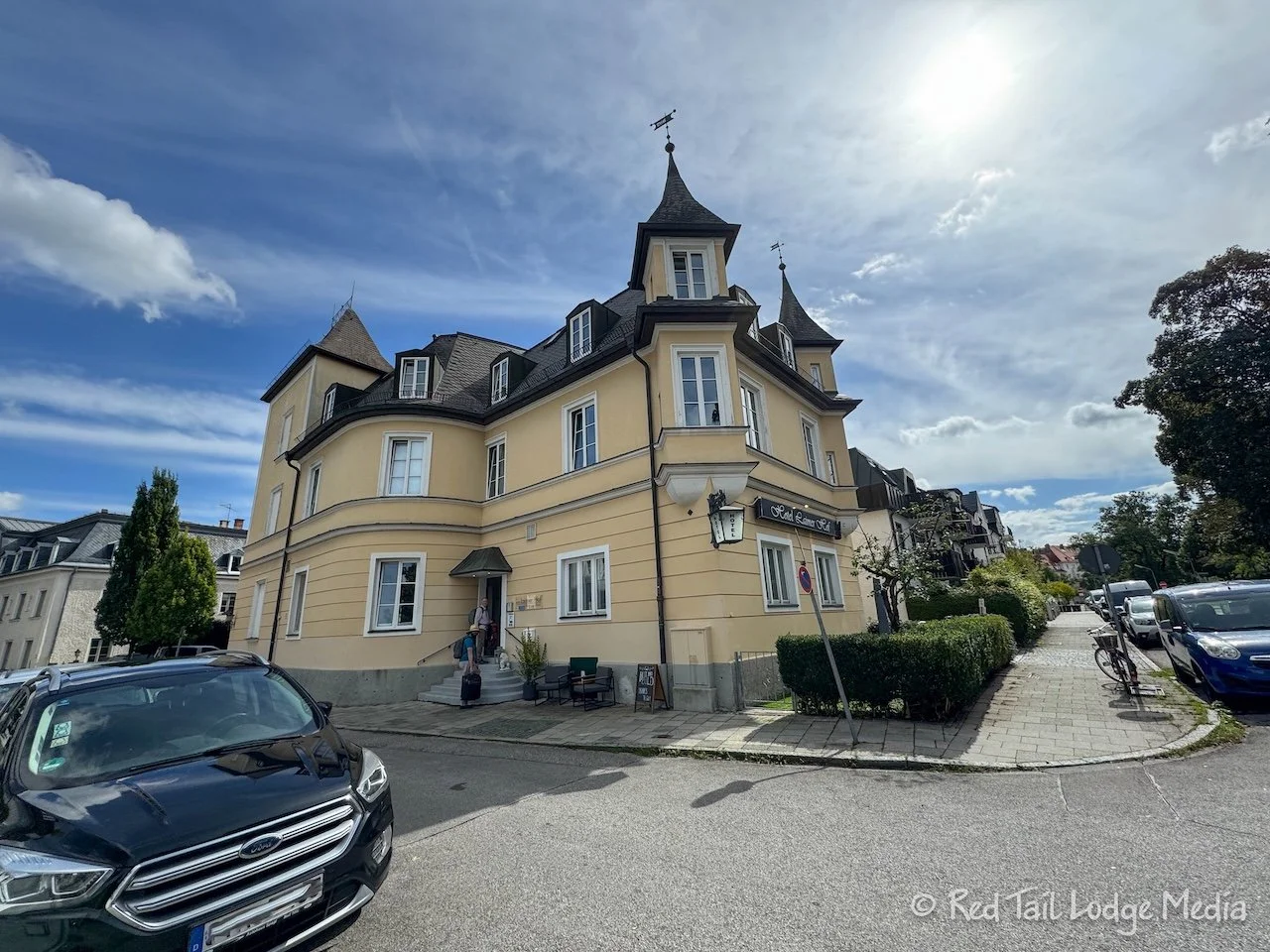
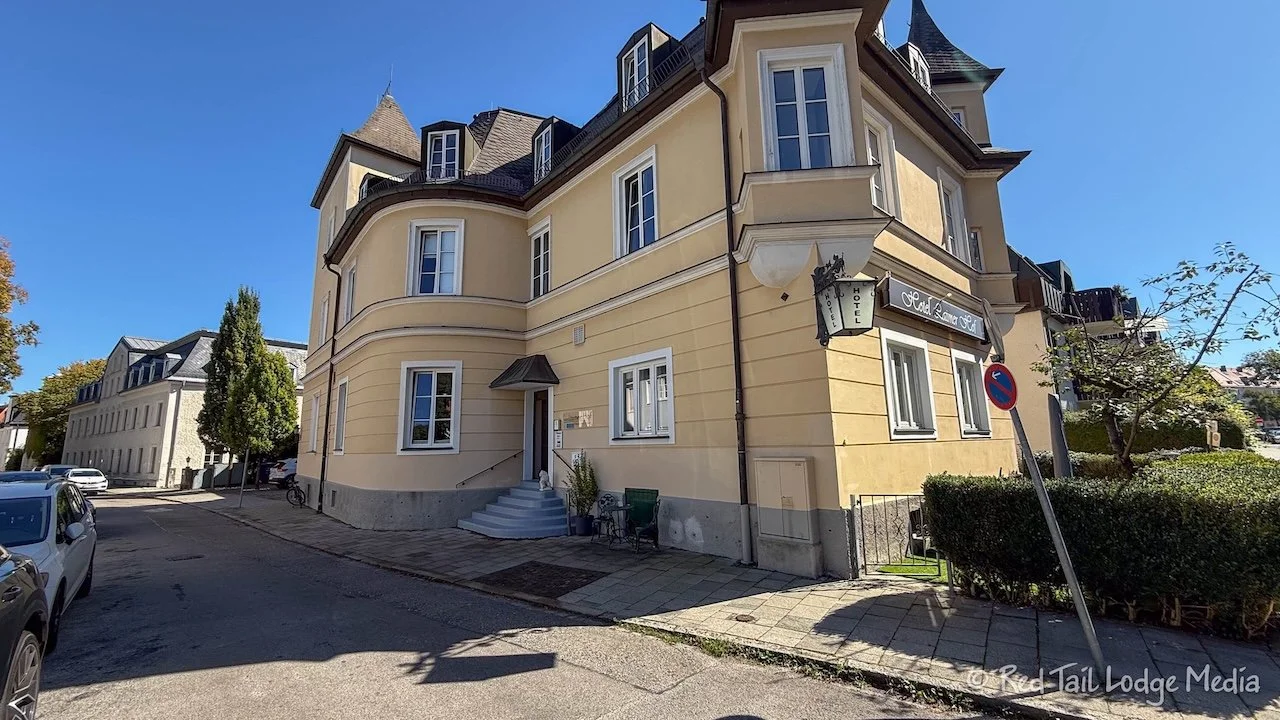
From there, it was about a 15 minute walk to our hotel, Hotel Laimer Hof. It was the same hotel we stayed at when we visited Germany eight years ago (Germany Day 4: Munich). We arrived around 1 pm. Only one of our two rooms were ready, so we put all of our luggage in the one room and went for a walk.
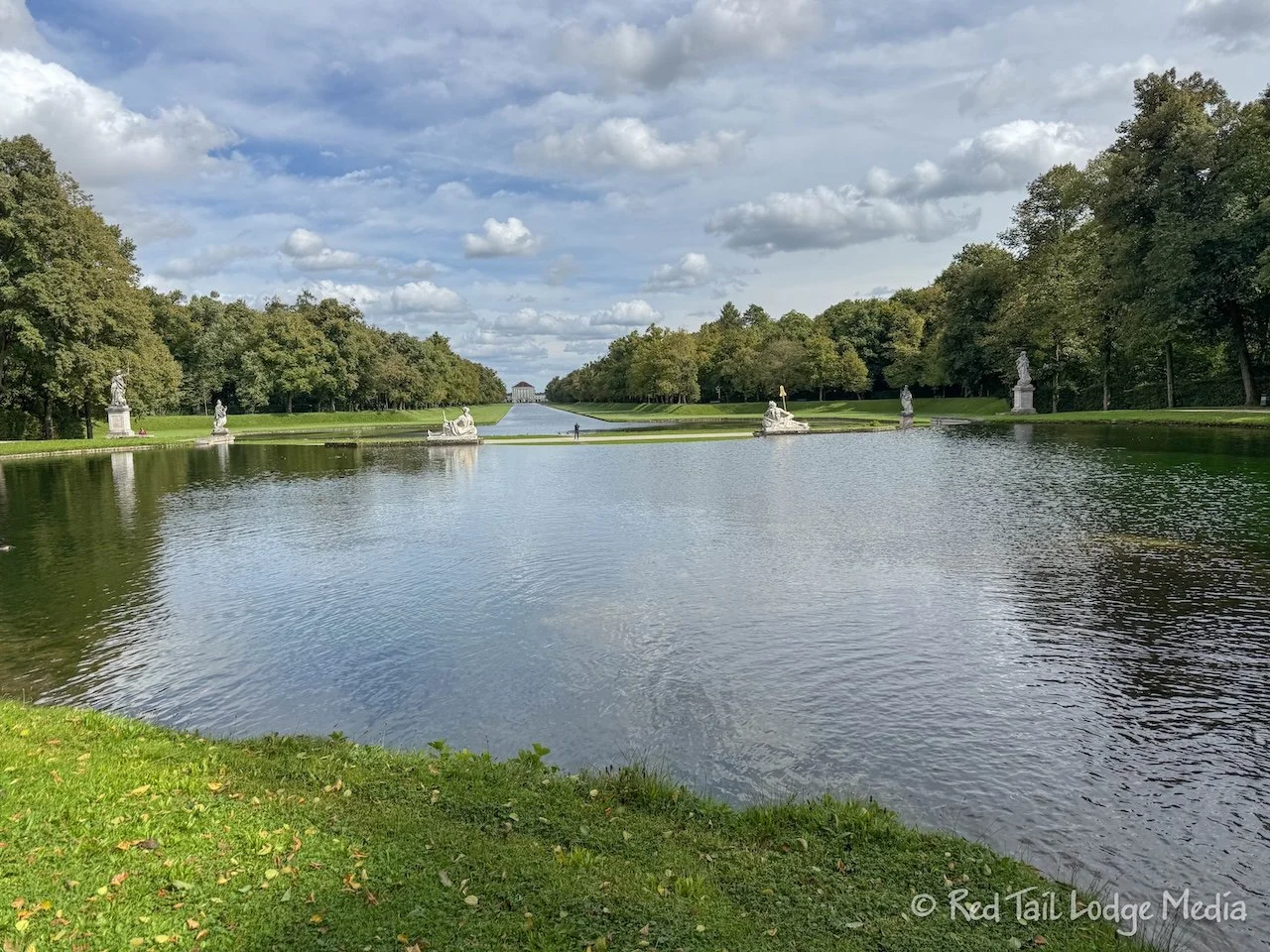
Our goal for the day was to keep our son, Justin, awake until about 8 pm, so hopefully it would help him get over his jet lag sooner. We have found walking the best way to accomplish that. Not only does it keep you awake, but it tires you out so you’ll get to sleep faster when you go to bed.
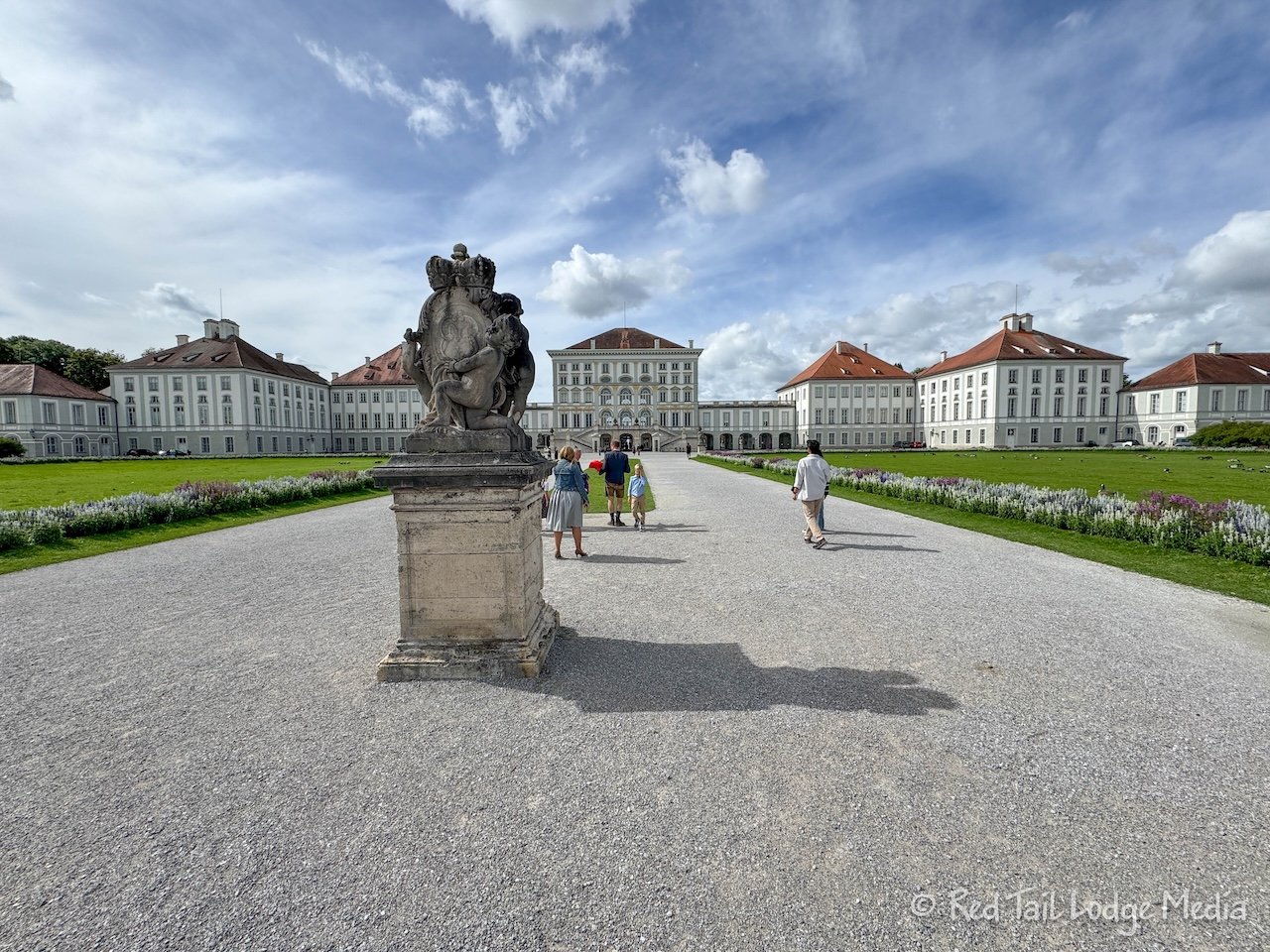
Schloß Nymphenburg was just a ten minute walk from the hotel. We didn’t go inside for a tour, but went for a stroll through the extensive grounds behind the palace. Schloß Nymphenburg is a baroque palace and was the main summer residence of the former rulers of Bavaria. After about an hour and a half, we returned to the hotel.
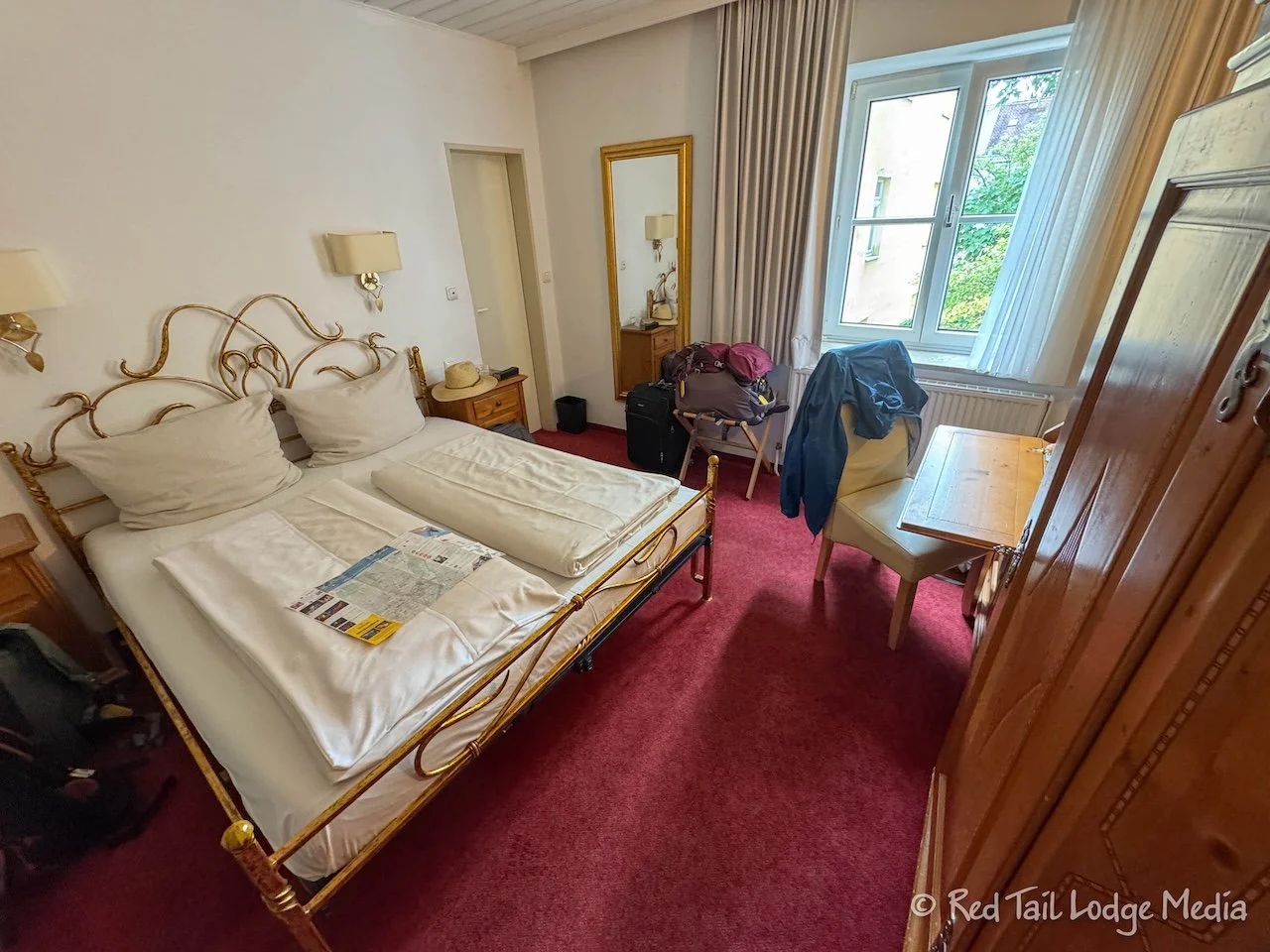
The second room was now ready, so we took showers, then walked over to the Hirschgarten, which was a ten minute walk in the opposite direction from Schloß Nymphenburg.
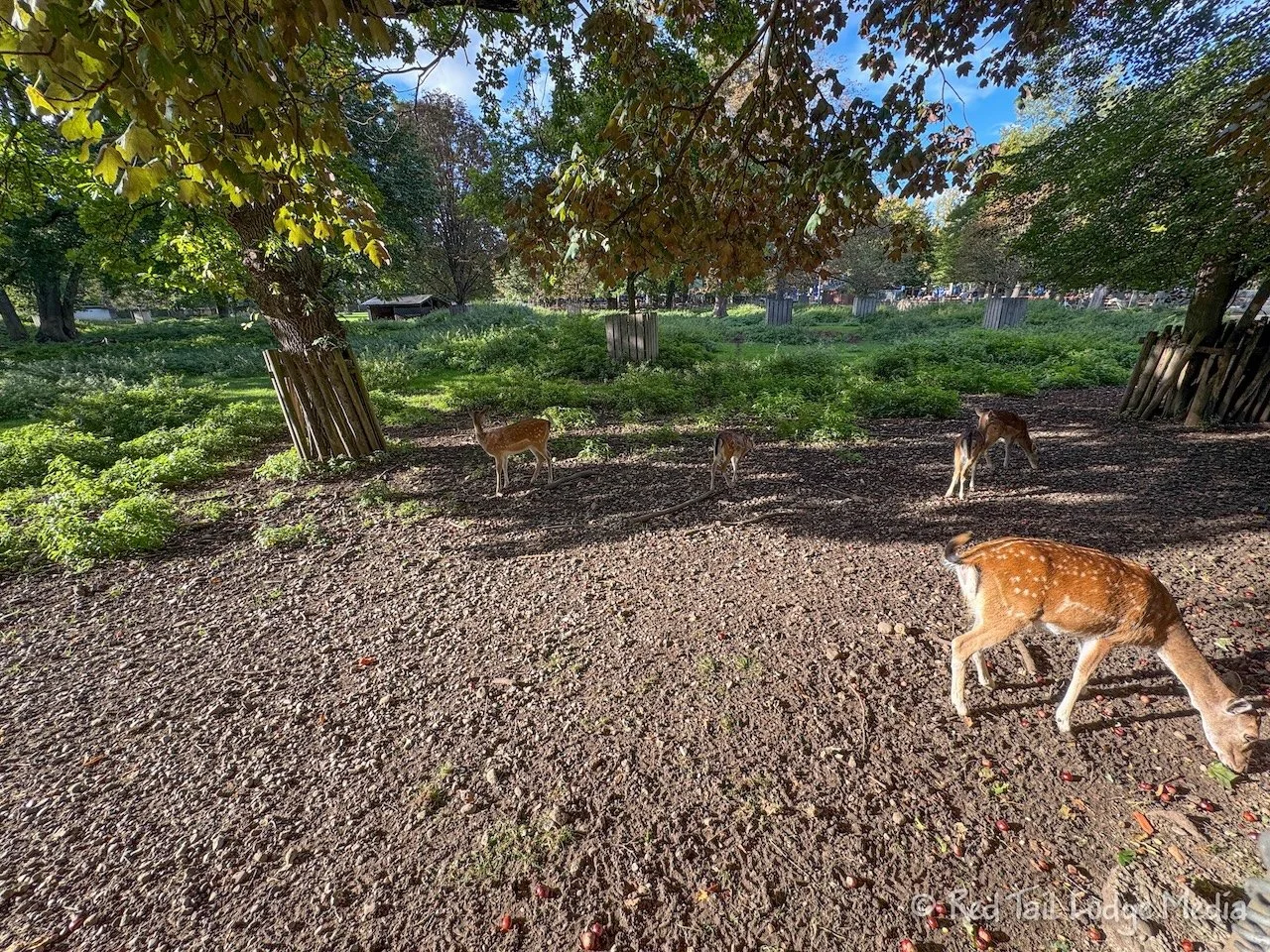
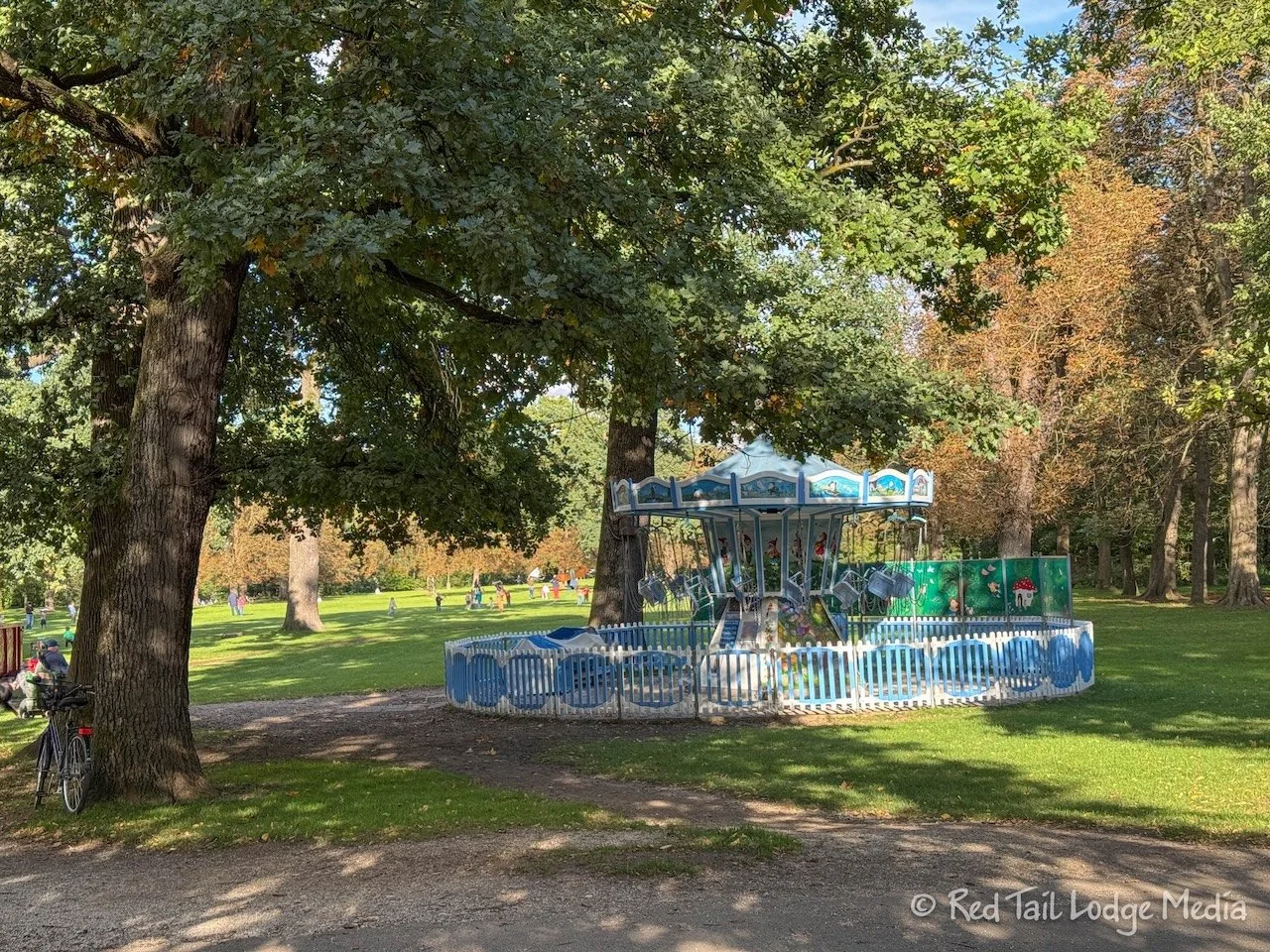
The Hirschgarten is a large park with deer inside of an enclosure. But, more importantly, there is a large biergarten, Königlicher Hirschgarten. In fact, they claim it is the largest beer garden in the world, with seating for 8000 people.
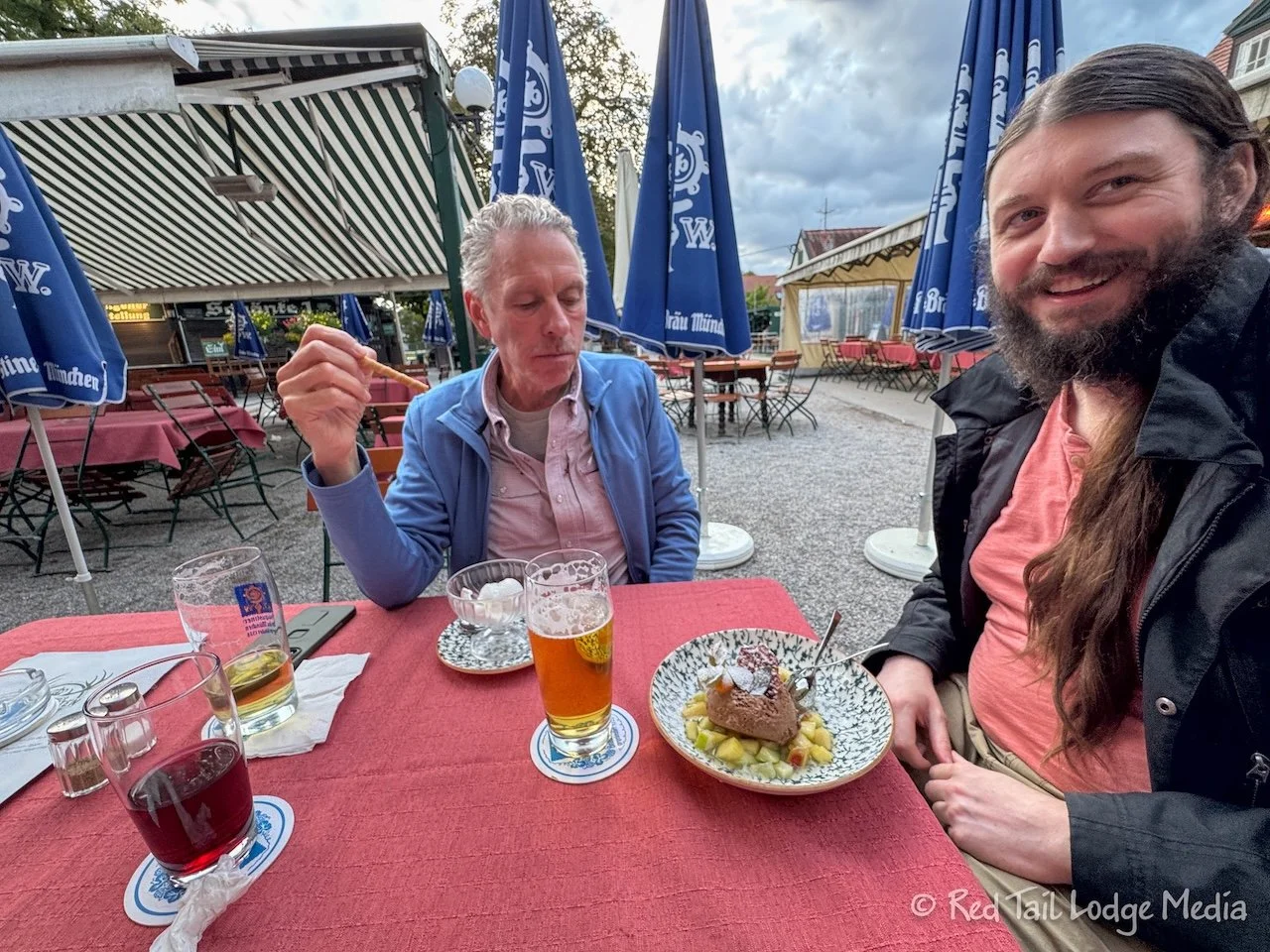
It was a little early for dinner, so we started out with a round of drinks. The men had beers while Ann had a Johannisbeerschorle (currant juice mixed with carbonated water). Then we walked around the park for a little while and came back to the biergarten for dinner.
Ann ate the Rinderroulade, Keith had the Hirschbraten, and Justin tried the Schwabenteller. Rinderroulade is bacon, onions, mustard, and pickles wrapped in thinly sliced beef. Hirschbraten is roasted venison, so it seemed appropriate to have in Hirschgarten. Schwabenteller translates to Swabian plate. Swabia (Schwaben) is an area in southwest Germany, where we lived for a couple of years, 35 years ago. The meal consisted of two pork fillets, Rahmschwammerl (creamy mushroom ragu), Käsespätzle (small egg dumplings with cheese), and Röstzwiebeln (roasted onions). We were too busy chatting that Ann forgot to get a picture.
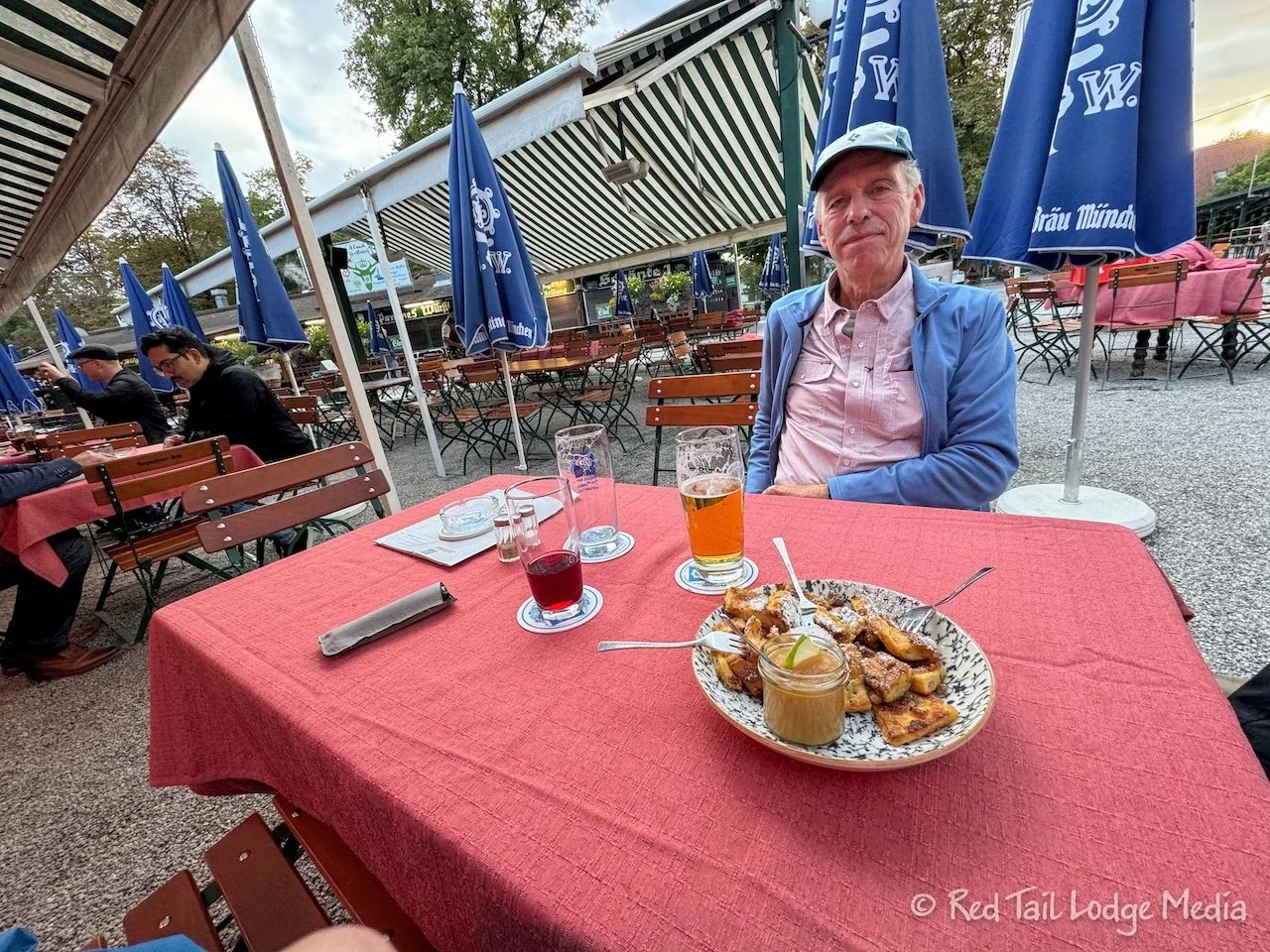
For dessert, Keith had a scoop of lemon sorbet, Justin ordered the chocolate mousse, and Ann opted for the Kaiserschmarrn (chopped pancakes fried with raisins). The chocolate mousse was served on top of chopped apples and limes which was an interesting combination. The Kaiserschmarrn was a little different than what Ann had before in Austria (Vienna, Austria - August 30th to September 2nd, 2025). This one was fried with a little sugar, so that it made a little bit of a caramelized crust.
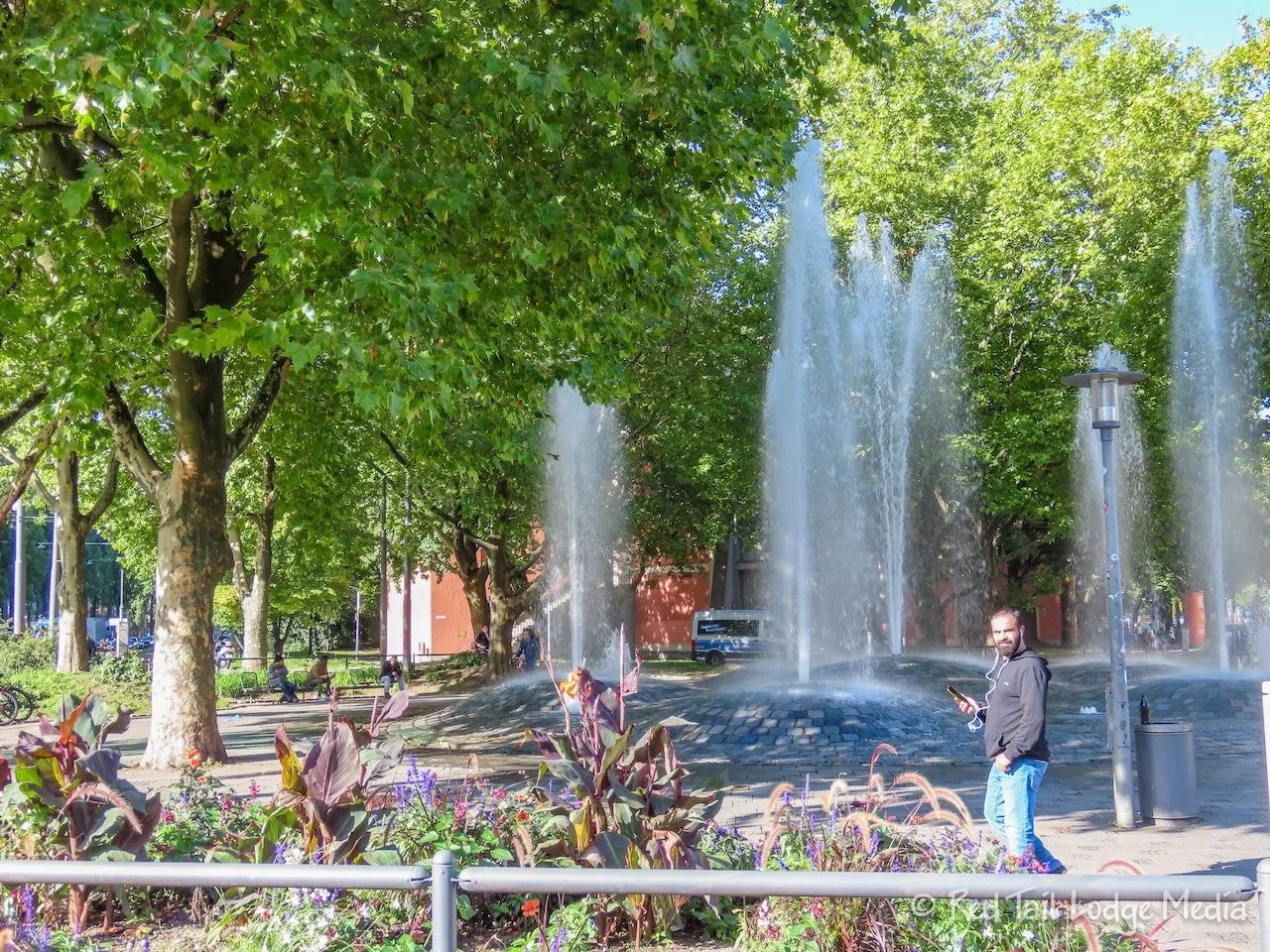
Wednesday, we wandered around the old town area of München. After a nice buffet breakfast at the hotel, including eggs cooked to order, we walked 5 minutes over to Romanplatz (square) where we picked up a Straßenbahn (street car) to take us into town. There was a ticket machine at the tram stop. We just bought single trip tickets again since we only planned on making two trips that day, one into town and one back.
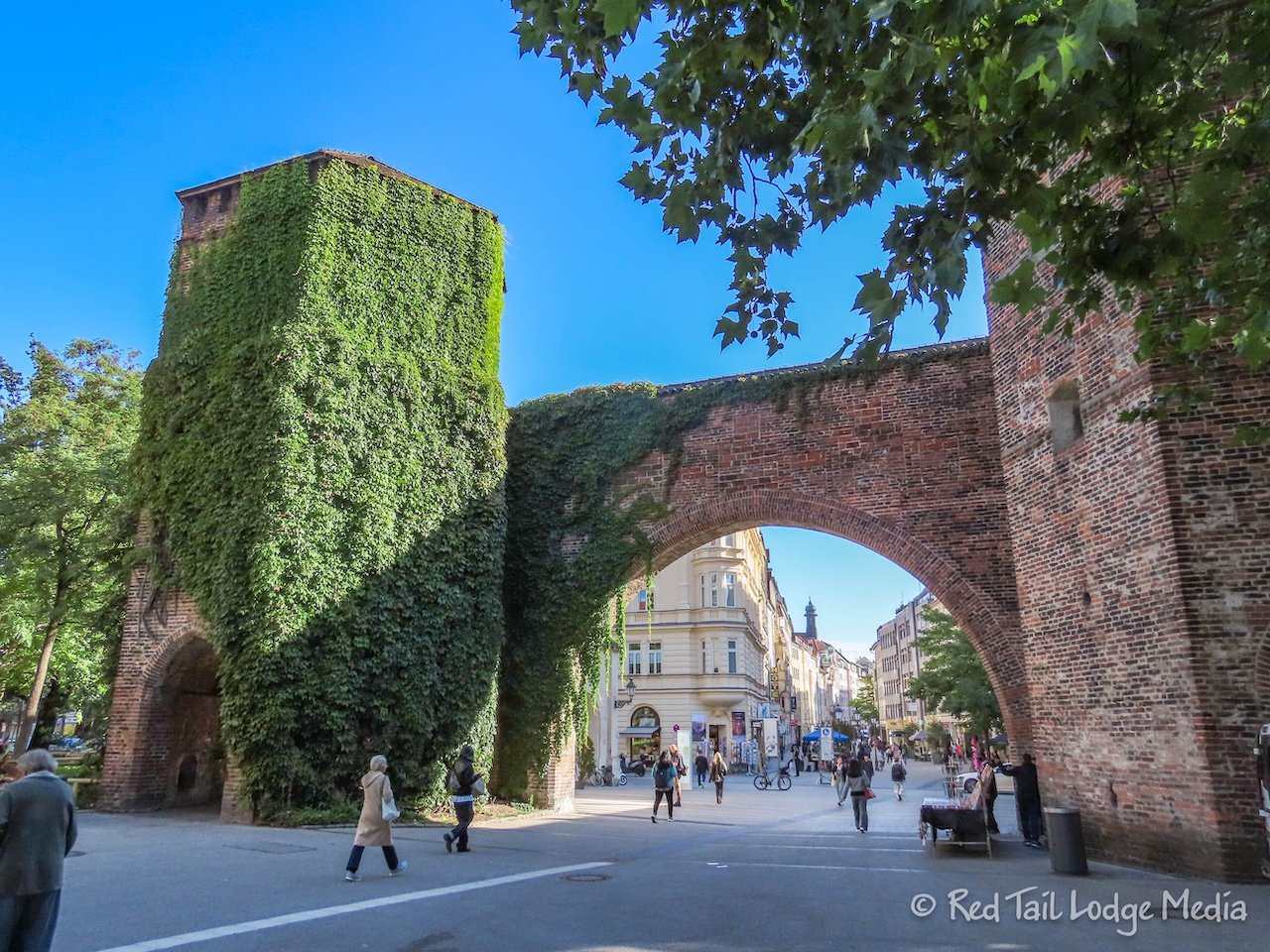
The number 17 tram took us to Sendlinger Tor (an old city gate), a 19 minute ride. We could have also walked back down to the S-Bahn station and taken an S-Bahn to the Hauptbahnhof (main train station) instead of taking the tram, but the Straßenbahn had the advantage of staying up on the streets, with large windows, so we could enjoy seeing the city on our way to the old town.
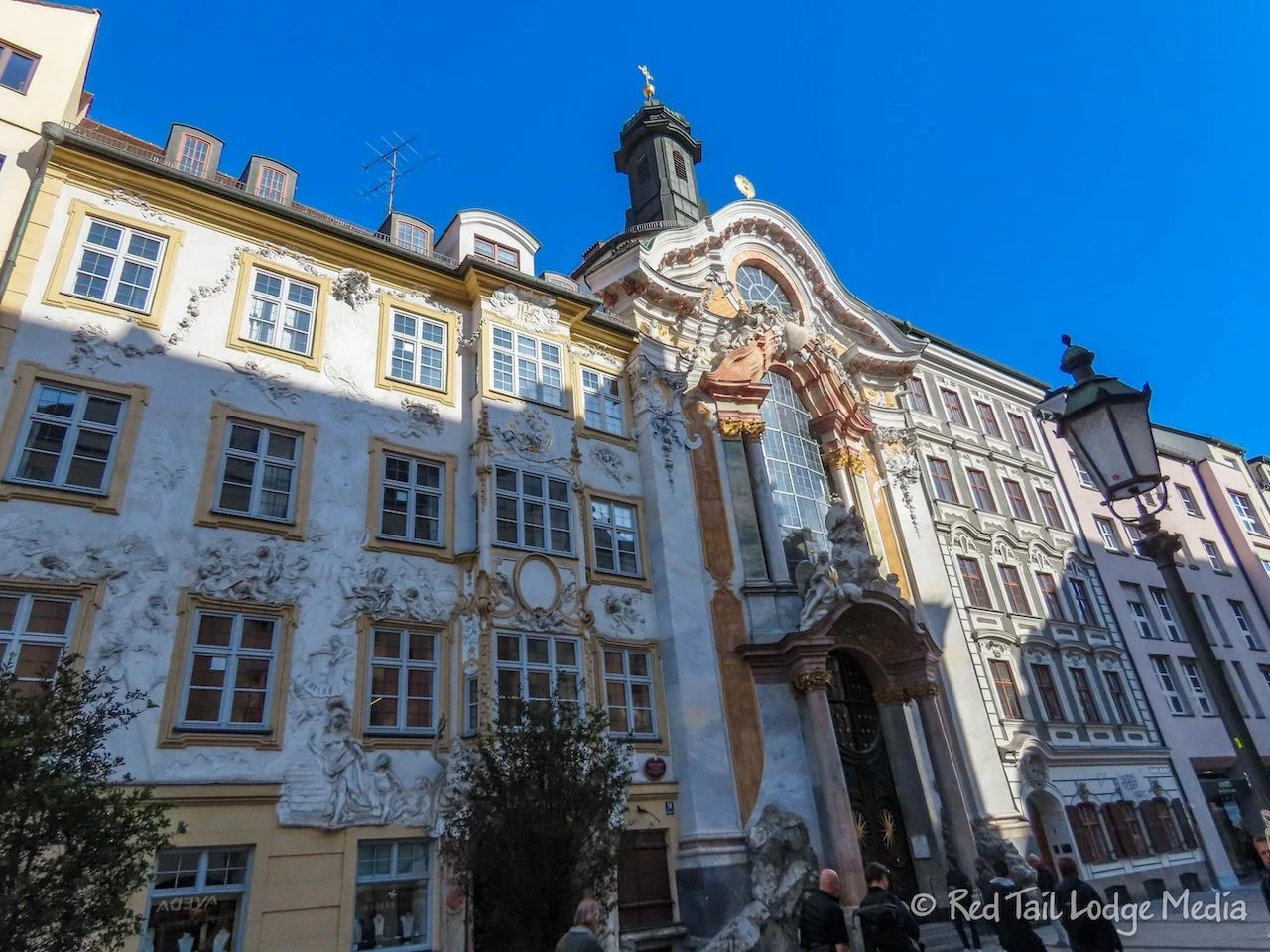
At Sendlinger Tor, we walked through the city gate and down the pedestrian street called Sendlinger Straße. Along the way, we stopped to check out Asamkirche, a church built in the rococo style. It was built from 1733 to 1746 by two brothers. One brother was the sculptor Egrid Quirim Asam and the other, the painter Cosmas Damian Asam. It was free to enter and admire the very ornamental and dramatic interior.
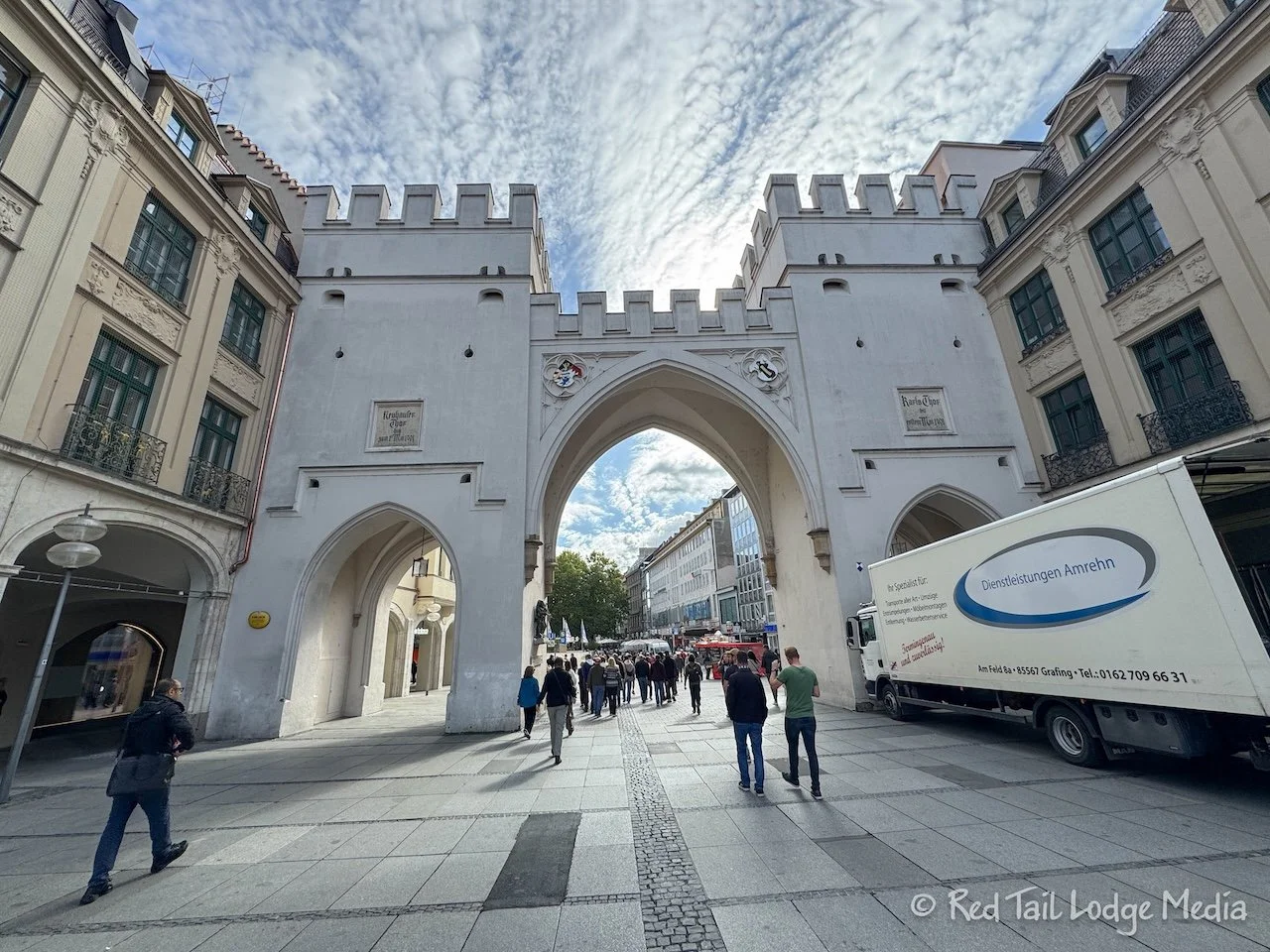
We made our way to Marienplatz, the square with the Rathaus (City Hall). Then we went turned left and went down Neuhauser Straße to Karlstor, another city gate.
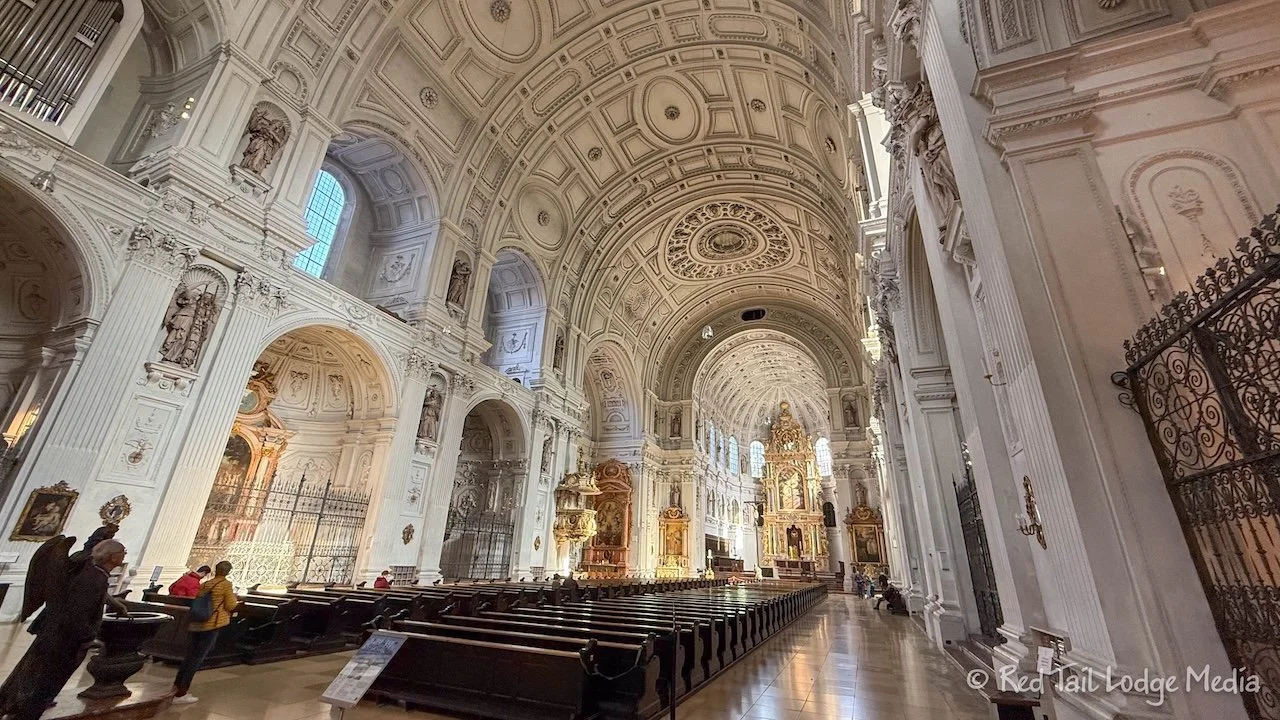
We poked into another church, St. Michael’s Church. It was not as intricately adorned as Asamkirche, but it was still beautiful. The church was built in the late 16th century.
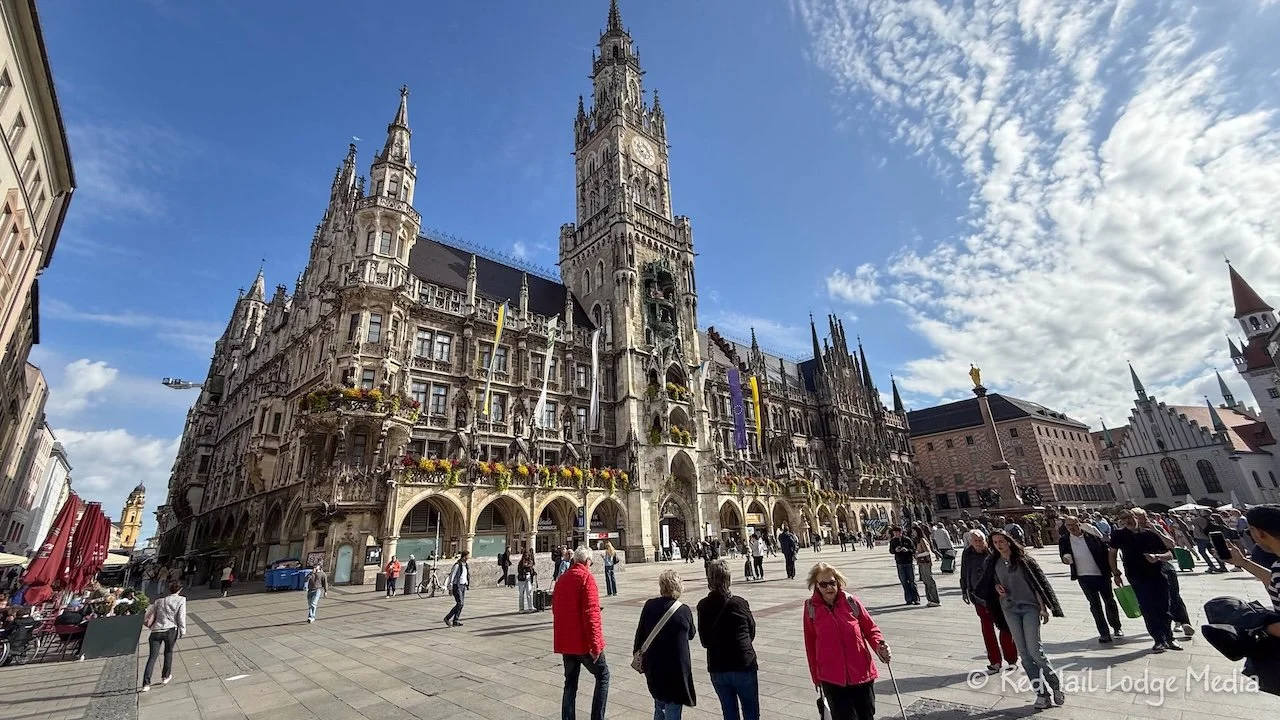
We returned to Marienplatz in time to watch the Glockenspiel on the Rathaus at 11 am. Every day at 11 am and 12 pm (and sometimes 5 pm), the bells play and life-sized figures re-enact the marriage of Duke Wilhelm V to Renata of Lorraine and the Schäfflertanz (coopers’ dance). The spectacle lasts about 15 minutes.
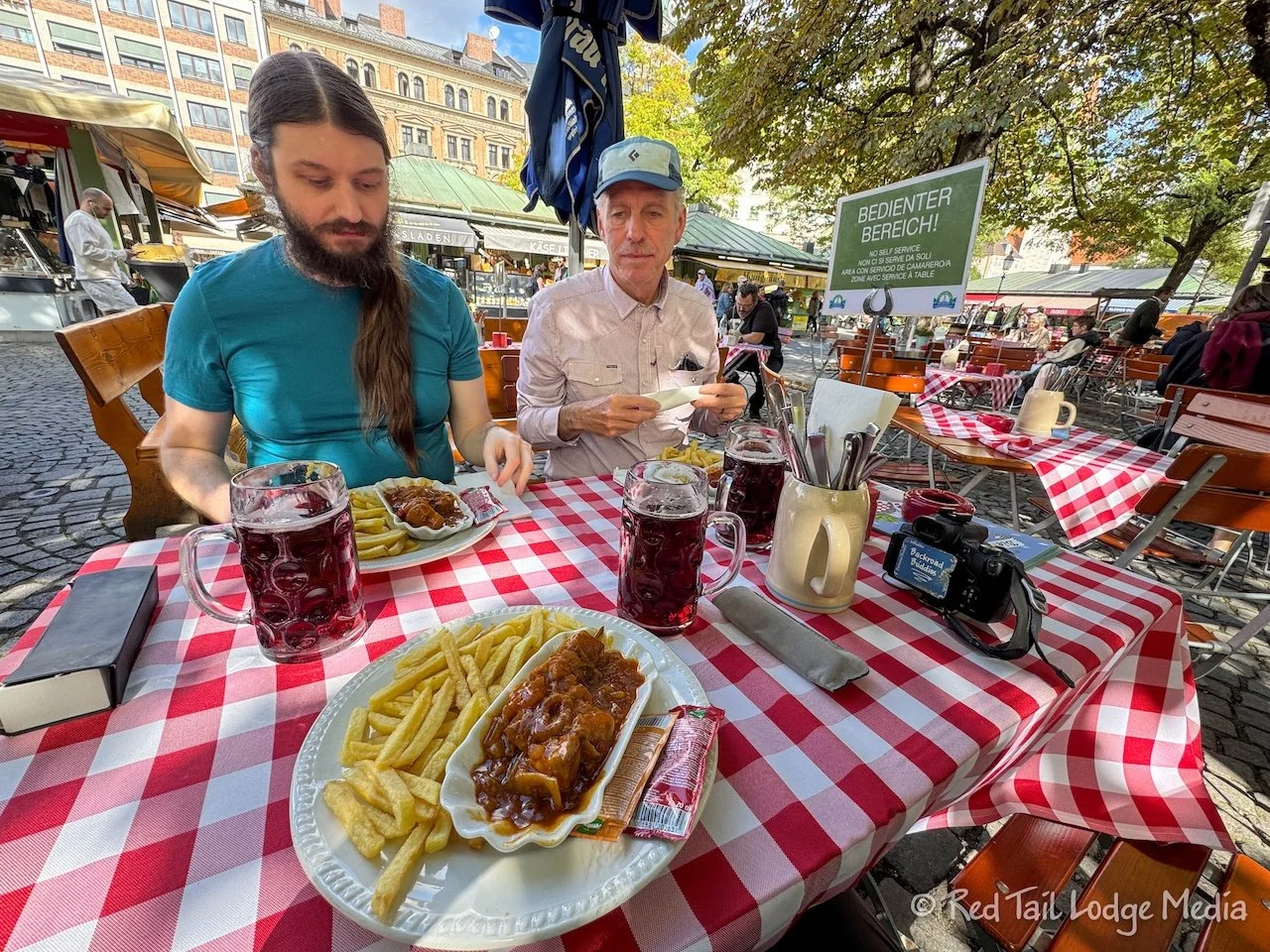
From there, we walked by the Spielzeugmuseum (toy museum) in the old Rathaus and over to the Viktualienmarkt for lunch. We ate at the Biergarten in the market. Keith had the curry wurst with fries while Ann and Justin had the Schischlik with fries. Schischlik is like a shish kebab. It had pieces of pork along with some onions and green peppers. It was served with a sweet sauce. It wasn’t bad, but the pork was a little overcooked and dry.
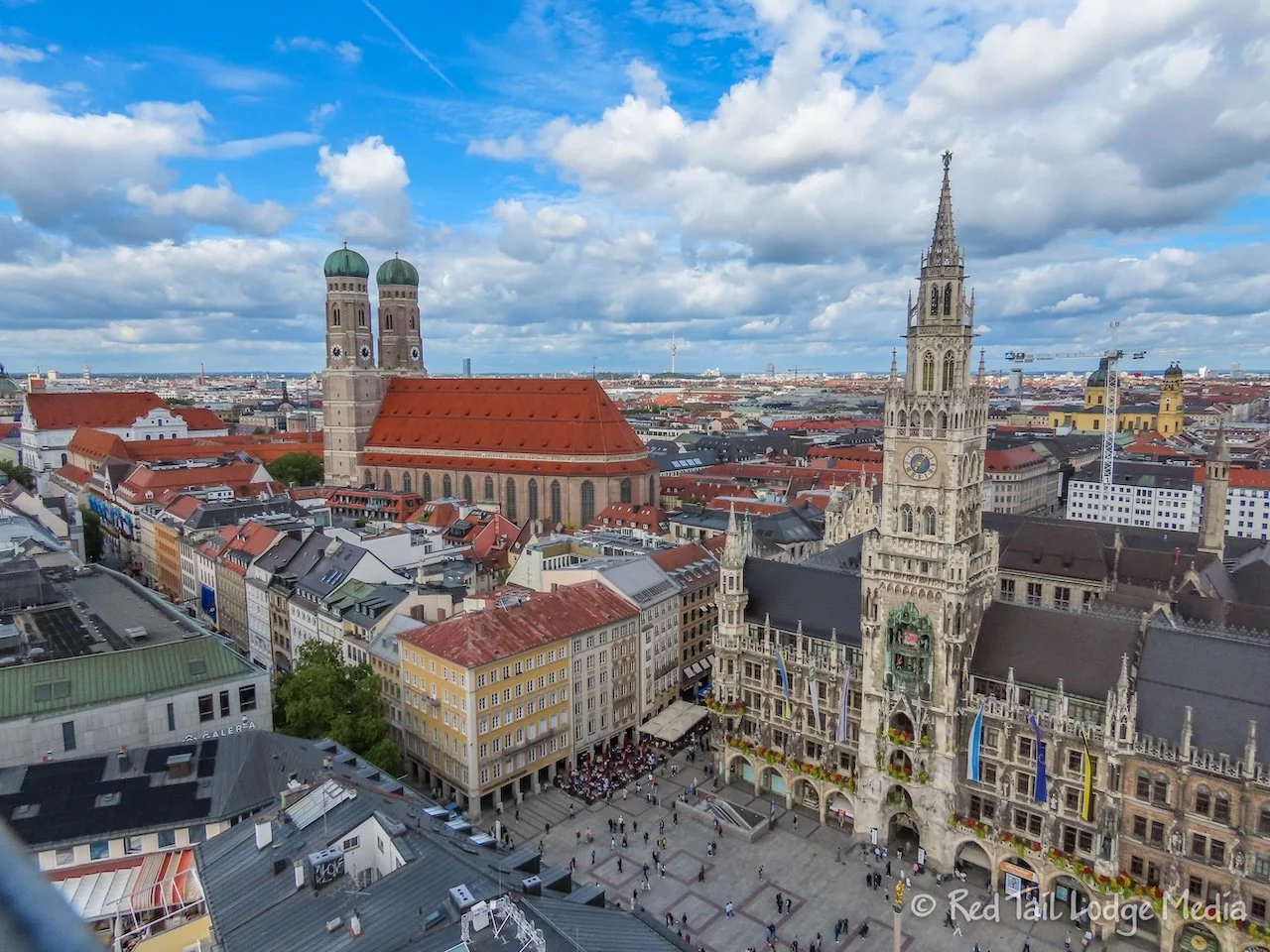
After lunch, as we started to walk out of the market, we noticed that people were up at the top of the tower of Peterskirche (St. Peter’s church). So we ventured over to see how much it was to climb up. It was only 5 euros per person, so Ann & Justin went up. Keith decided to wait down below. The views out over München were fantastic. You could even faintly see the mountain peaks of the Alps in the distance to the south. Peterskirche is the oldest parish church in München, dating back to 1368.
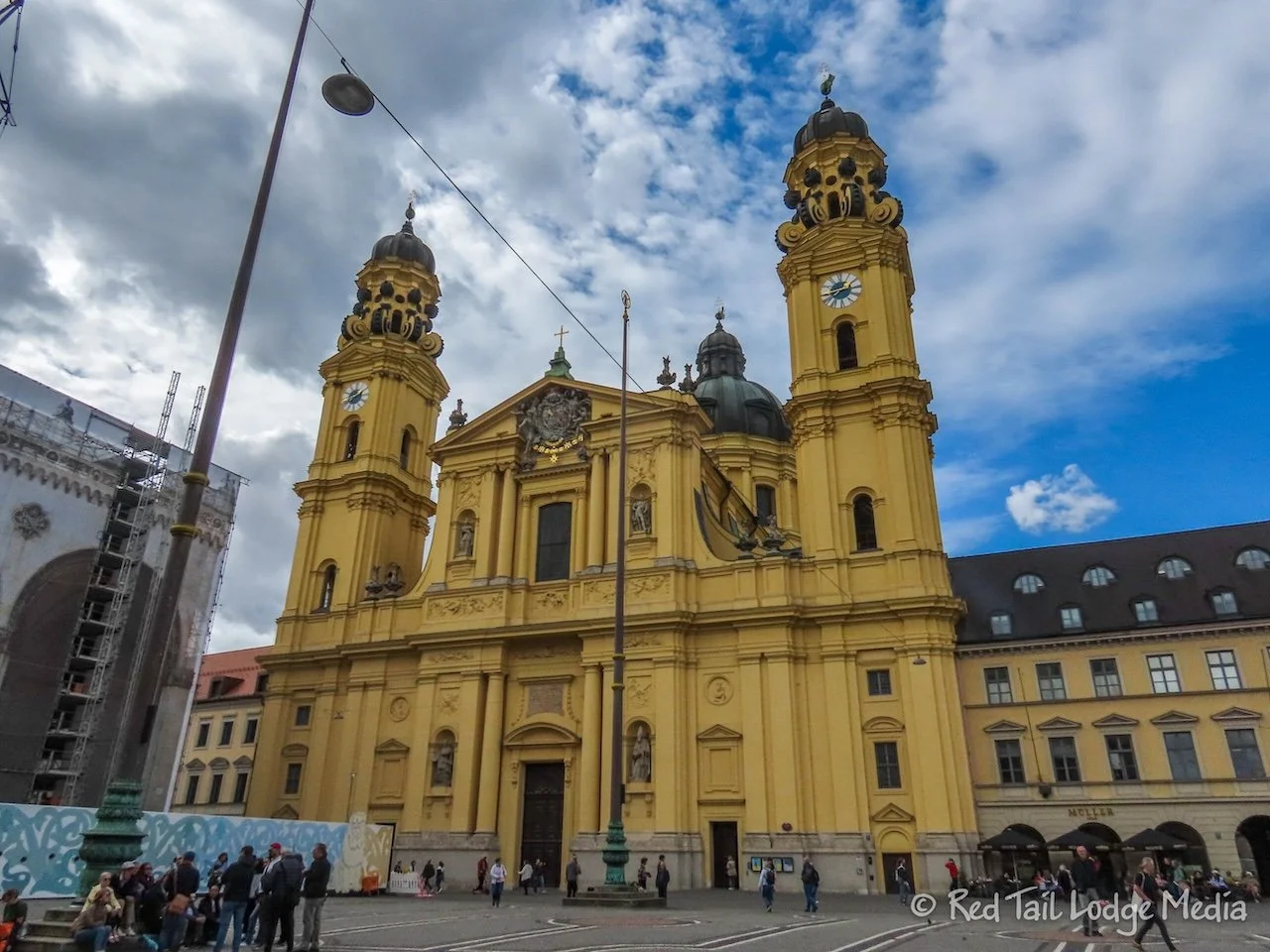
From there, we strolled through Max-Joseph-Platz (square), by the Residenz (Residence Palace), through Odeonsplatz, and into the Hofgarten behind the Residenz, admiring all of the architecture along the way.
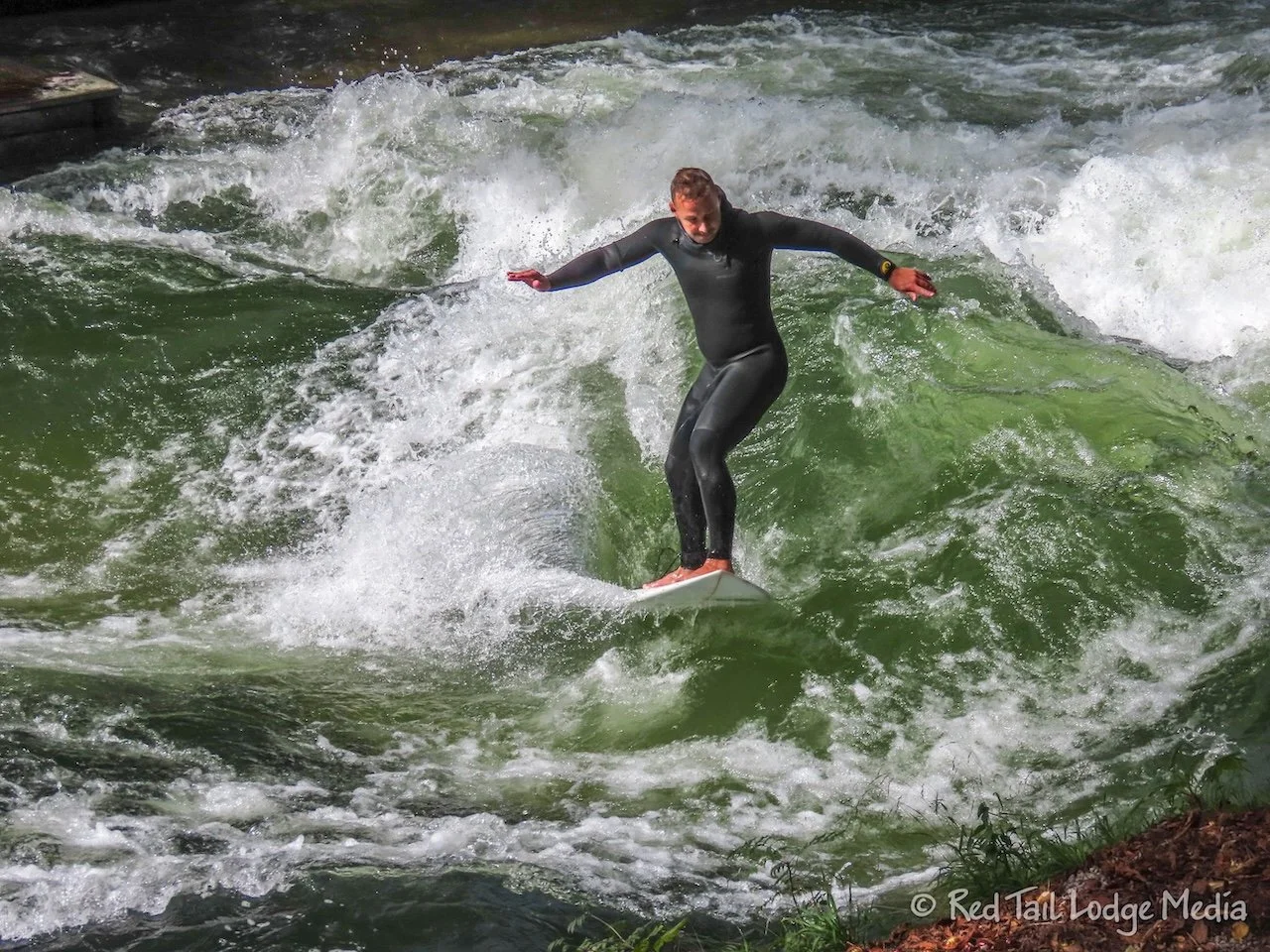
We continued our stroll over into the Englischer Garten (English Garden). The Englischer Garten is a huge park. We were planning to explore it more thoroughly the following day, so we were just skimming the surface on our way over to Maximilliansanlagen on the other side of the Isar River. The last time we were in München, eight years ago, we stumbled upon an artificial wave in the Eisbach river that runs through Englischer Garten. People surf on the wave. We wanted to see if we could find it for Justin to see. Ann thought she found it in Google Maps, but when we got there, we didn’t recognize it as being the same. So we googled a little more and found that there are apparently four spots along the Eisbach where people can surf. We headed towards the one near the Eisbachbrücke on Prinzregentenstraße. Yup, that’s the one we saw before. It was interesting to watch all the surfers.
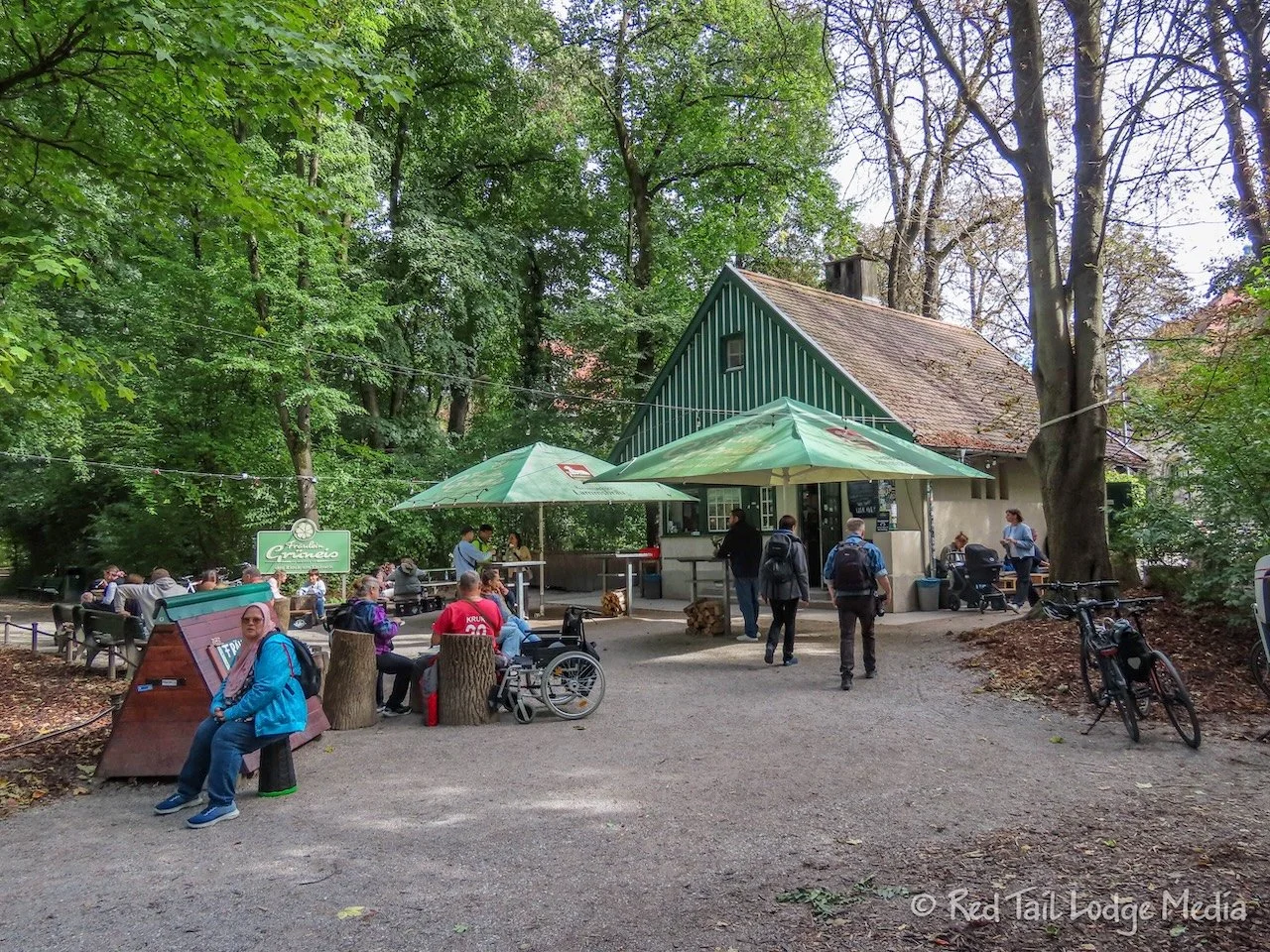
It was time for another drink, so we stopped at Fräulein Grüneis, a little café nearby. A couple of schorle’s (fruit juice mixed with carbonated water) and an alcohol-free beer tide us over until dinner.
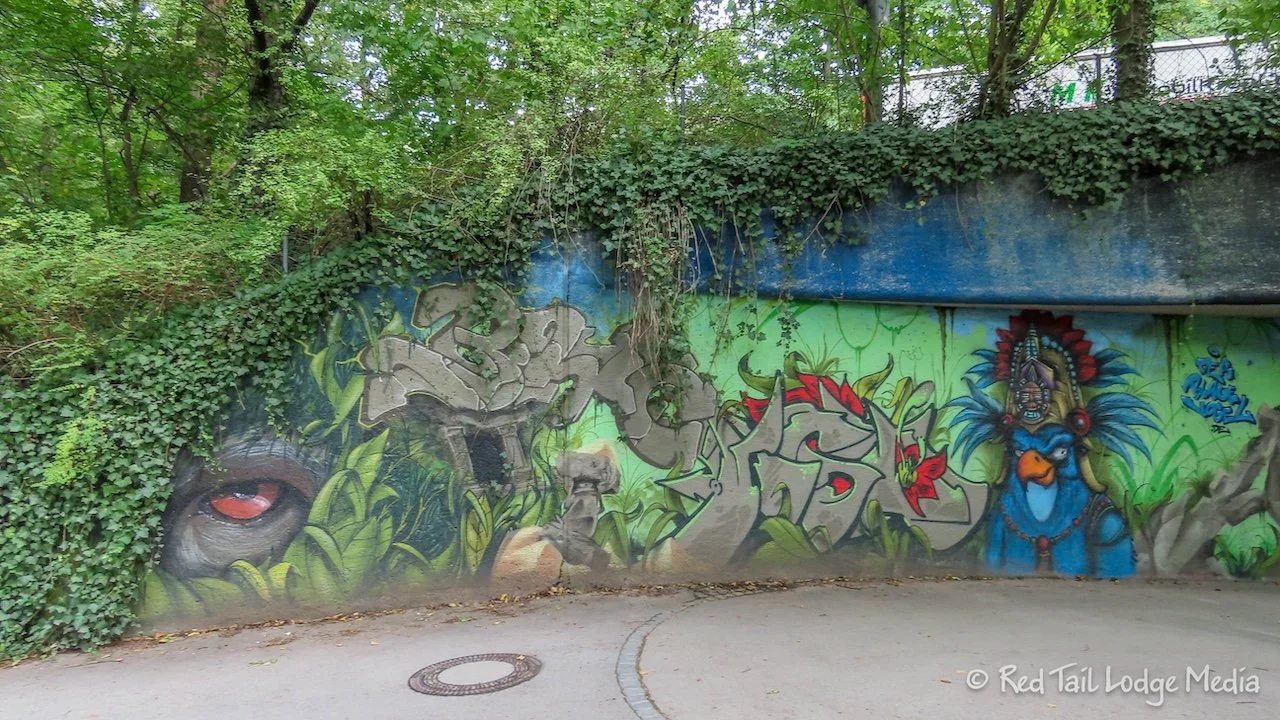
We crossed the Isar River on Luitpoldbrücke, over to the Friedensengel (Angel of Peace) monument. What was just as interesting was the pedestrian tunnel underneath Prinzregentenstraße. Along the tunnel’s walls were wonderful pieces of street art or graffiti, called Galerie under dem Friedensengel in Google Maps. There was lighting between each wall panel, which seemed to highlight the art. It was a nice little surprise. We love stumbling across things like that.
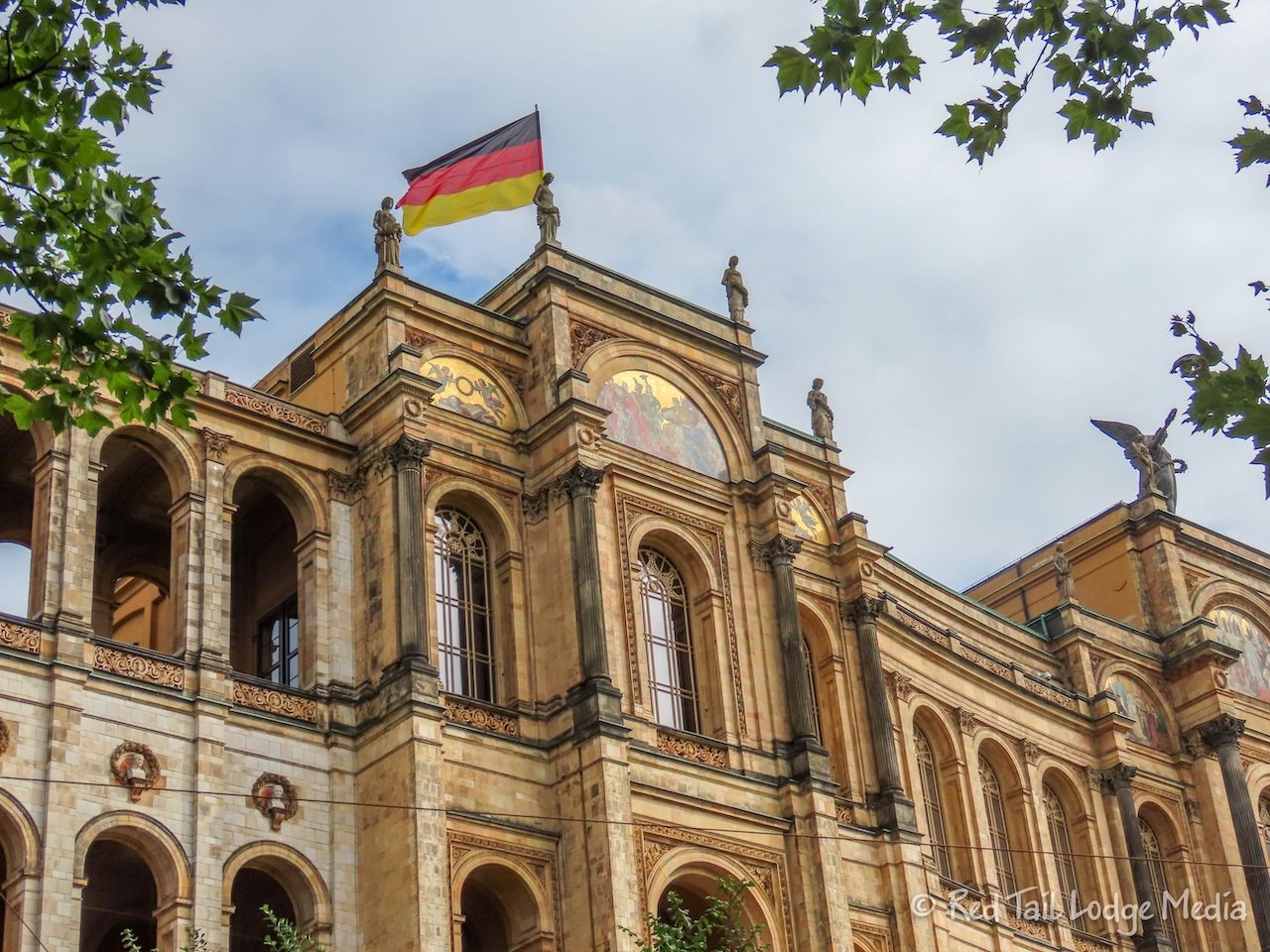
We headed south through the green space next to the river, passing by the Maximillianeum, the home of the Bavarian State Parliament. We crossed back over the Isar River on the Kabelsteg, a pedestrian bridge which took us to the Praterinsel (island), then over the other branch of the Isar River.
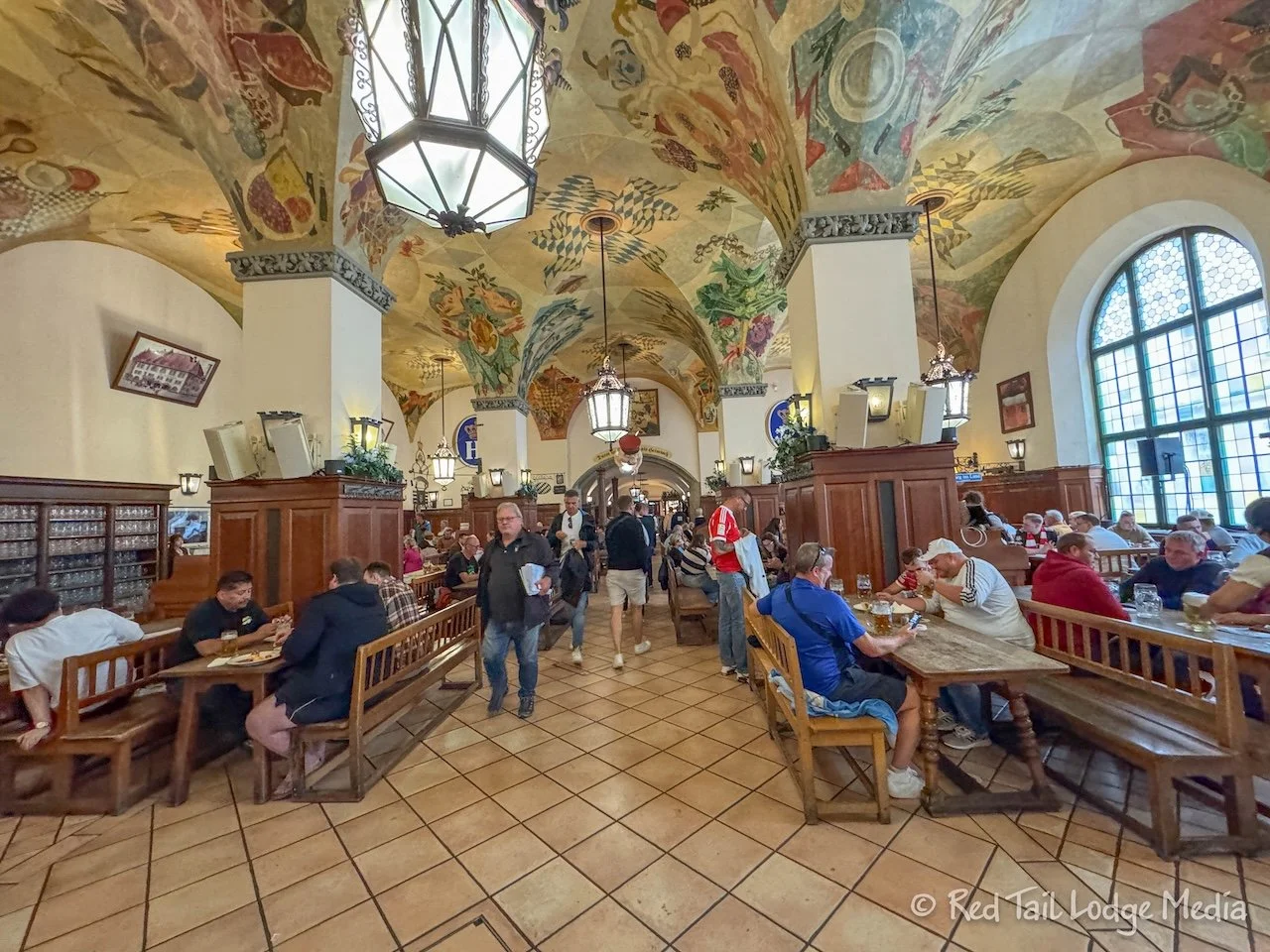
From there, we walked down Maximillianstraße to work our way over to Hofbräuhaus for dinner. The beer hall inside and beer garden outside were busy and loud. It was a little cool outside, so we wanted a seat inside. As we wandered around the beer hall, trying to find an open seat, we worked our way around to a more secluded section which was quieter, with windows looking out at the beer garden. Perfect!
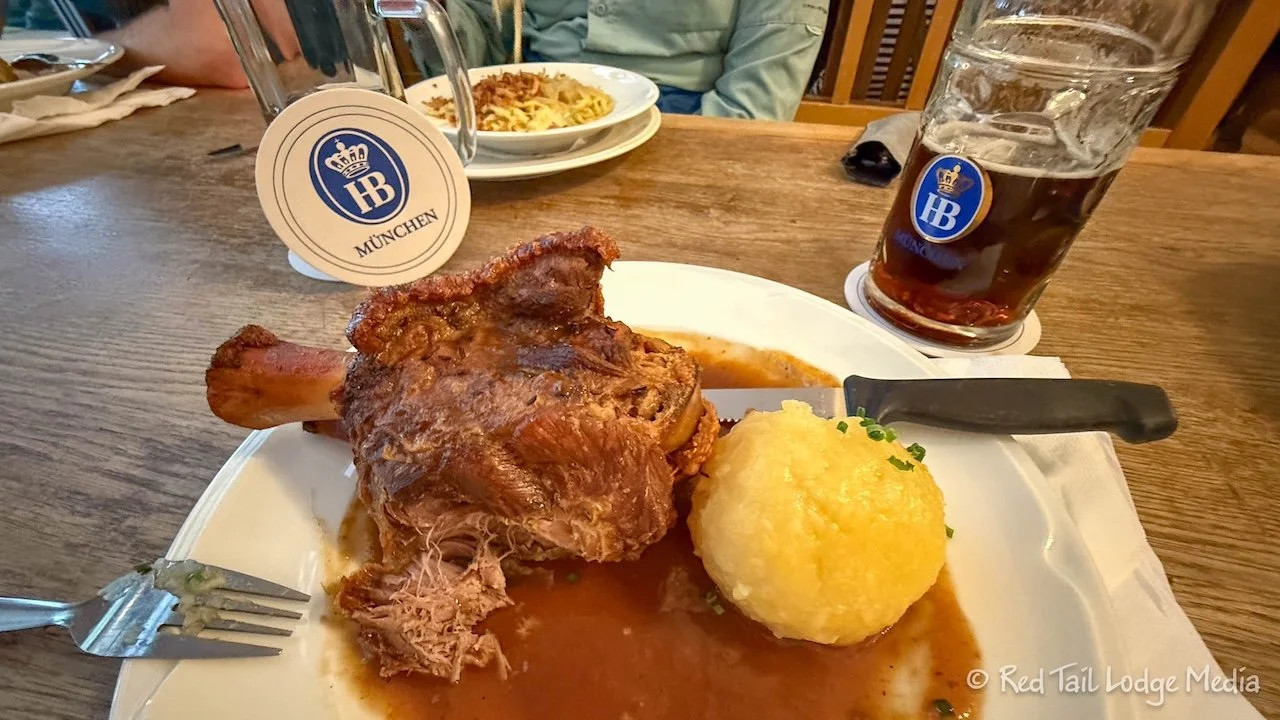
For dinner, Keith had the Schweinhaxe (pork knuckle), Ann ordered the Käsespätzle (small egg dumplings with cheese and onions), and Justin tried the Dreierei Knödel. The Dreierei Knödel was similar to what Ann had in the Dolomites (Dolomites, Italy - August 23rd to 25th, 2025). It was three Knödel (large dumplings), with one made with spinach, one with beets, and one with cheese. Hofbräuhaus served them on top of vegetables, instead of the browned butter like Ann had before.
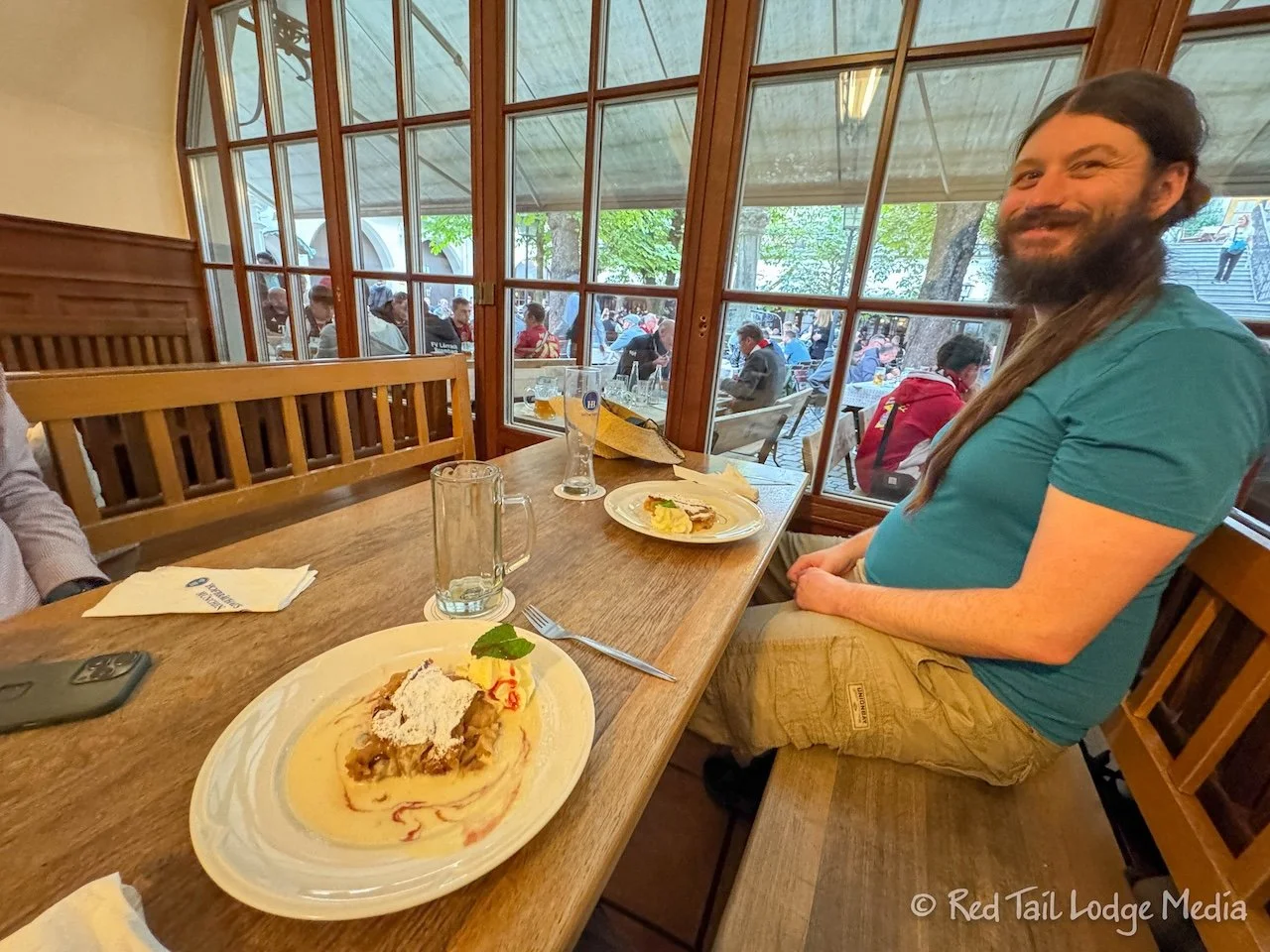
For dessert, Ann and Justin had apple strudel with vanilla sauce. Everyone was happy with their food selections along with their drinks.
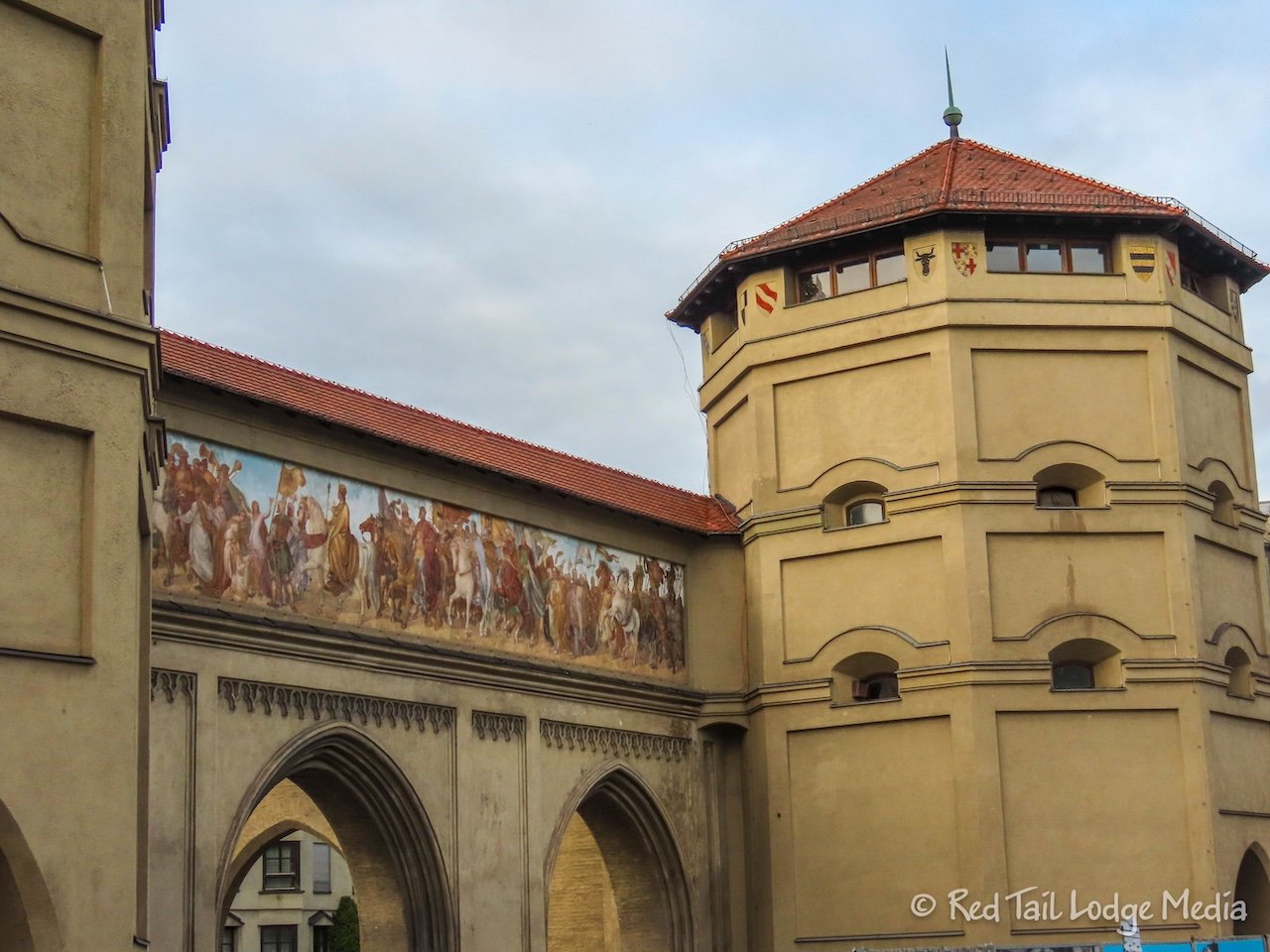
To get back to the hotel, we went back to Sendlinger Tor to pick up the tram back to Romanplatz. We were a little concerned because there was no ticket machine at the tram stop. Justin remembered that there was a ticket machine on the tram. So we hopped on the next one, and thankfully, there was a machine. We tried to notice other trams that went by and it didn’t seem like all of them had machines on board. We don’t know what you should do in that case.
Thursday, we explored Englischergarten. Instead of taking the tram into town, we took the S-Bahn from the Laim station to Marienplatz. This time we bought a group Day ticket (up to 5 people) instead of single trip tickets. It turned out to be cheaper, even if we only took two trips. The only issue with the group ticket, is that we had to stay together the whole day, as it was only one physical ticket. For us, that wasn’t a problem.
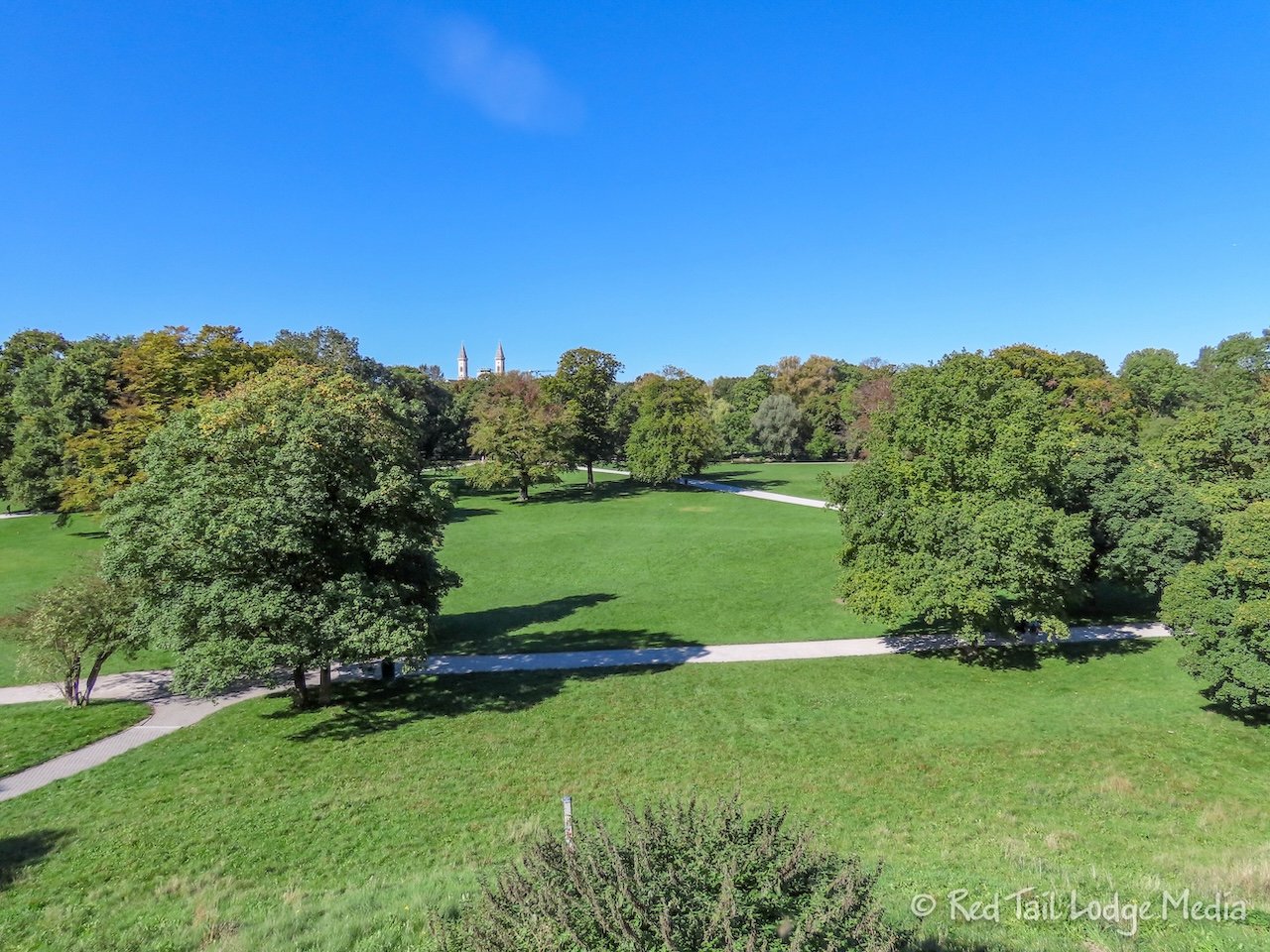
From Marienplatz, we walked over to the Englischer Garten. Then we strolled the full length of the park, roughly 6 kilometers (3.7 miles). The park consists of a network of pedestrian and bike paths through open meadows and woods, and alongside streams and small lakes. Scattered throughout are monuments and beer gardens.
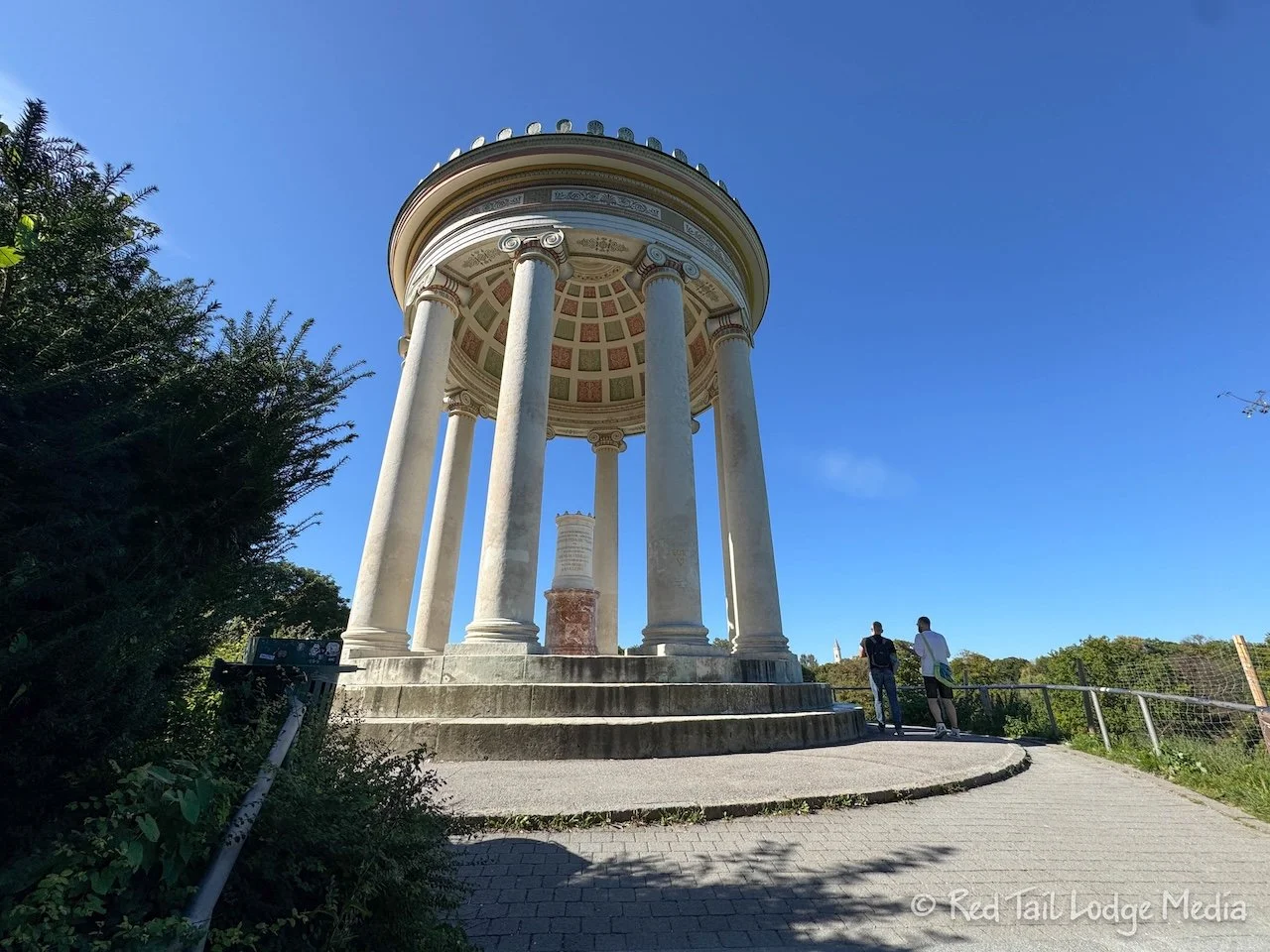
After checking out the Monopteros monument, we headed over to the beer garden by the Chinesischerturm (Chinese Tower). Monopteros was built by King Ludwig I in 1836.
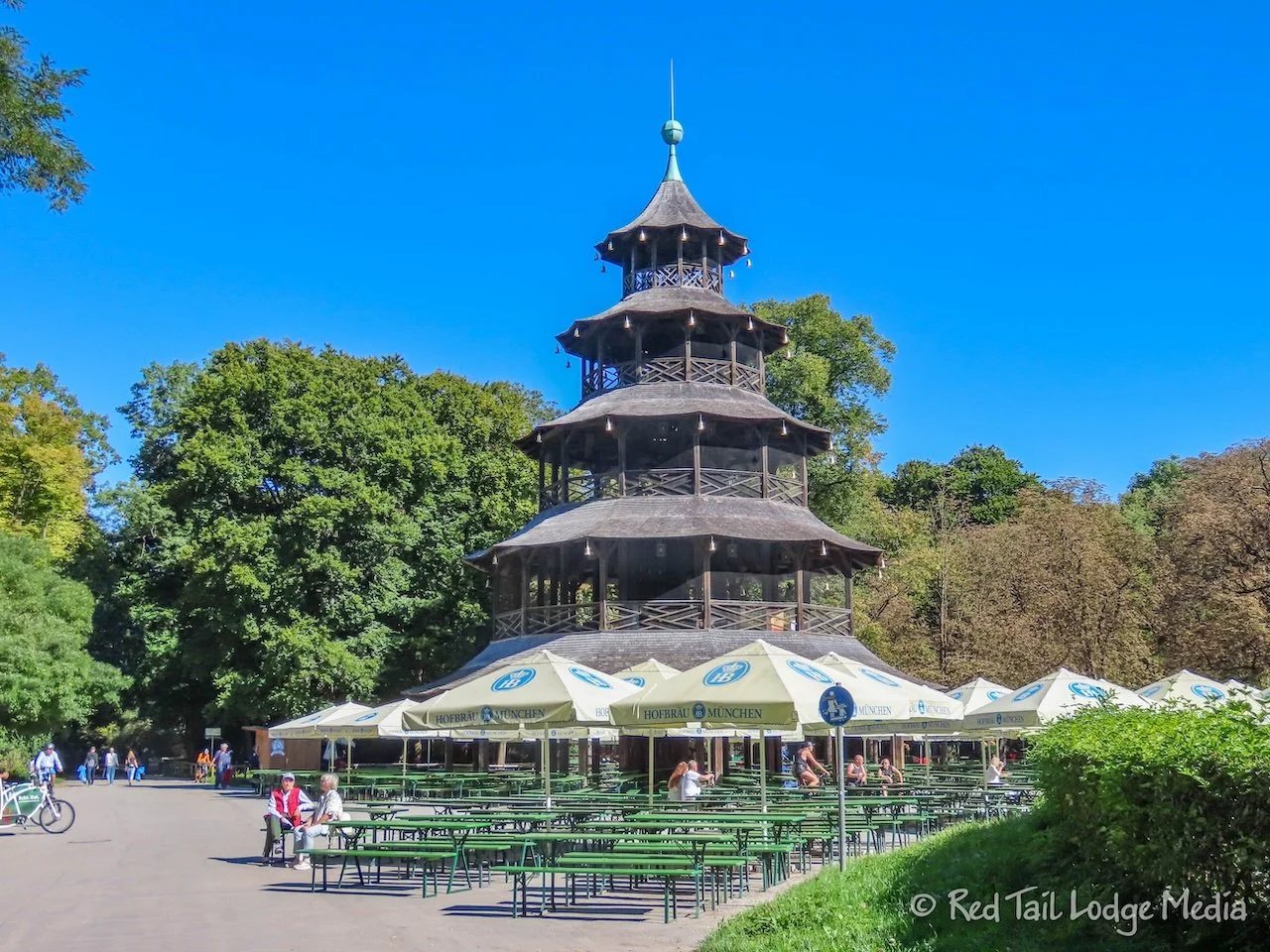
We went to the self-service part of the beer garden, which was a cafeteria style system. We entered the food and drink area, placed what we wanted onto trays, then checked out at the cashier. All three of us had a prepared salad and a small soft pretzel along with a Maracuja (passion fruit) schorle. Everything was tasty.
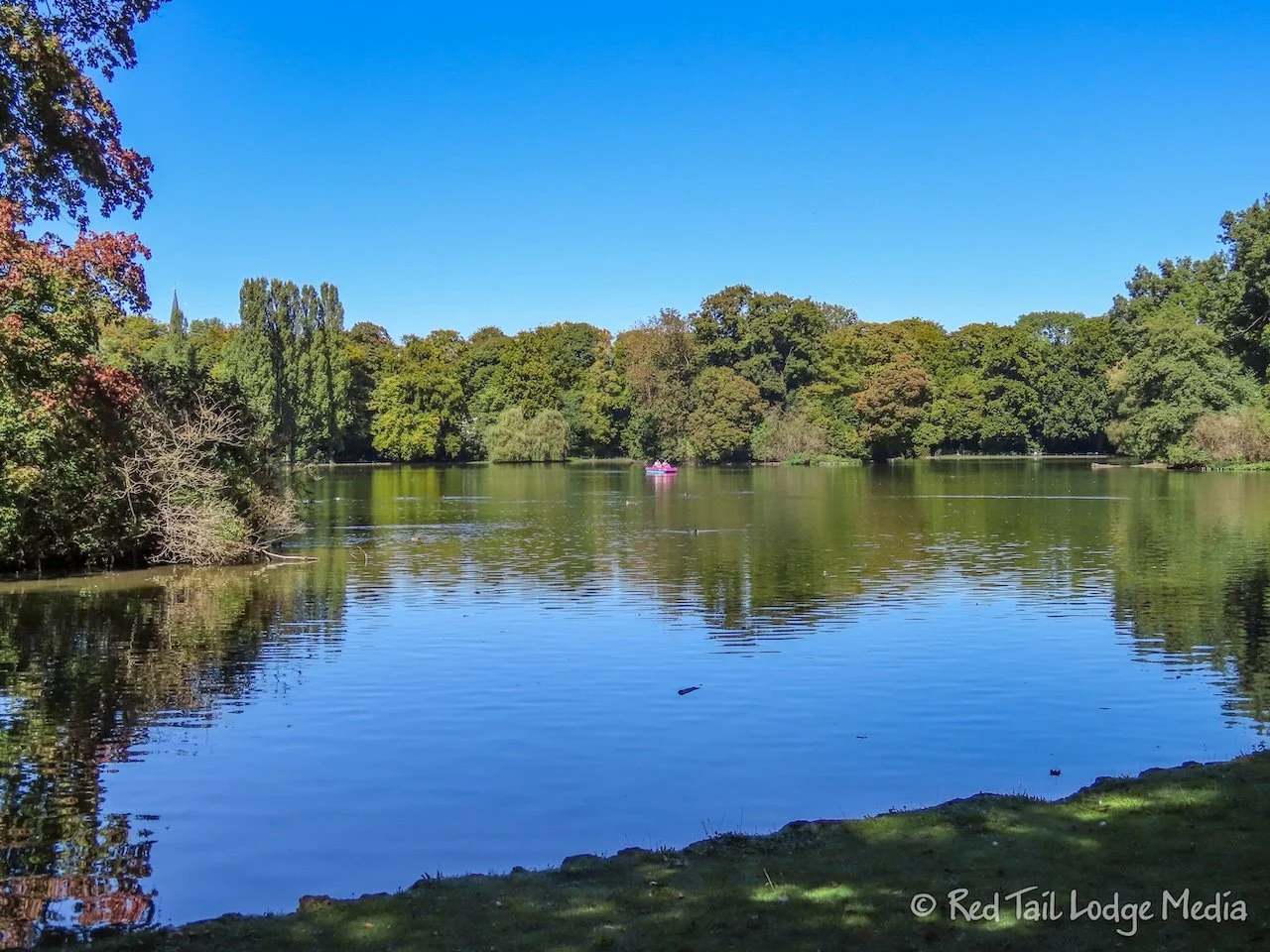
After lunch, we continued heading north through the park. At Kleinhesseloher See (lake), there were people out in pedal boats, enjoying being out on the water with the ducks. Then we crossed over Isaring (a roadway) to leave the southern half of the park (Englischer Garten Süd) and enter the northern half of the park (Englischer Garten Nord). We saw a sign that indicated they were planning on moving the Isaring into a tunnel to create more area inside the park.
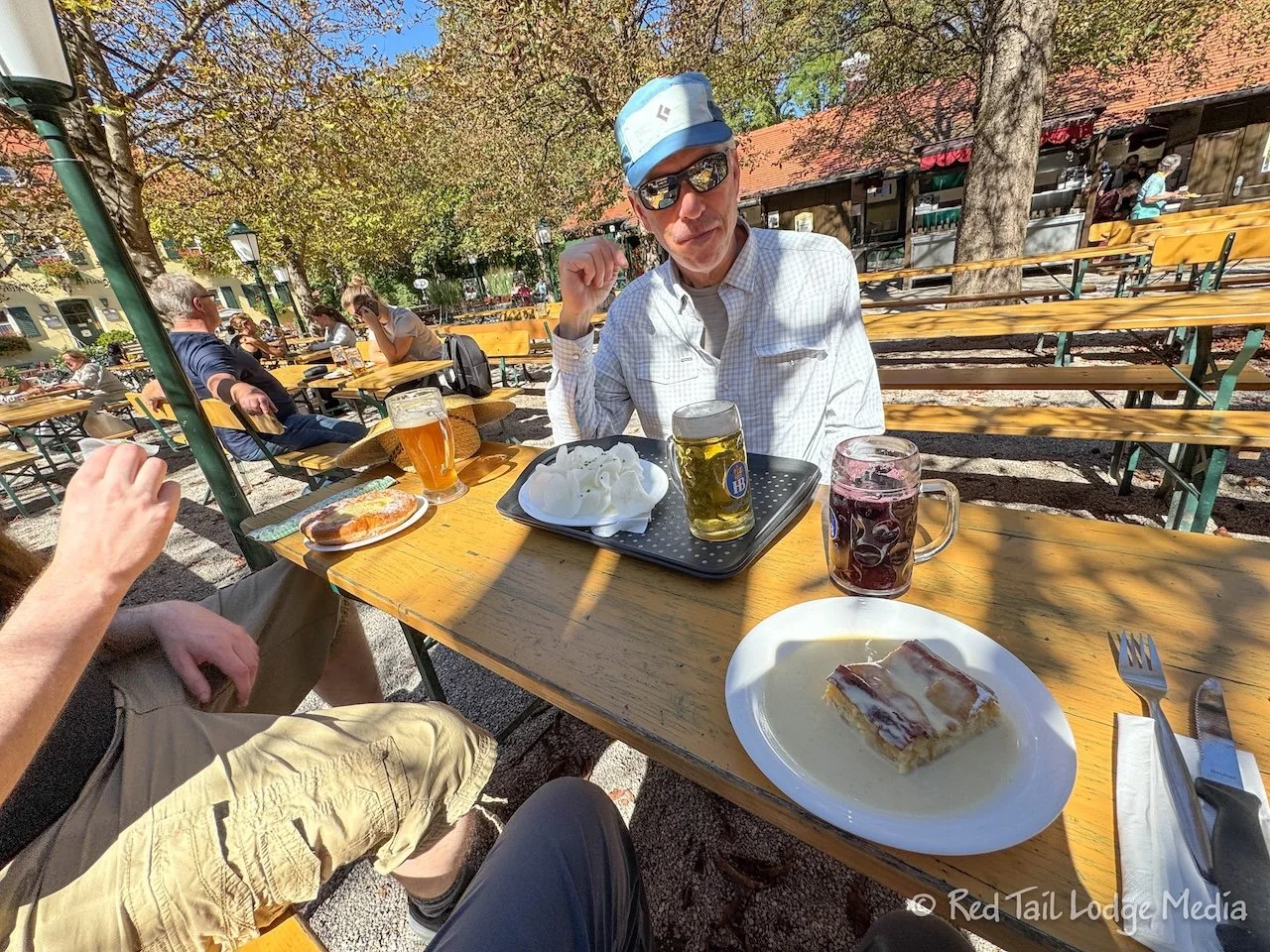
When we reached Aumeister at the northern end of the park, we stopped at the beer garden there for drinks and treats. Keith got Radi (spiral cut white radish), which is a typical fest food in Bavaria. Ann opted for the Topfenstrudel. She was expecting it to have apples in it in addition to the Tyrollean curd cheese (Topfen), like the one she had in Innsbruck (Innsbruck, Austria - September 3rd to 5th, 2025), but it only had the cheese. To be fair, it was called Topfenstrudel, not Topfenapfelstrudel nor Seegrubenstrudel (like it was in Innsbruck). Justin tried the Auszogne, which is a large, yeast donut without a hole in the middle. Ann had one of those back in Ingolstadt (Ingolstadt, Germany - September 14th to 15th, 2025), also called Kiachal, but this time it was covered with granulated sugar instead of powdered sugar.
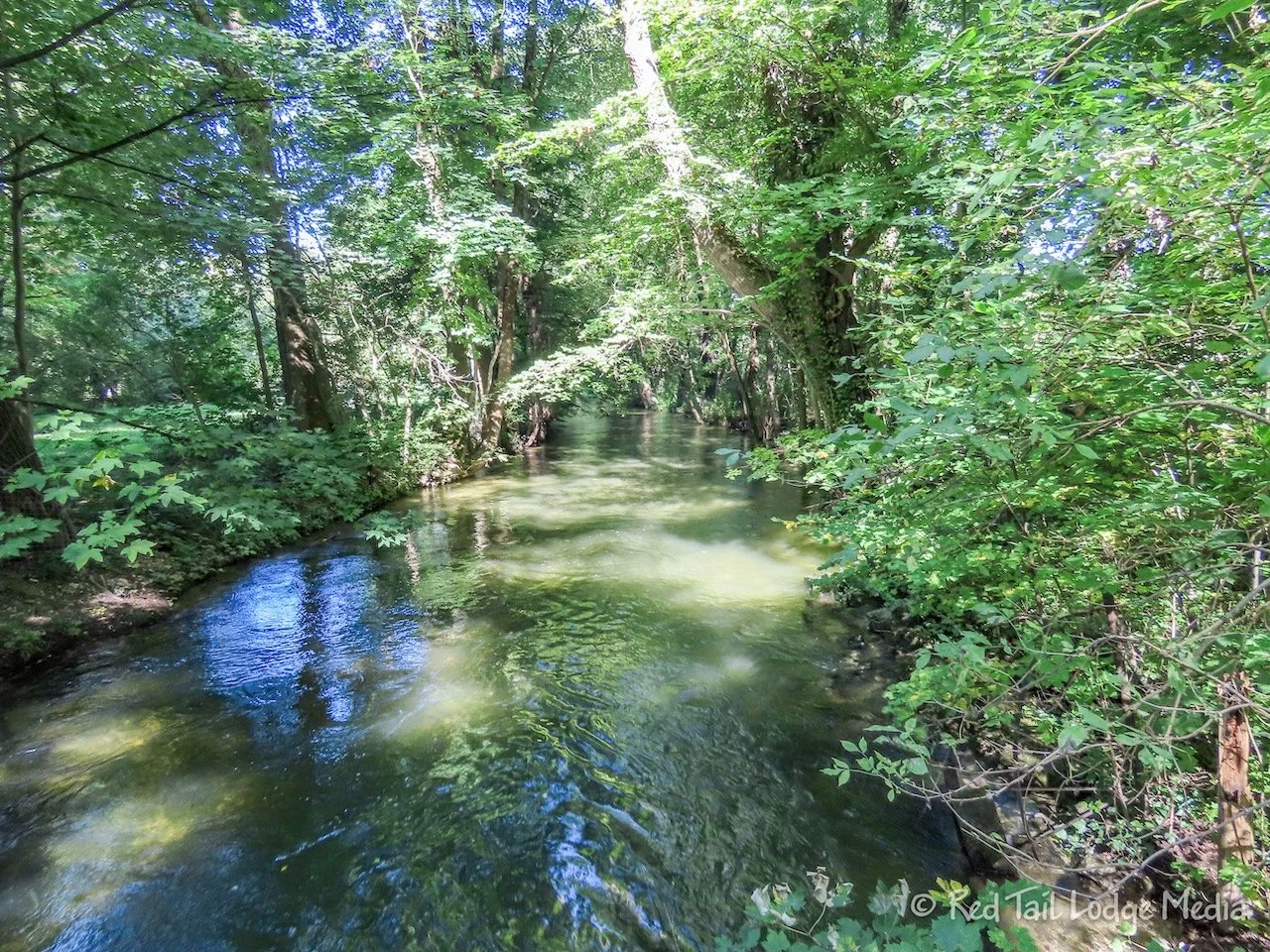
There are paths and green space that continue past the end of the Englischer Garten, which go all the way up to the airport and beyond. We love all the paths in Germany. It makes it so easy to get around by foot and bicycle.
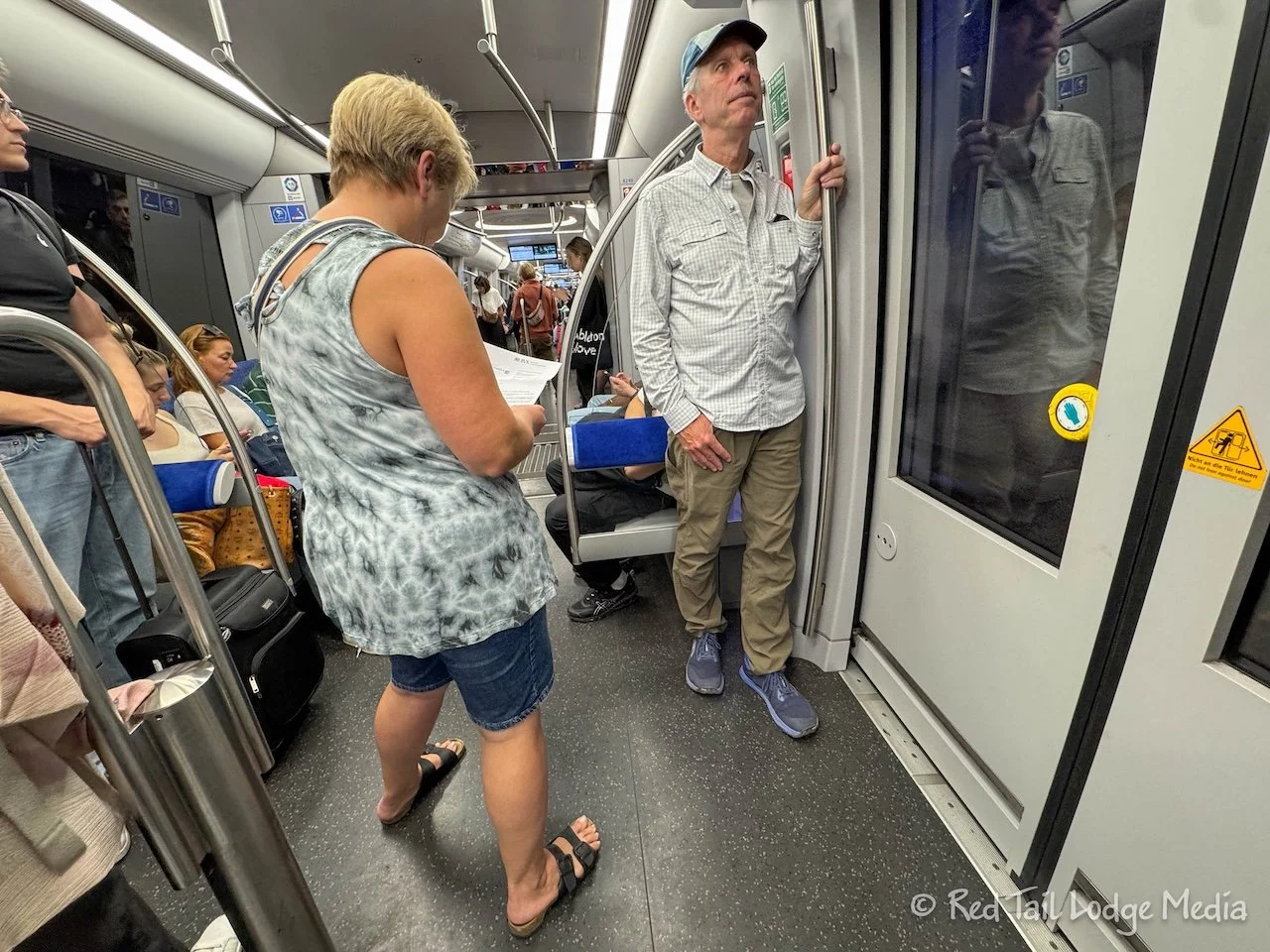
After our treats, we walked over to the Studentenstadt U-Bahn (Untergrundbahn - underground or subway) station. Since we were still in the M zone (just barely), we were able to use our group day ticket (which we had chosen for the M zone). We hopped on the U6 and rode it back to Marienplatz. The U6 runs every 10 minutes. Public transportation works so much better when it runs frequently enough that you don’t have to look up a schedule or wait for long periods of time. But because of that, the trains are heavily used and you can’t always get a seat. However, standing for a ten minute ride is not that uncomfortable.
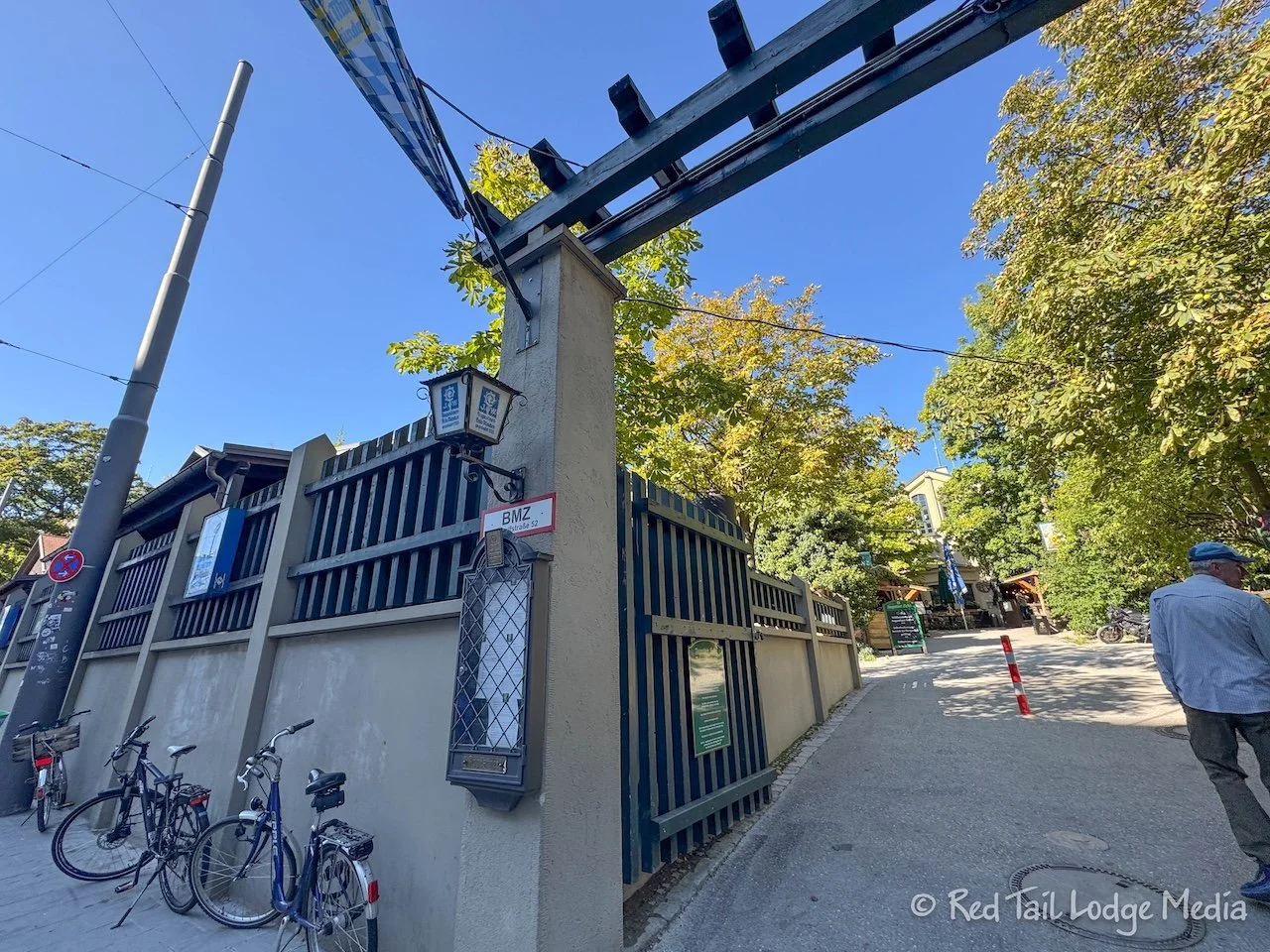
From Marienplatz, we walked over to Augustiner Keller for dinner. We could have connected the U6 to a tram that would have gotten us closer to Augustiner Keller, but we had some time to kill and we needed to burn off the calories from our treats at Aumeister.
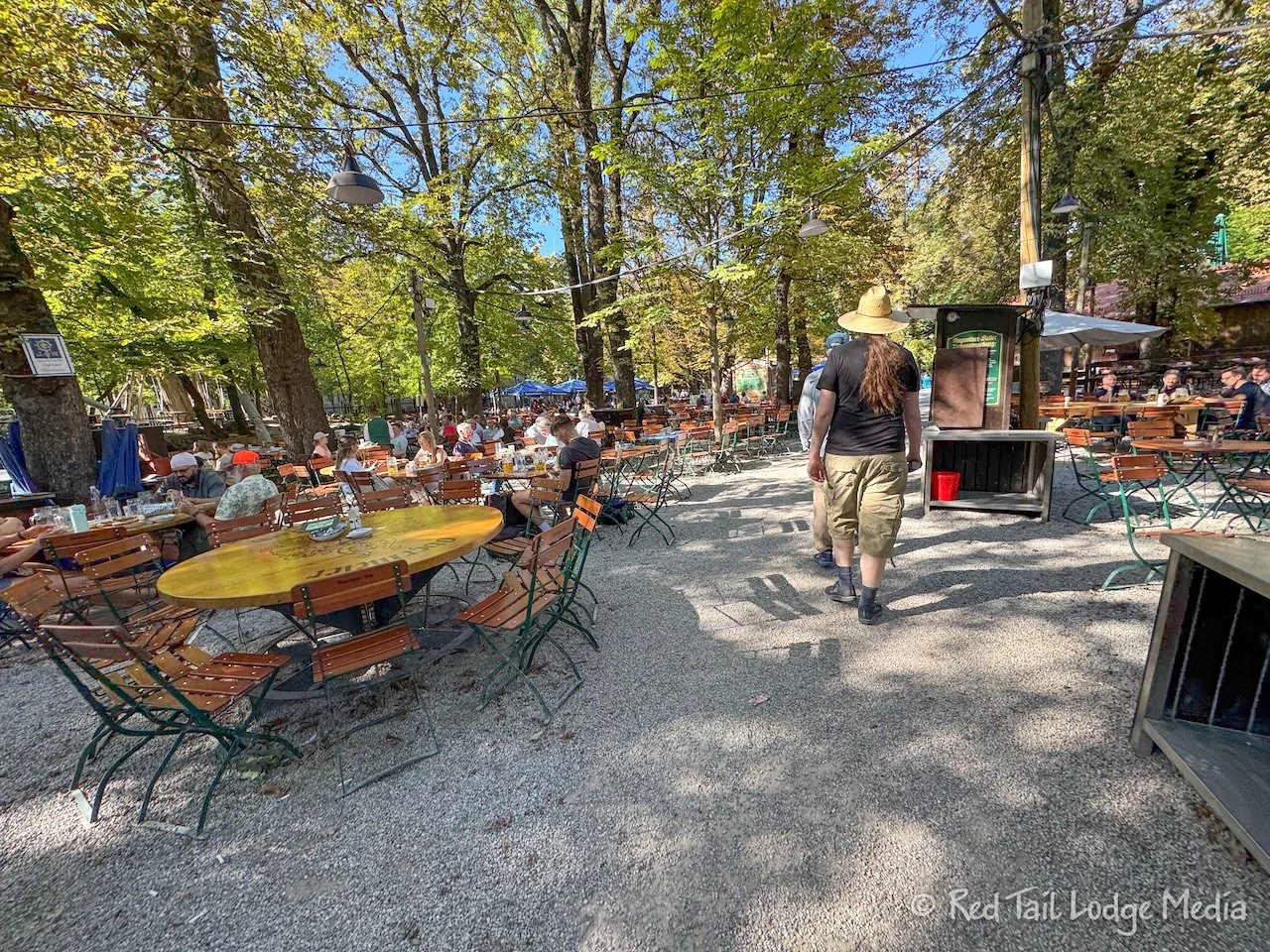
We arrived at Augustiner Keller around 4 pm. Augustiner is Munich’s oldest independent brewery, being established in 1328. Their beer garden is pretty large, seating about 5000 people. The beer garden hasn’t changed much since 1896. We’ve heard that it is popular among the locals.
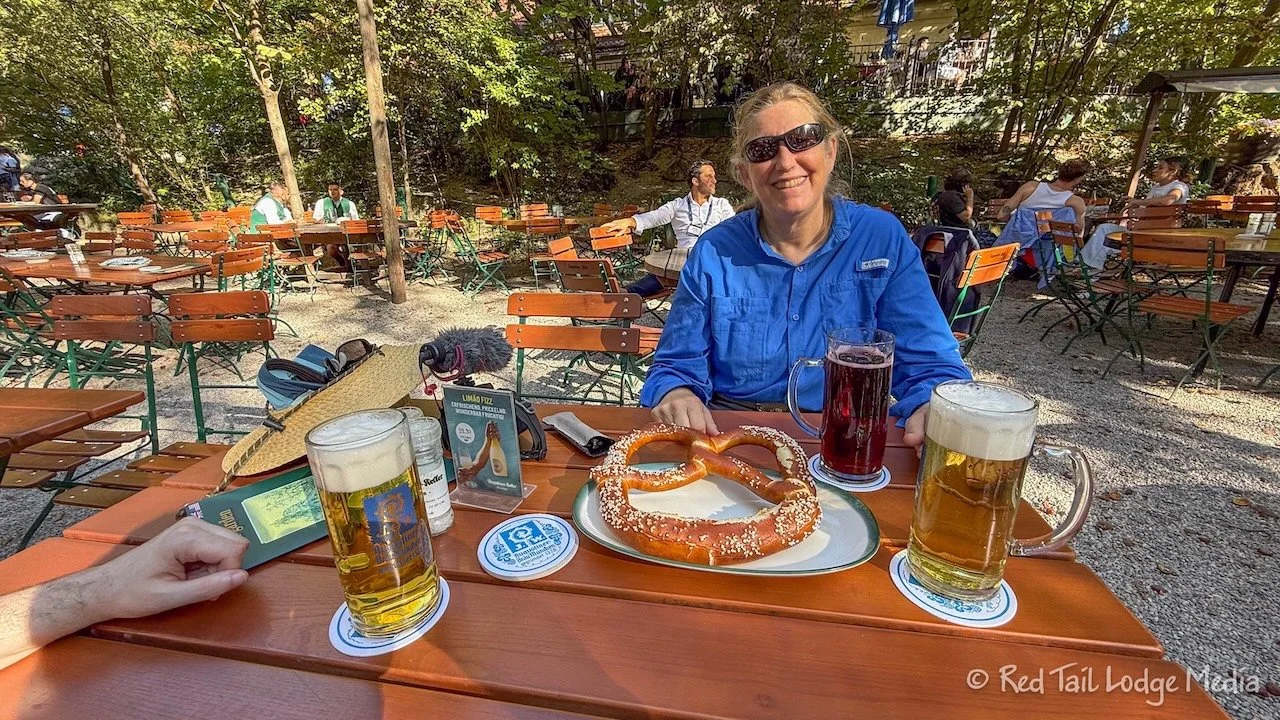
Since it was a little early for dinner, we started out with a round of drinks and split a large soft pretzel. After we finished those, we ordered another round of drinks, just before 5 pm, while we could still order half liter drinks instead of the Maß or full liter mugs.
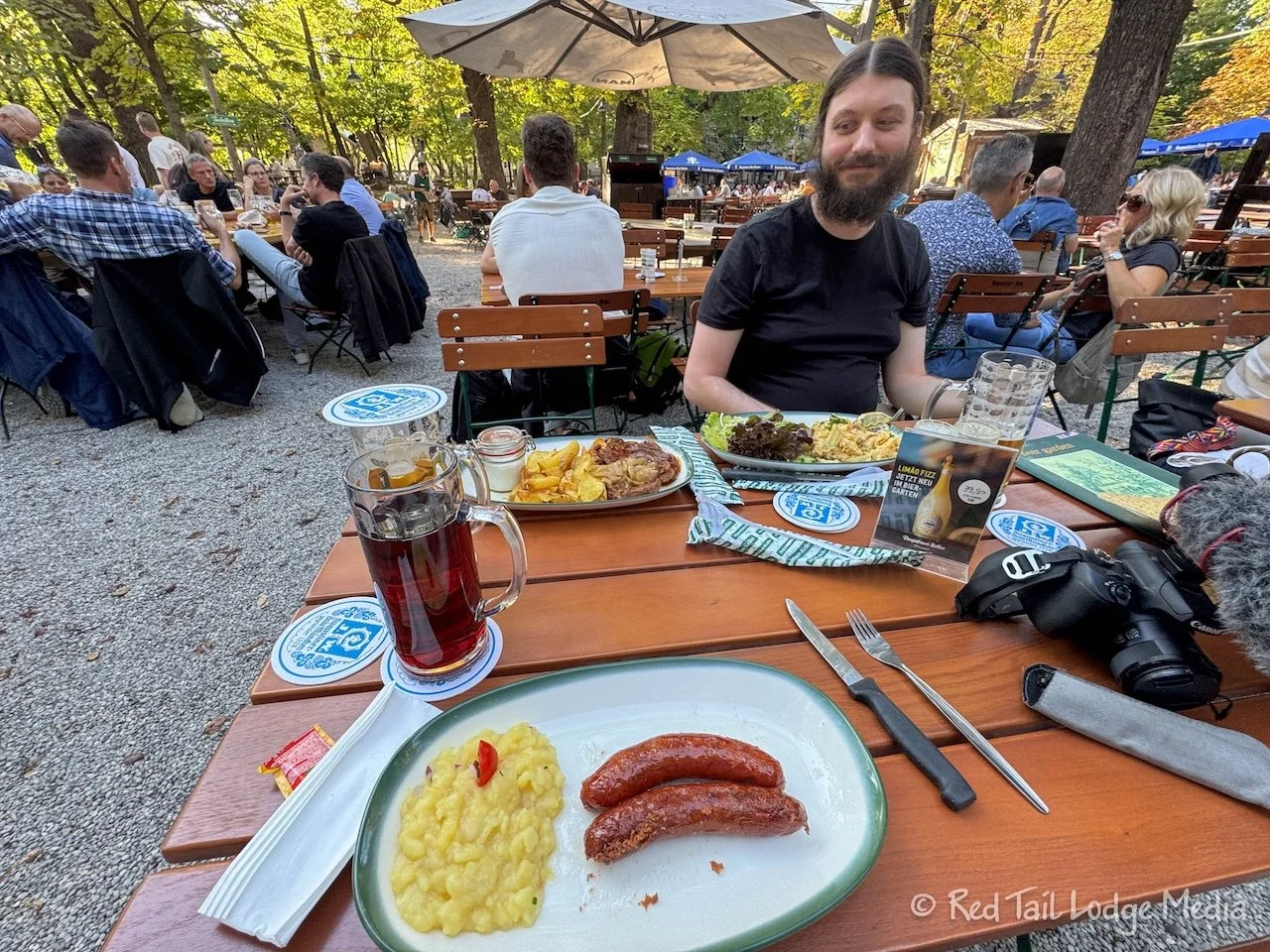
To eat, Ann ordered the Käsekrainer (smoked sausage filled with cheese). Justin tried the Maultaschen and Keith had the pork steak with fried potatoes and sour cream. Ann would have preferred less cheese in the sausage, as it seemed to dominate the flavor. Maultaschen is spinach ravioli, sliced and pan-fried.
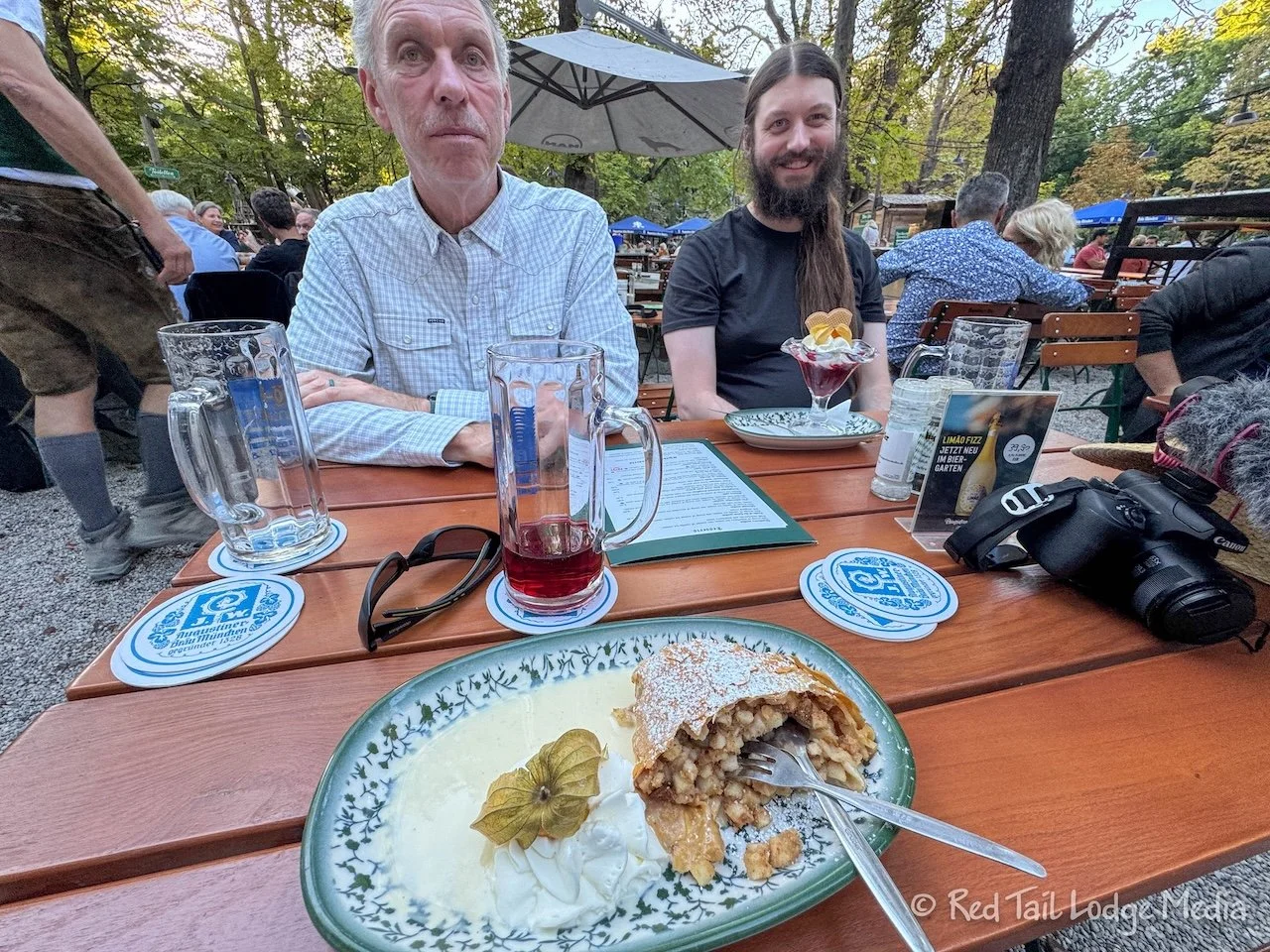
For dessert, Ann had the apfelstrudel while Justin had something called the fruits of the woods. The waiter had given us English menus, so we don’t know what Justin’s dessert was called in German. In fact, our waiter didn’t recognize the English name of the dish and had to look at the menu for the description. It was vanilla ice cream with a variety of berries on top that were somehow prepared with beer. Justin said it tasted pretty good.
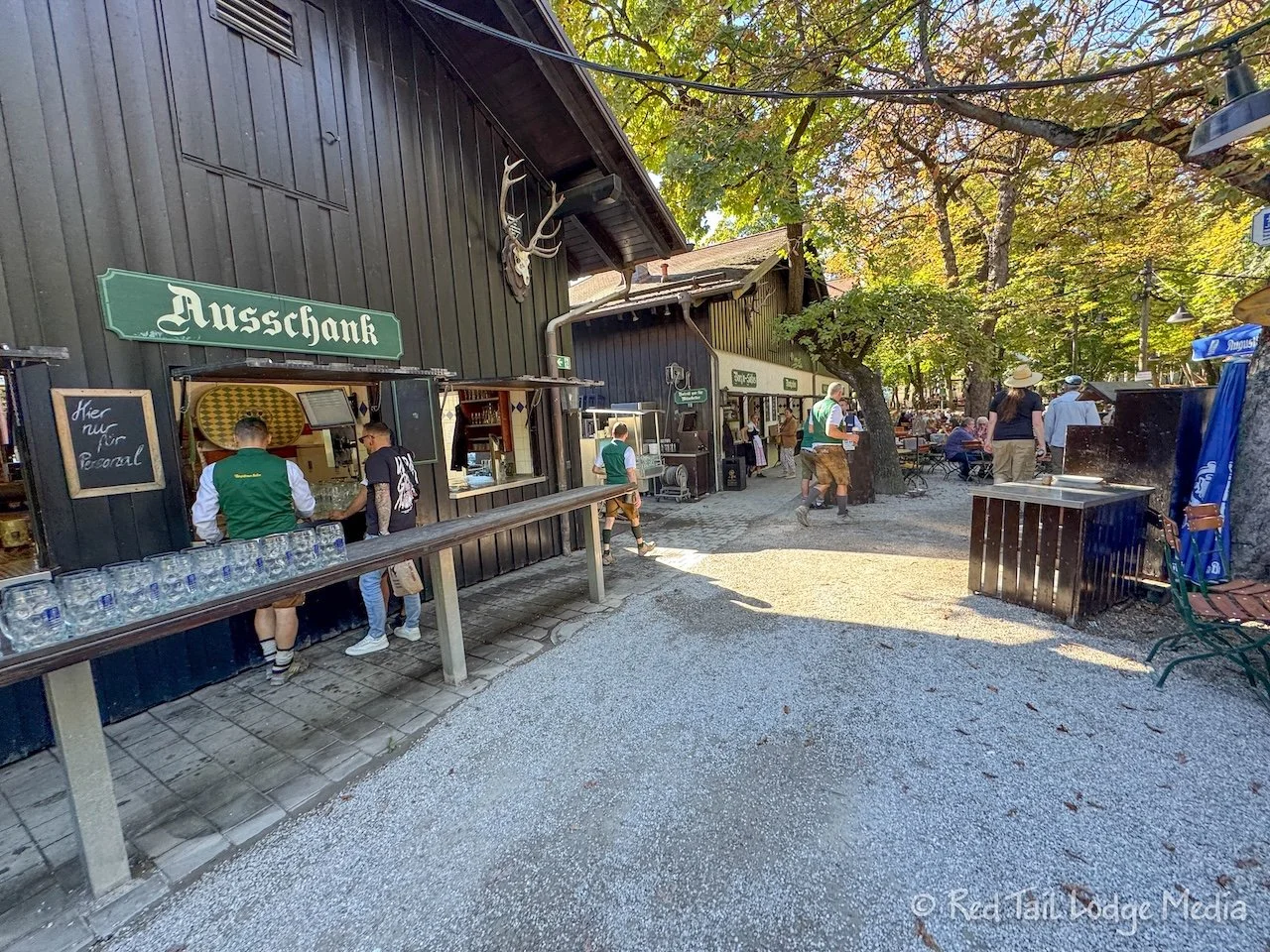
After spending several hours at Augustiner Keller, we finally left. The Hackerbrücke tram station was nearby, so it was an easy ride back to the hotel.
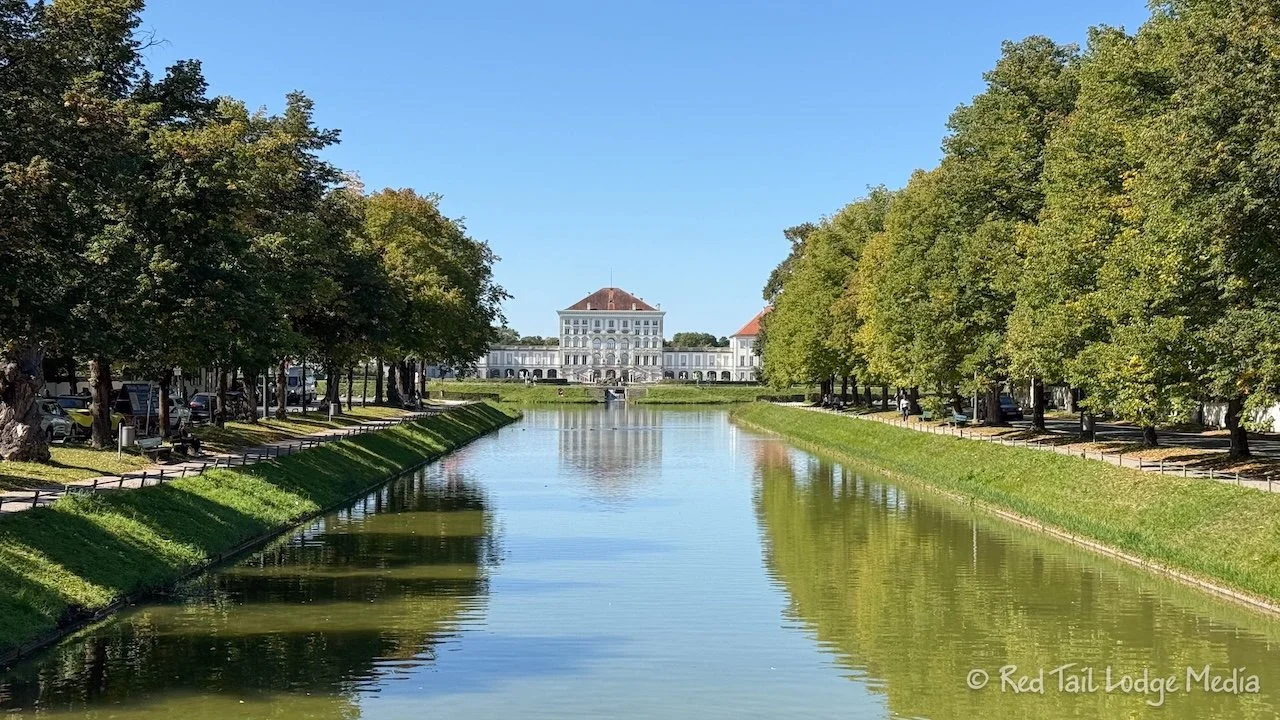
Friday was a rather relaxed day. We left the hotel late, as we had tickets to tour the Schloß Nymphenburg at 11 am and it’s only a ten minute walk away. When we arrived, we bought an English audio tour for each of us. Looking at the crowds, we probably didn’t need to buy our tickets ahead of time because it didn’t look like they were sending anyone away or making them wait for a later time slot.
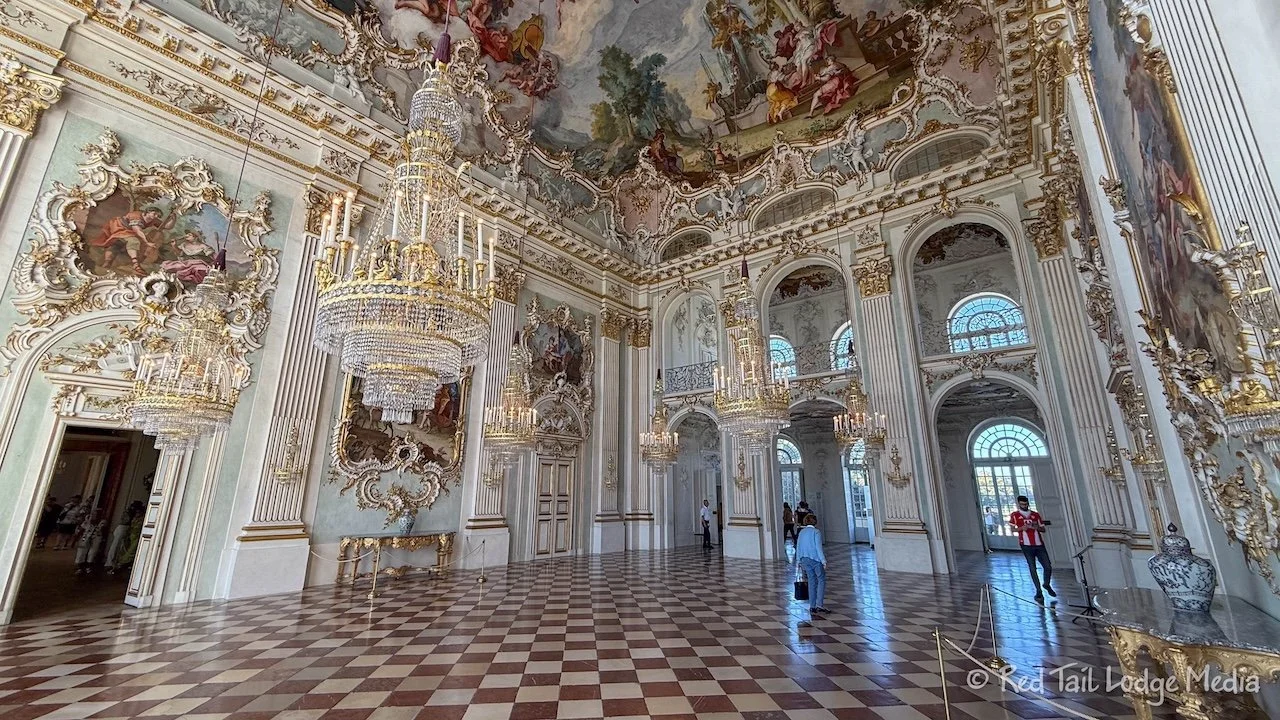
It took us about an hour to go through the tour. If we had listened to all of the optional additional information, it might have extended it to an hour and a half. But an hour was just about right for us. Not knowing Germany’s history very well, there were a lot of names and dates being tossed around, of which we retained very little. However, some of the information was pretty interesting, like King Ludwig I’s Gallery of Beauties, which was portraits of beautiful women, both of nobility and the middle class (bourgeoisie) of Munich. Having portraits made for people other than nobility was rather unusual for the time. Justin wondered what Ludwig’s wife thought about the portraits.
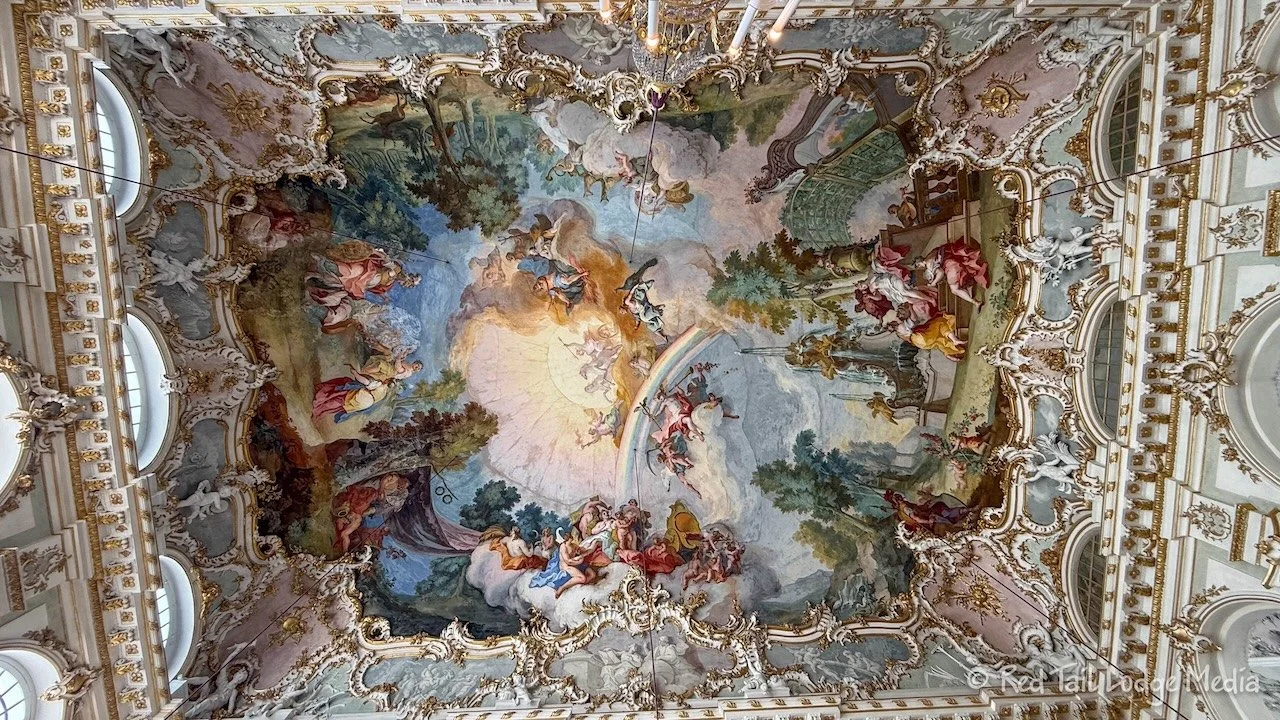
It was King Ludwig I’s marriage to Therese of Saxe-Hildburghausen in 1810 which started the Oktoberfest. Their wedding celebration in Theresienwiese (Therese’s Meadow) was so well received, that the people of Munich started celebrating the festival every year that followed (other than being canceled a couple of years at a time for various reasons such as war and pandemics).
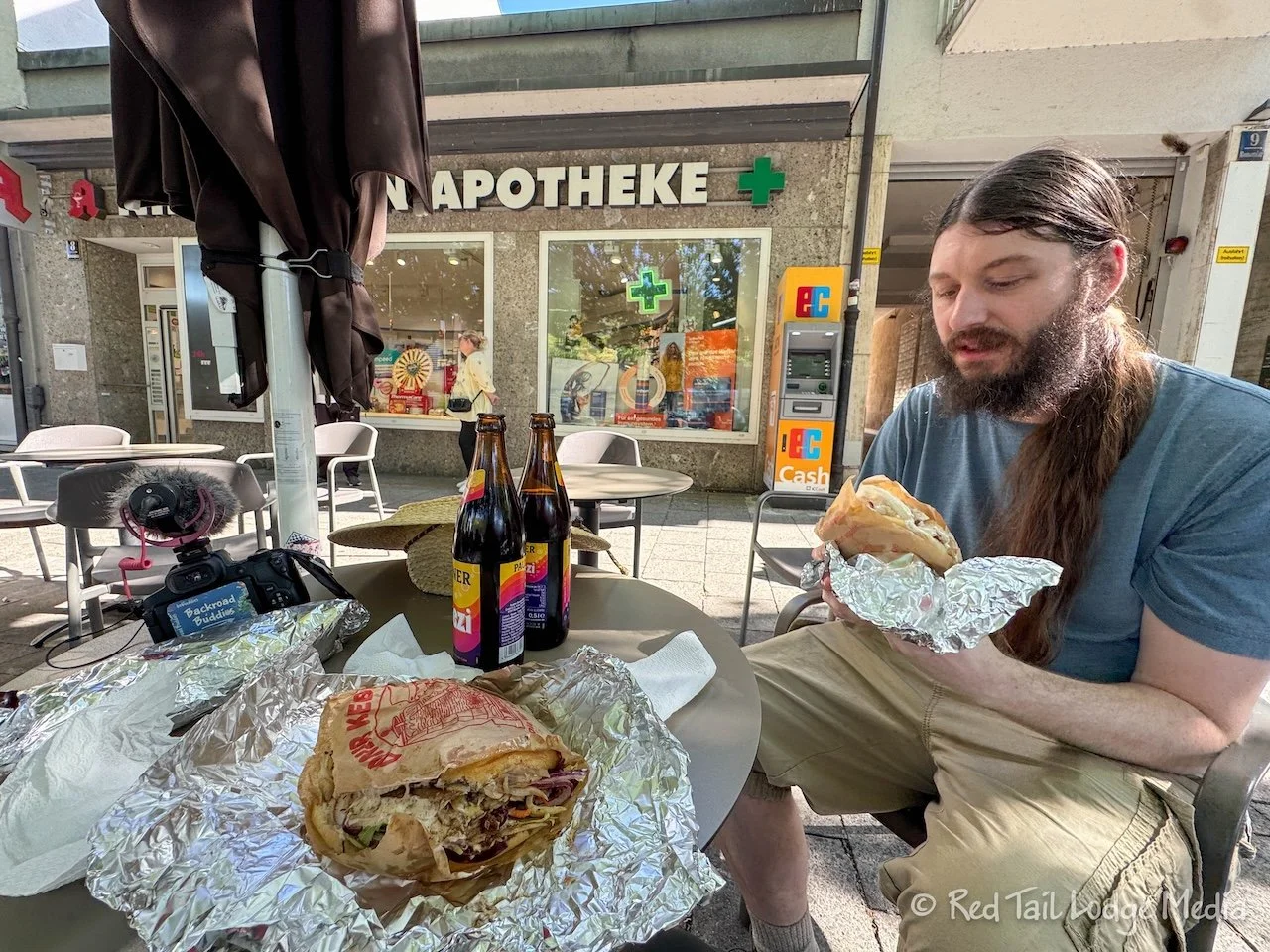
After the tour, we walked over to Romanplatz to a Döner stand, called Romanplatz Special Kebap, for lunch. Keith, of course, had a Dürhüm while the rest of us had Drehspieß sandwiches. The difference between a Döner and Drehspieß is minor and has to do with the standards for the cut of meat used in a Döner. Both the Dürhüm and the Drehspieß were pretty good, but Ann still thinks her favorite was the Döner back in Innsbruck, Austria.
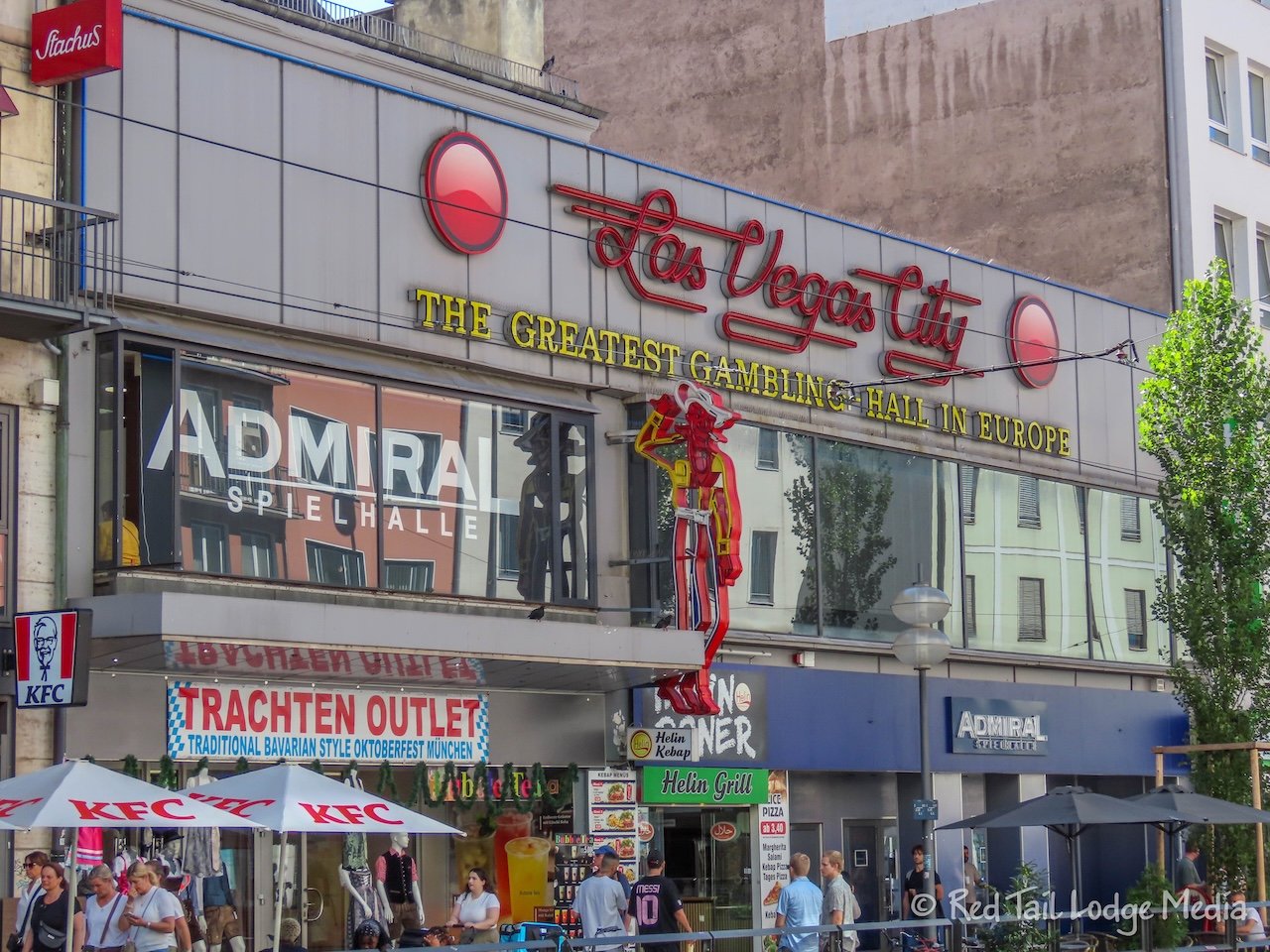
At Romanplatz, we took Tram 16 or 17 to the Hauptbahnhof. We walked through the Hauptbahnhof so Justin could see what the large train station looks like. Well, at least what the platform area looked like, as the station’s building was currently closed and under construction.
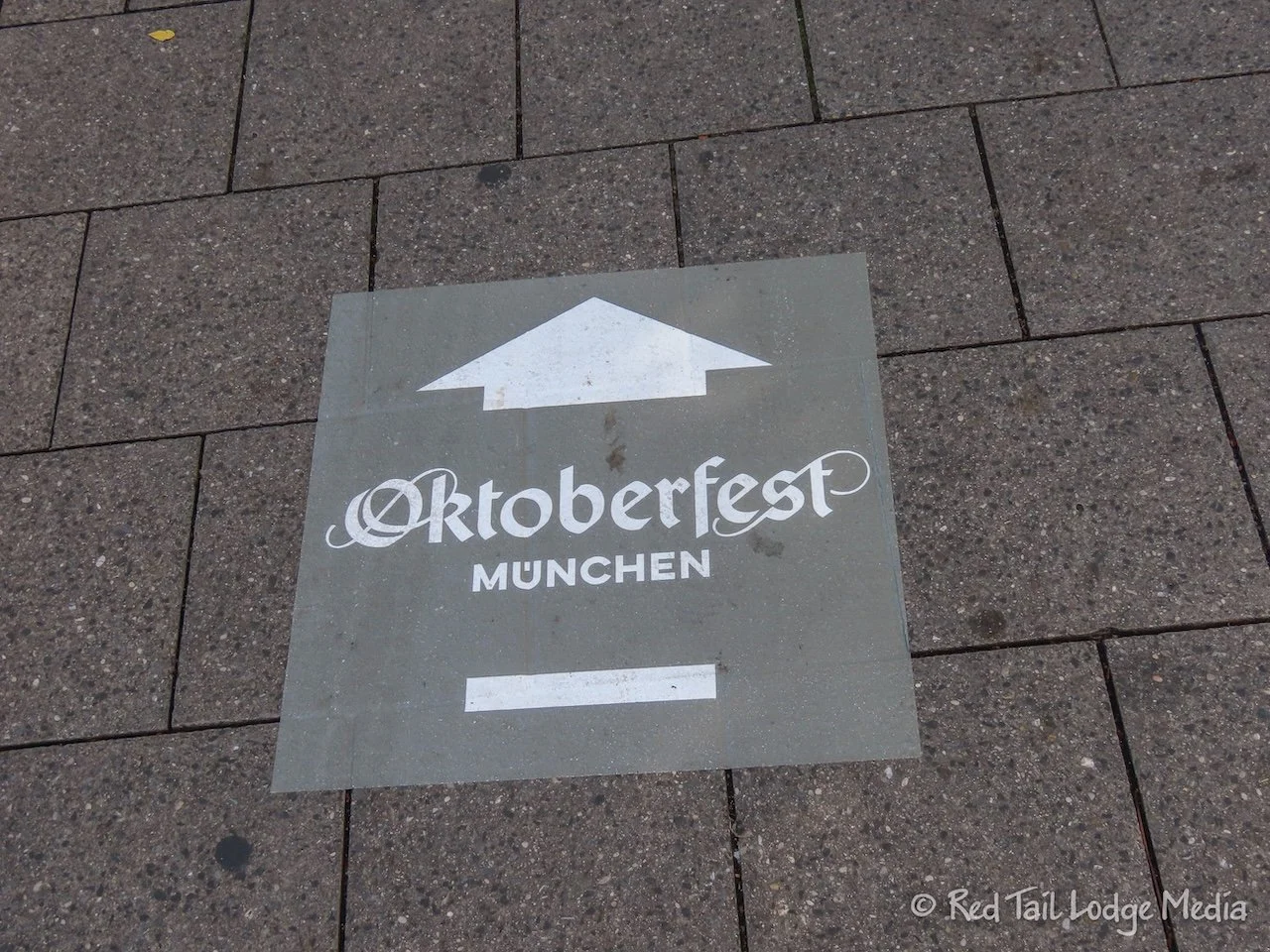
From there, we followed the signs on the sidewalk over to the Wiesn (Theresienwiese), where the Oktoberfest is held. Of course, we couldn’t actually go inside the fest grounds, as the fest had not started yet and they were still setting everything up.
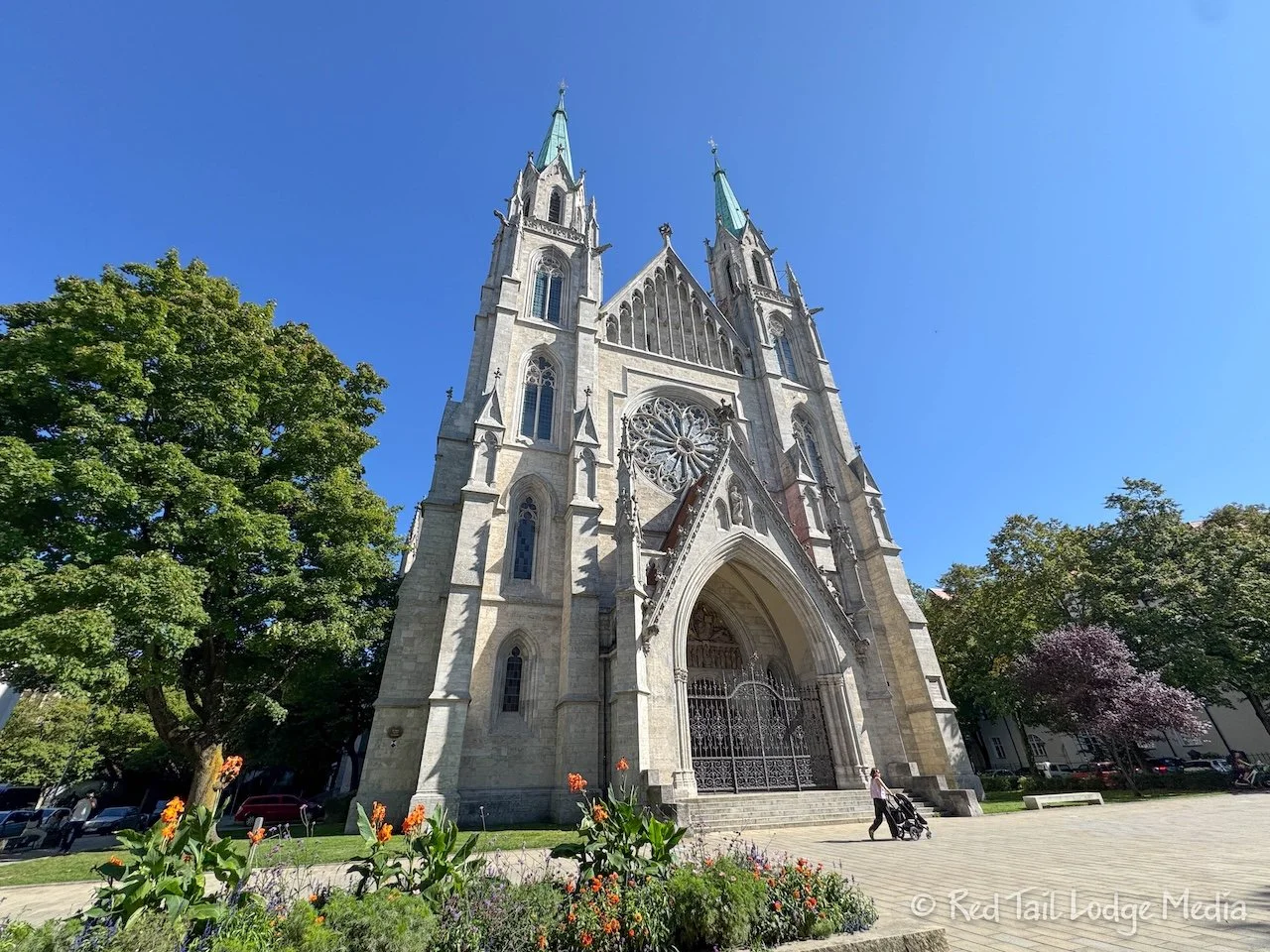
We were getting thirsty, so we headed east over to Viktualienmarkt. On the way, we passed by Paulskirche (St. Paul’s Church) and strolled through a rather international neighborhood. Many of the shop signs were in Arabic in addition to German. We walked past a busy Yemeni restaurant with food that looked and smelled delicious. We made a note to come back the following day.
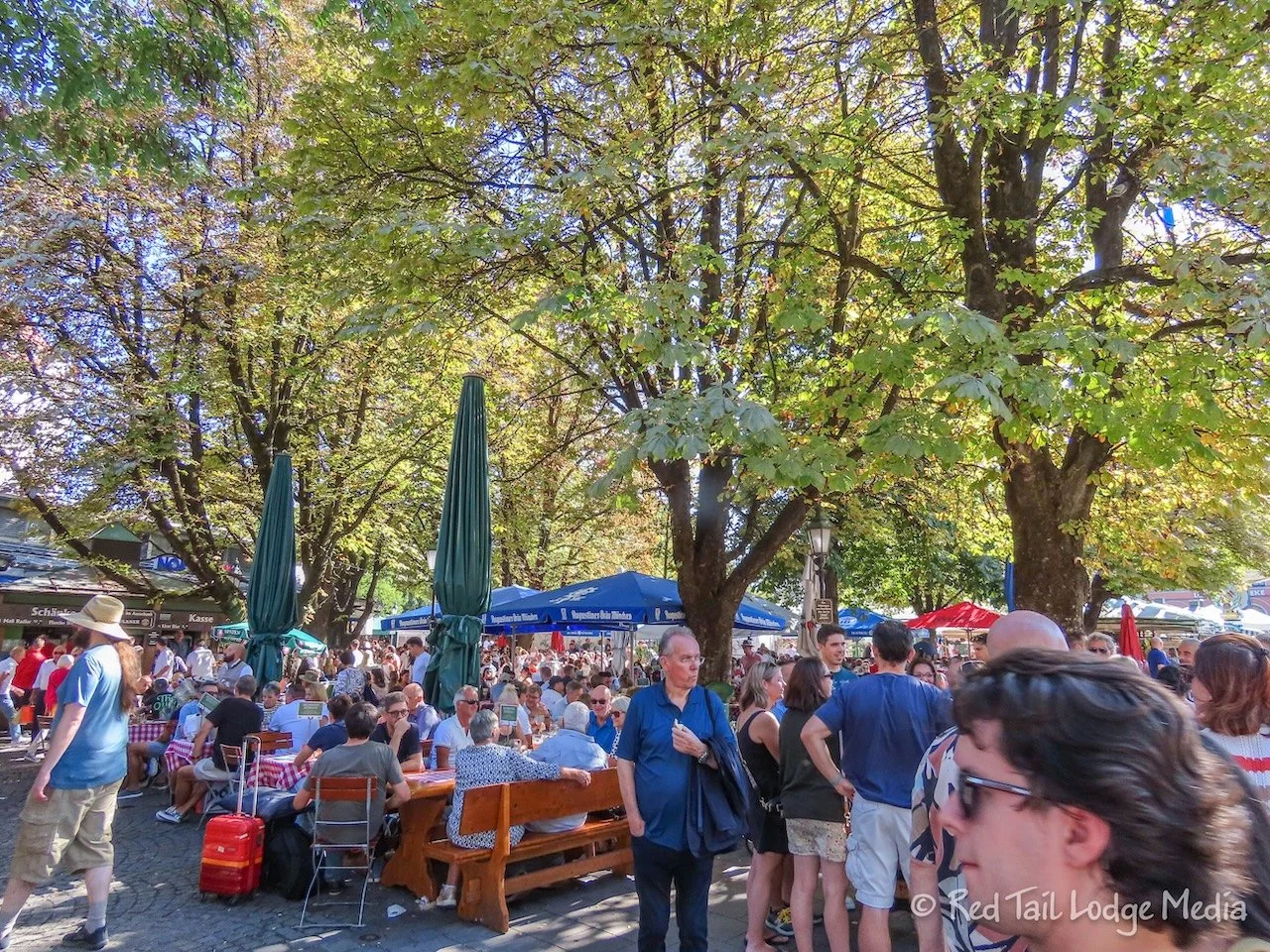
When we reached Viktualienmarkt, it was packed. We were hoping to get a seat in the beer garden there, but there wasn’t a seat to be found. It was Friday afternoon, the day before the start of Oktoberfest, and the crowds of people seemed to indicate that everyone was starting to show up. We grabbed some drinks from a food stand and found a bench to sit on, in the hot sun. At least the drinks were cold.
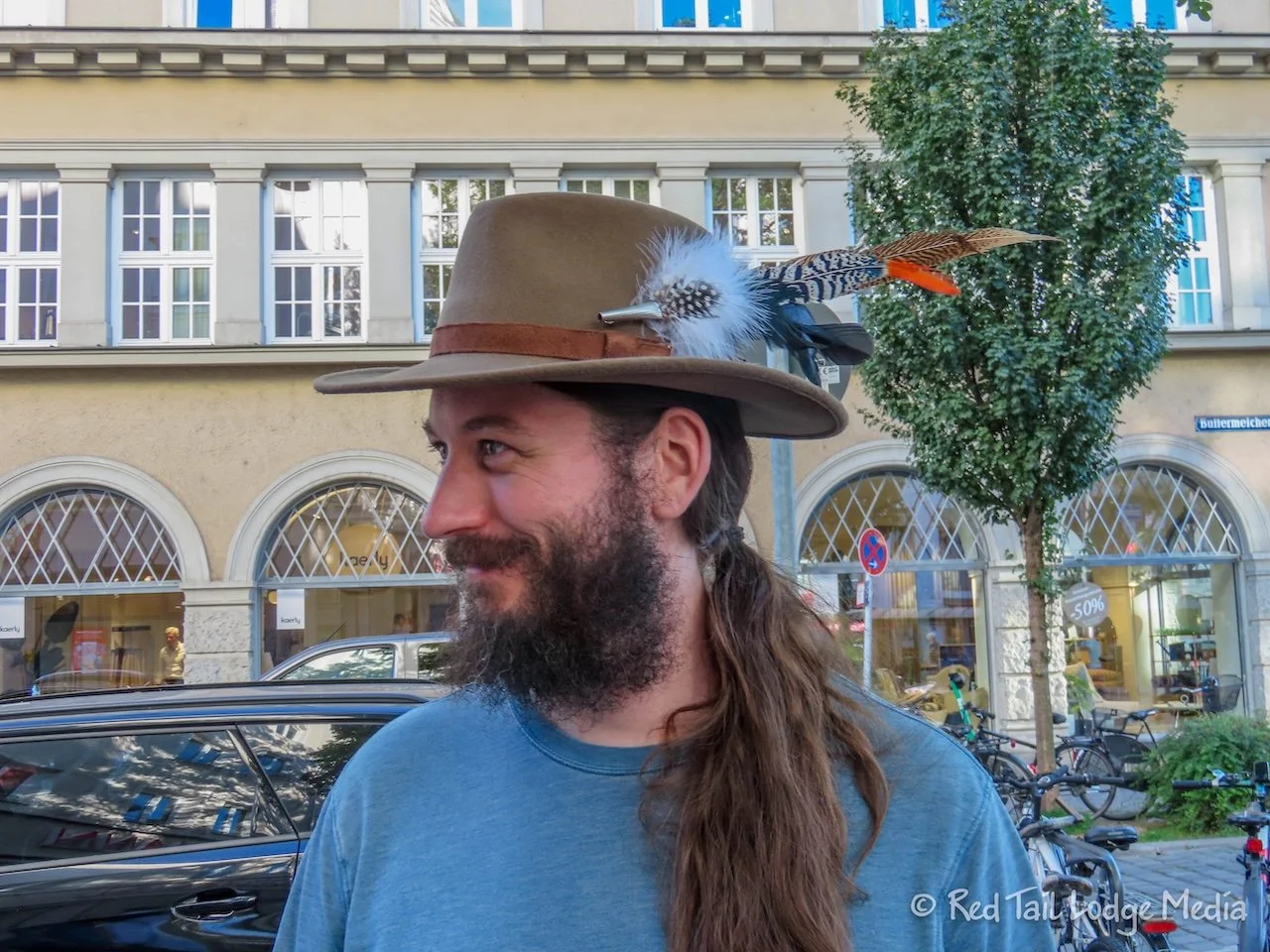
Then the men went shopping. Ann didn’t need anything and hates to shop. Keith saw some slippers he wanted, but they didn’t have his size. Justin needed a new wool hat. He found a hat he liked at Breiter Hut & Mode, one with a feather in it. He should fit right in at Oktoberfest, even without lederhosen.
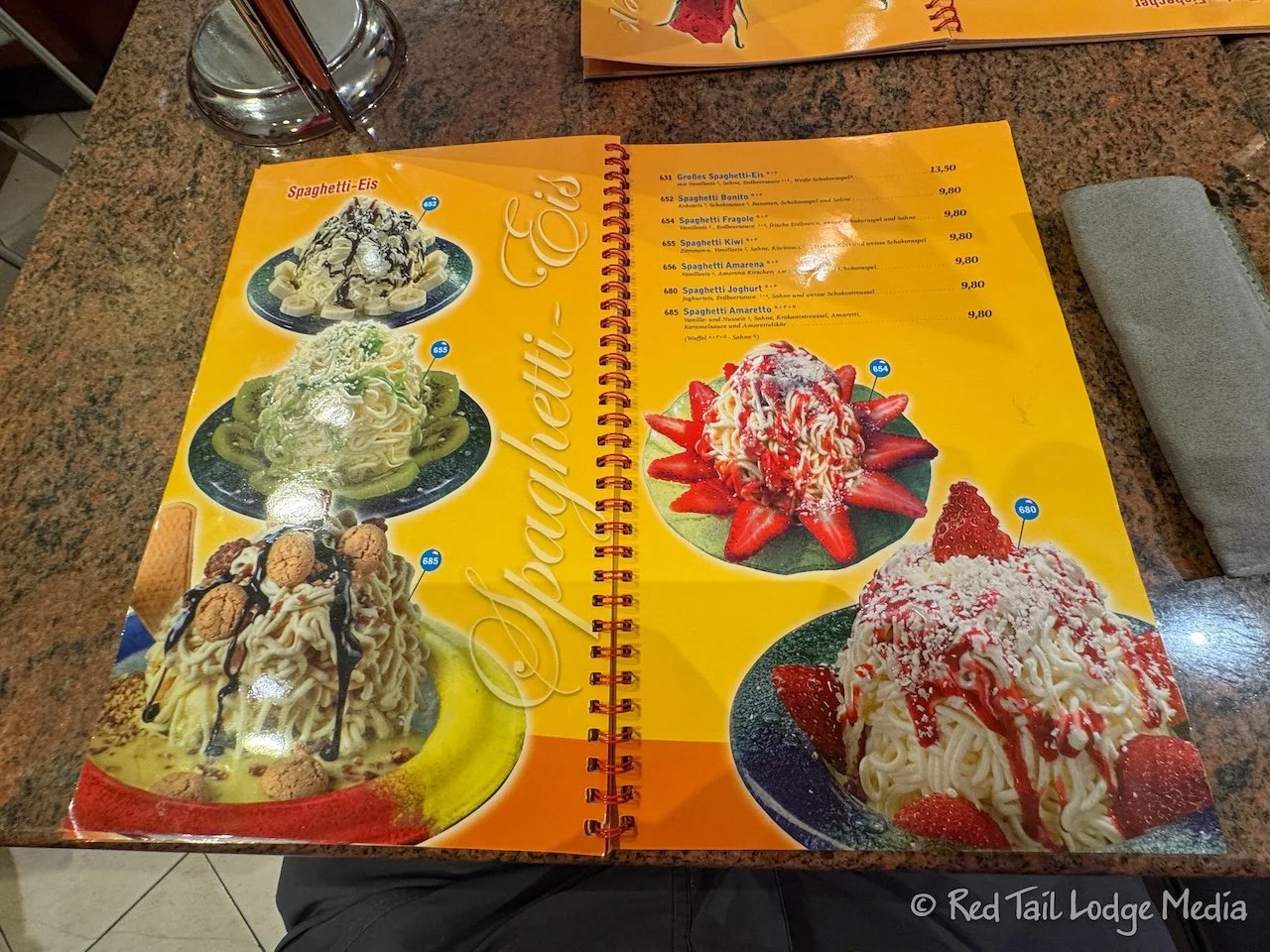
After shopping, we walked over to Café Al Teatro so Justin could try Spaghettieis. Spaghettieis is ice cream squeezed through a ricer to look like spaghetti, then it is topped with a red berry sauce, such as strawberry or raspberry, to resemble tomato sauce, with shavings of white chocolate to represent parmesan cheese. We fondly remember Spaghettieis when we lived in Germany 35 years ago. However, it seems like there are a lot more options now than just the classic combination.
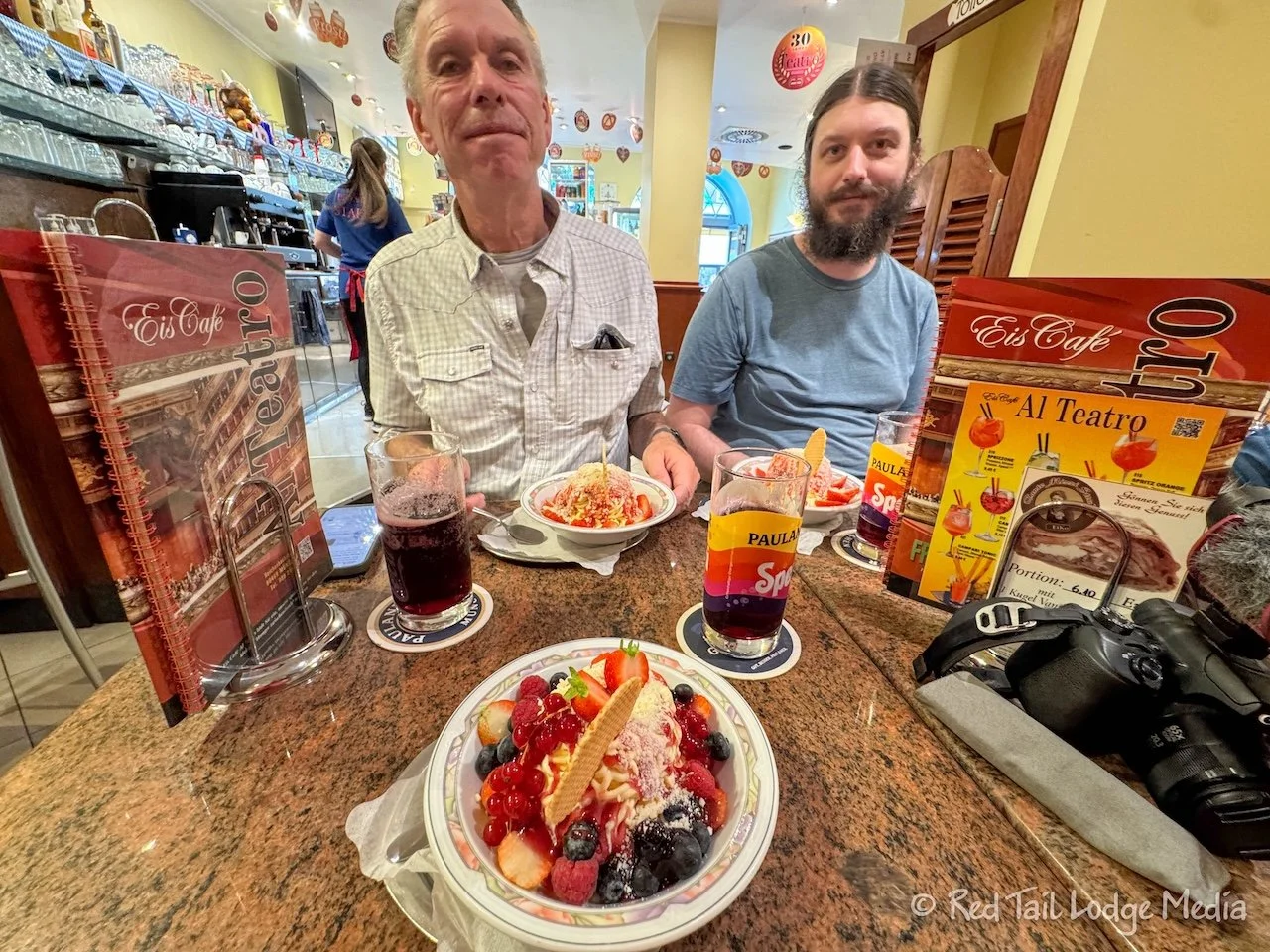
Ann ordered the Spaghetti alla boscaiola, which had a raspberry sauce with mixed fresh berries of strawberries, blueberries, raspberries, and red currant. Justin and Keith ate the Spaghetti Fragole, which came with strawberry sauce and fresh strawberries. The fresh berries make the dish no longer look like spaghetti, but they make it even more delicious tasting.
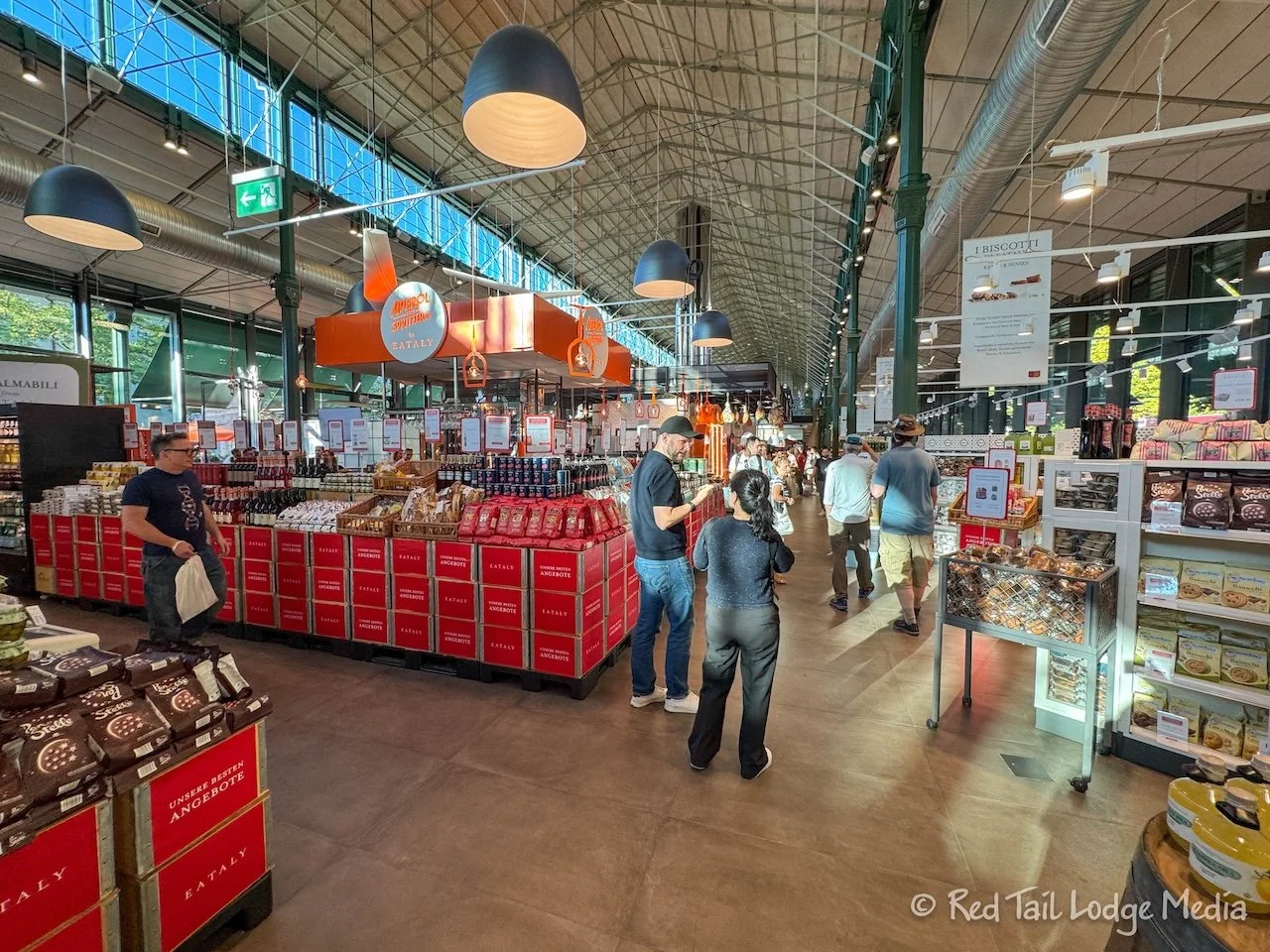
We walked around a little bit more, then headed over to Eataly for dinner. Eataly Schrannenhalle is an indoor market full of products from Italy, such as pasta, wine, bread, coffee, and just about anything else you can think of. There is also a pizzeria and restaurant. We opted for the pizzeria. It was nice and quiet inside the market hall, unlike the noisy crowds just outside.
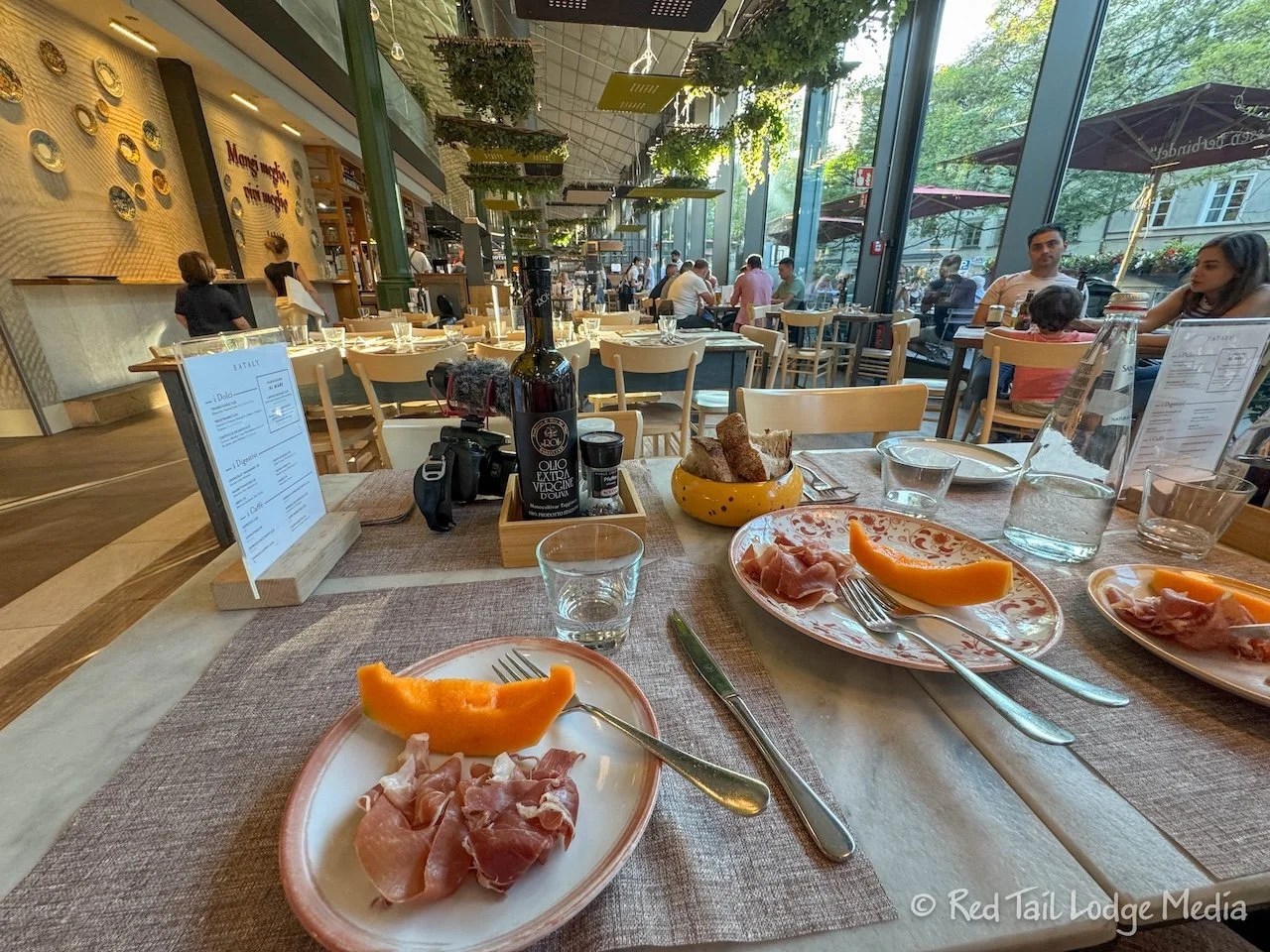
As you could probably guess, we weren’t very hungry, so we split a couple of dishes. We started out with an appetizer of prosciutto e melone (prosciutto and melon). We find that combination of flavors rather refreshing on a hot day.
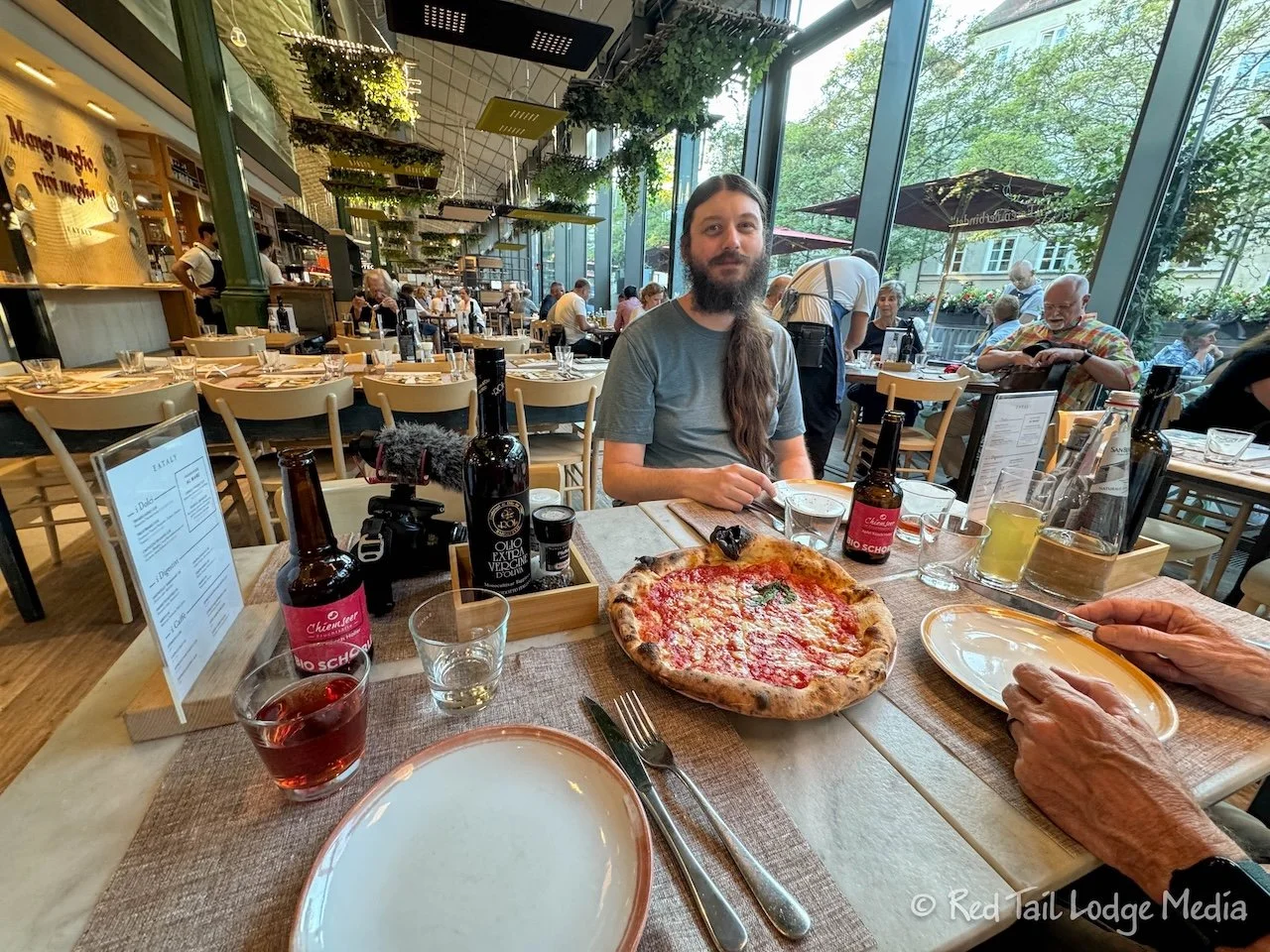
Then we split one Margherita pizza. They even cut it into slices for us, since they knew we were splitting it. In Europe, pizzas are typically served whole, as single servings, that people eat with a knife and fork. It was a perfect amount of food for us.
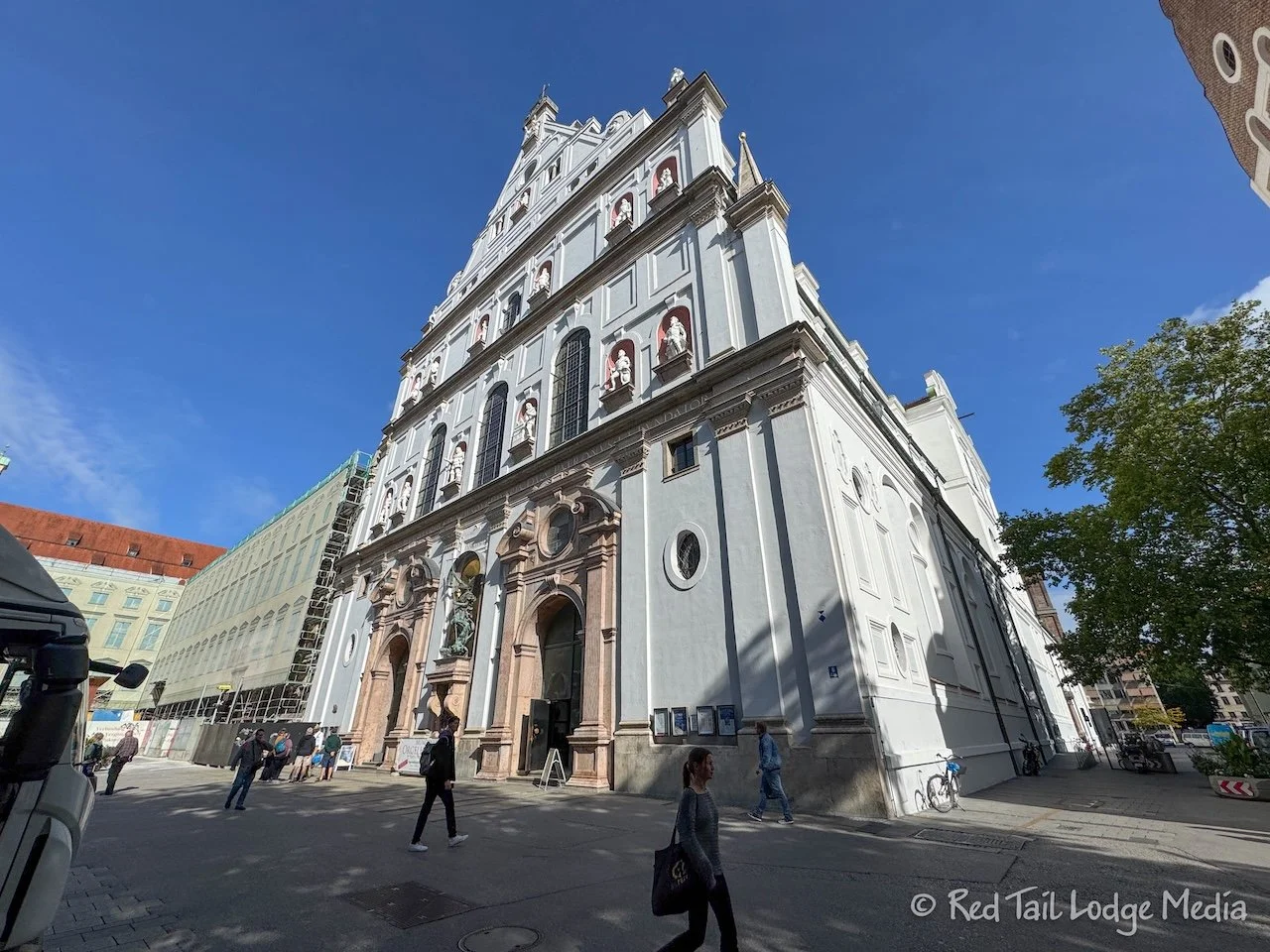
From there, we walked over to St. Michael’s church. There was a free concert there that evening with an orchestra and choir, called Hardy Orchestra. The Hardy Orchestra is led by a Ukrainian composer, with members from Ukraine, Germany, Poland, Armenia, and the Czech Republic. The concert was put on in coordination with the DUWEI (https://du-wei.de/), the German-Ukranian Welfare Association. Donations were being accepted.
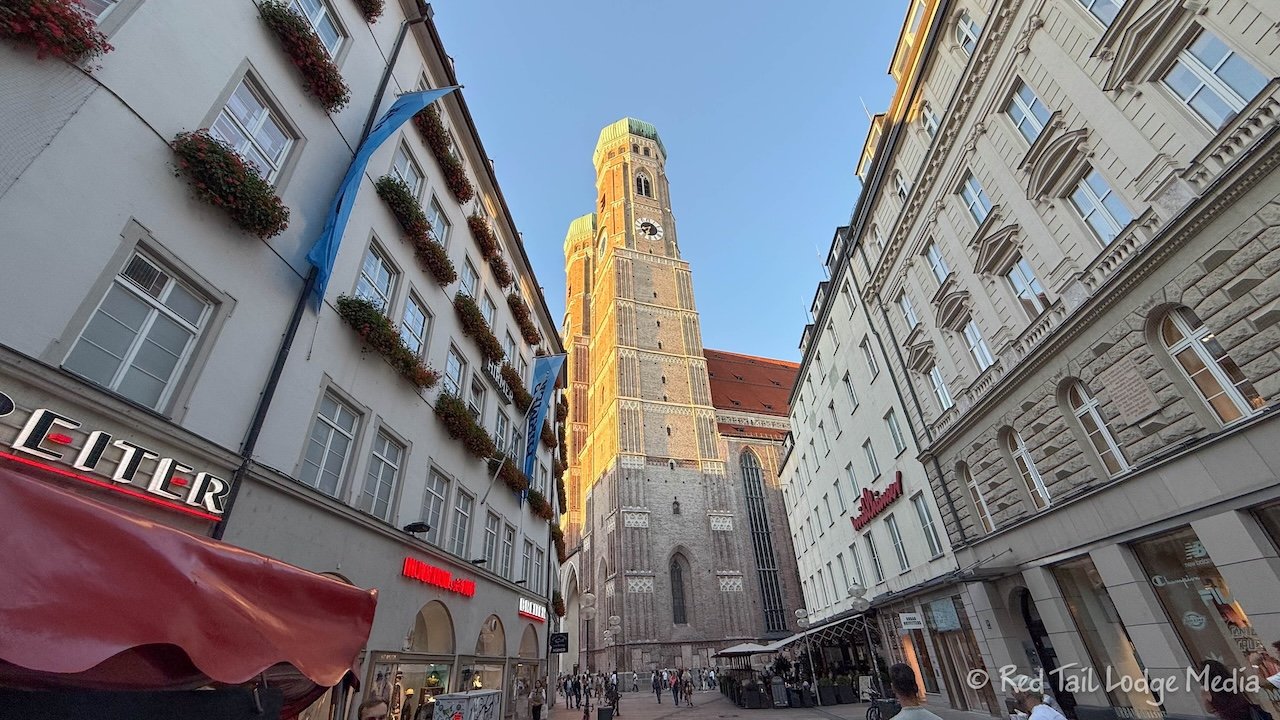
After the concert, we rode the Tram back to Romanplatz to get back to the hotel. Munich is still a vibrant city after dark. The neighborhood of our hotel is not brightly lit, but we felt very safe walking the streets there.
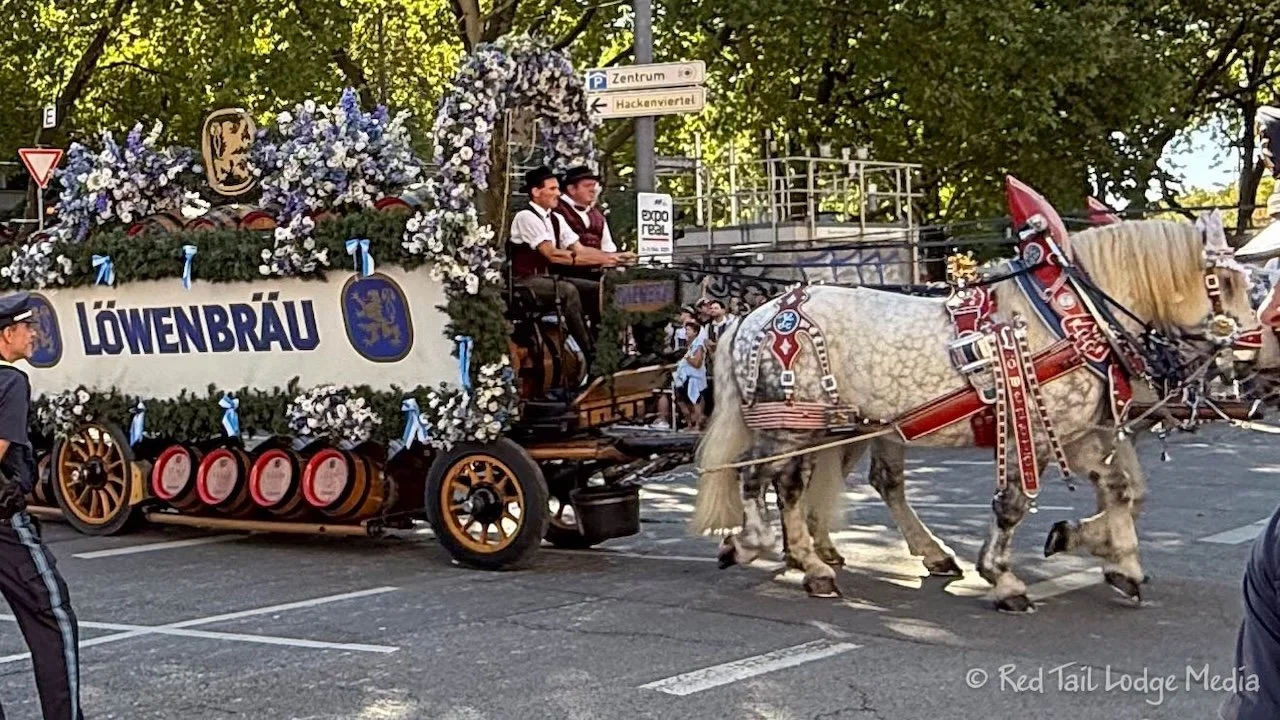
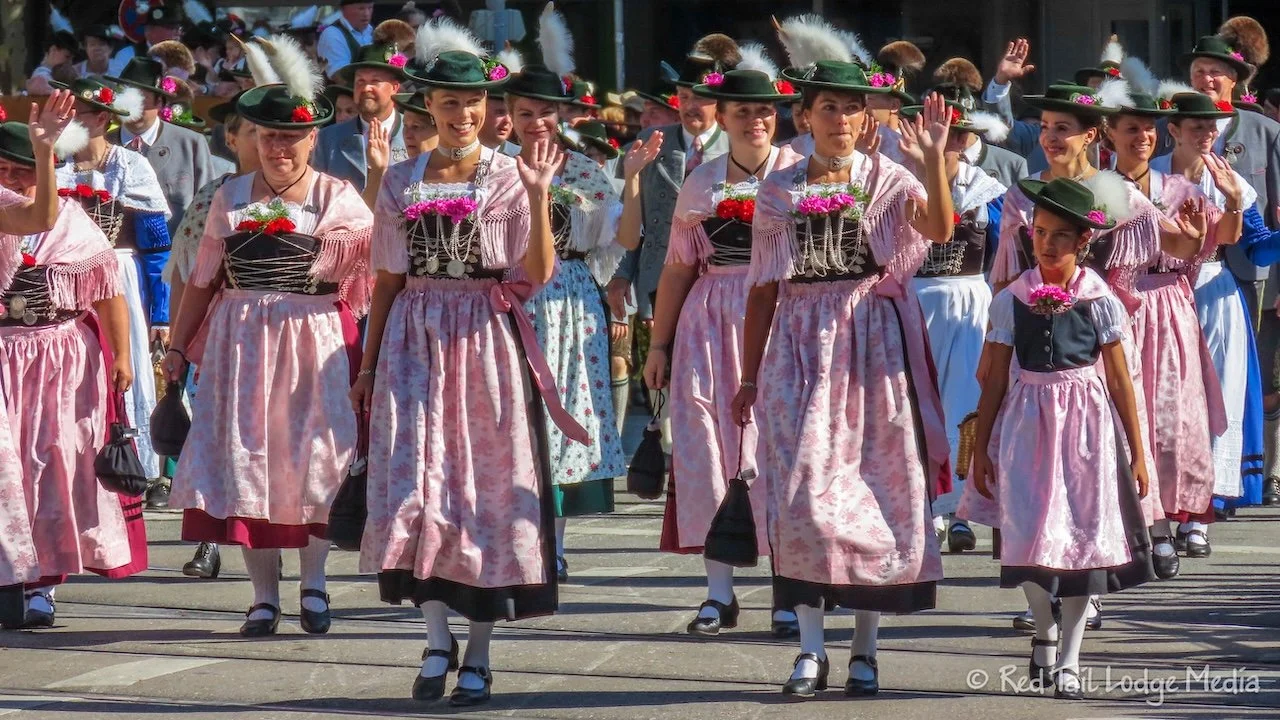
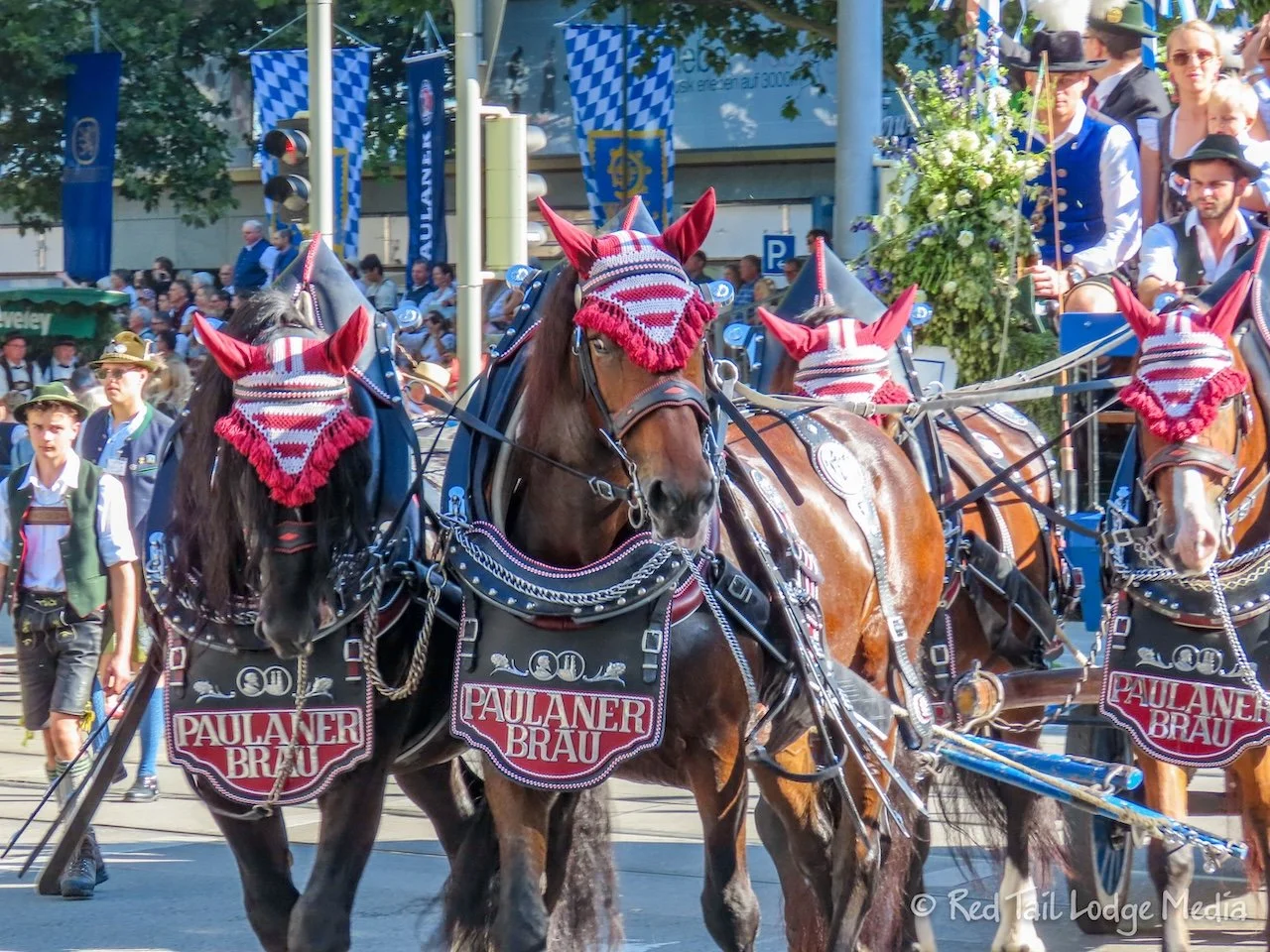
Saturday, we watched the Einzug der Wiesnwirte (Arrival of the tent patrons). It is the first of two parades at the Oktoberfest. This first one consists of all of the beer wagons pulled by large horses associated with each of the tents. In between are marching bands. The wagons and horses are elaborately decorated.
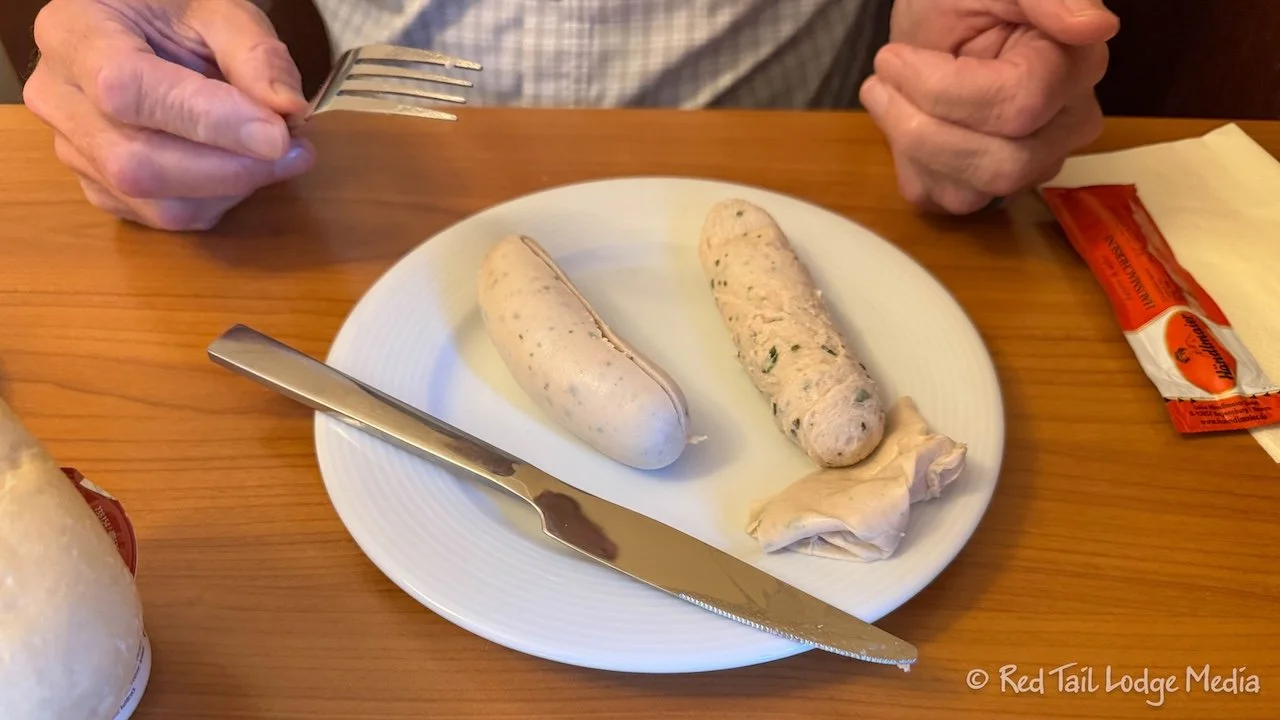
At breakfast before we left the hotel, we ate Weißwurst (white sausage). Weißwurst is a München specialty. We planned on eating it at Augustiner Keller a couple of evenings prior, but Weißwurst is only served for breakfast or lunch. Augustiner Keller stops serving it at 2 pm. Our hotel started offering Weißwurst at breakfast on Friday morning. We’ve had Weißwurst before, but what we didn’t know before was that you are supposed to remove the casing of the sausage before eating it. The staff at our hotel was kind enough to explain that to us. All you do is slit it down the middle and peel it off. Of course we ate the Weißwurst with sweet mustard, as is the custom.
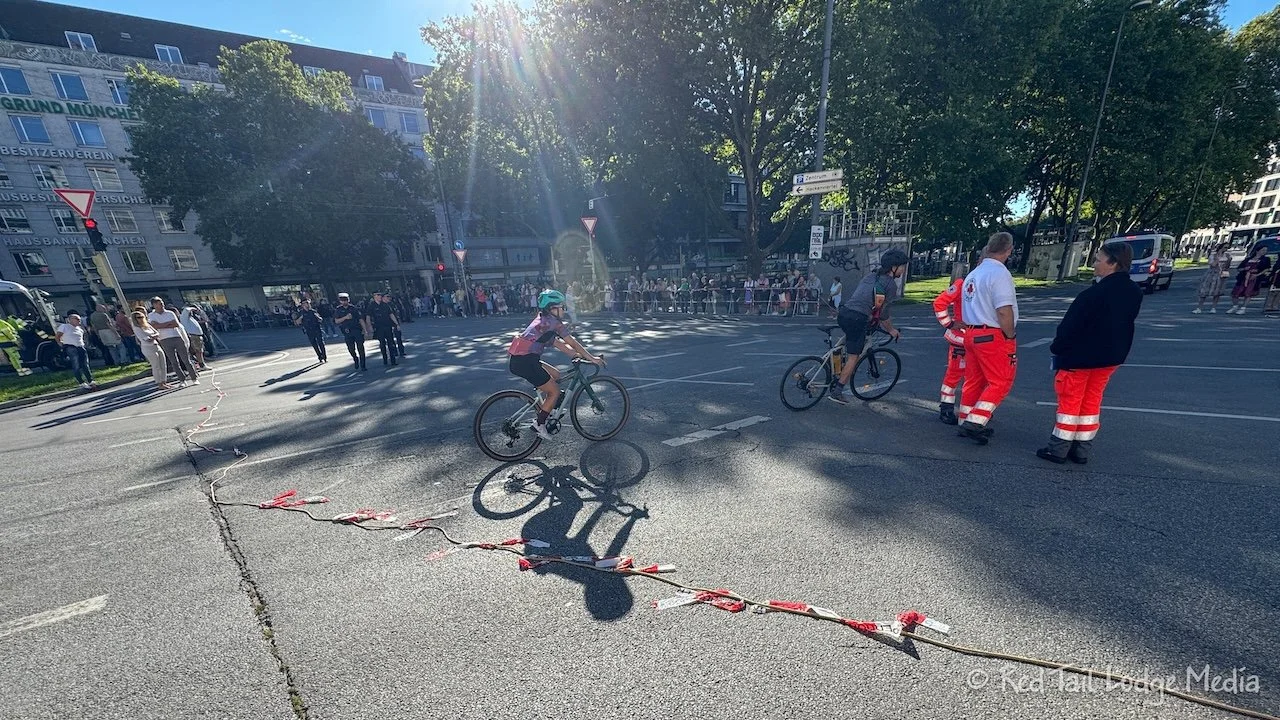
We showed up along the parade route, at the corner of Sonnenstraße and Schwanthalerstraße. We arrived about an hour before the start of the parade and we luckily got a spot in the first row of people up against the road barrier. It was probably still open because it was in the full sun, with the parade coming from the east, so you were looking directly in the sun. We were hoping that the sun would work its way behind a tree top by the time the parade started. Unfortunately, the sun kept rising so that it stayed just along the edge of the tree canopy, but luckily, it was no longer shining directly into our eyes.
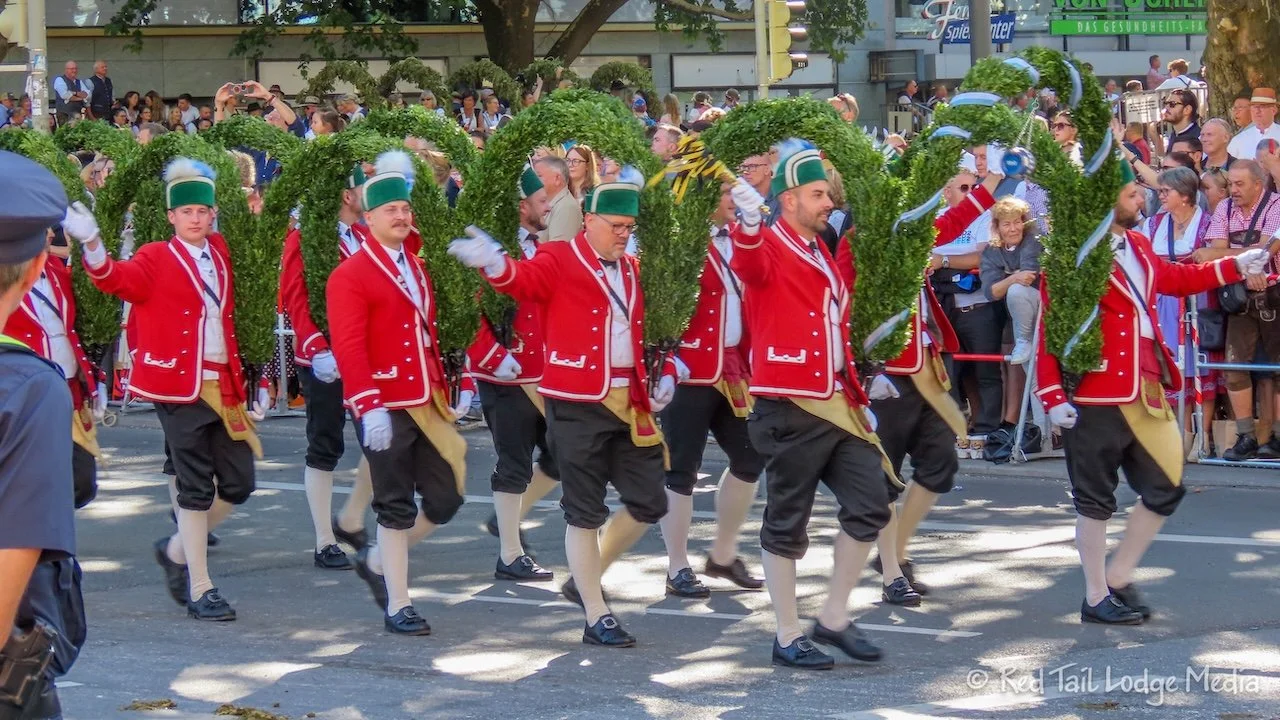
The parade lasted about an hour. It was a wonderful experience, so colorful and festive.
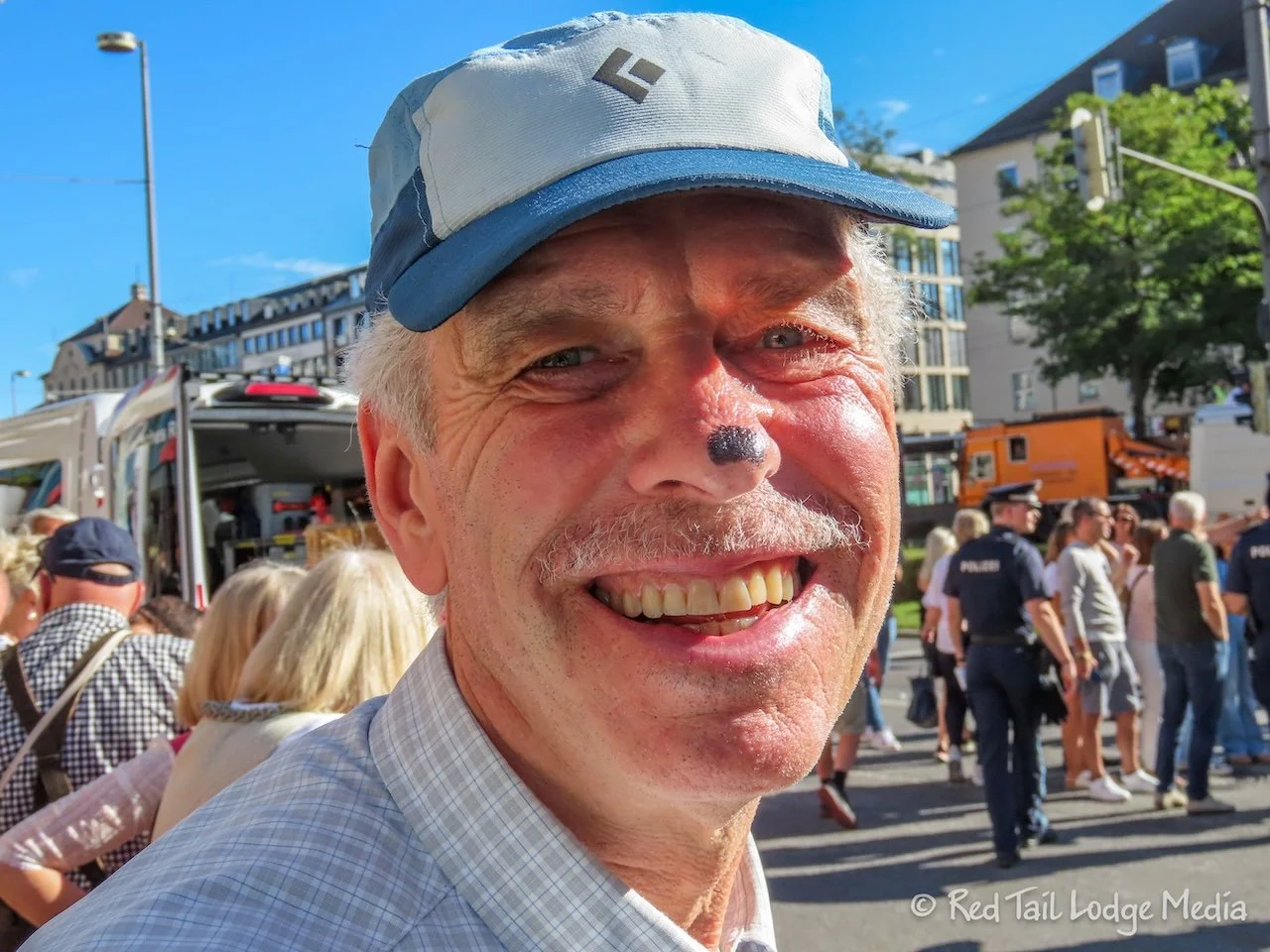
There was a jester or clown going around putting black smudges on the noses of people watching the parade.
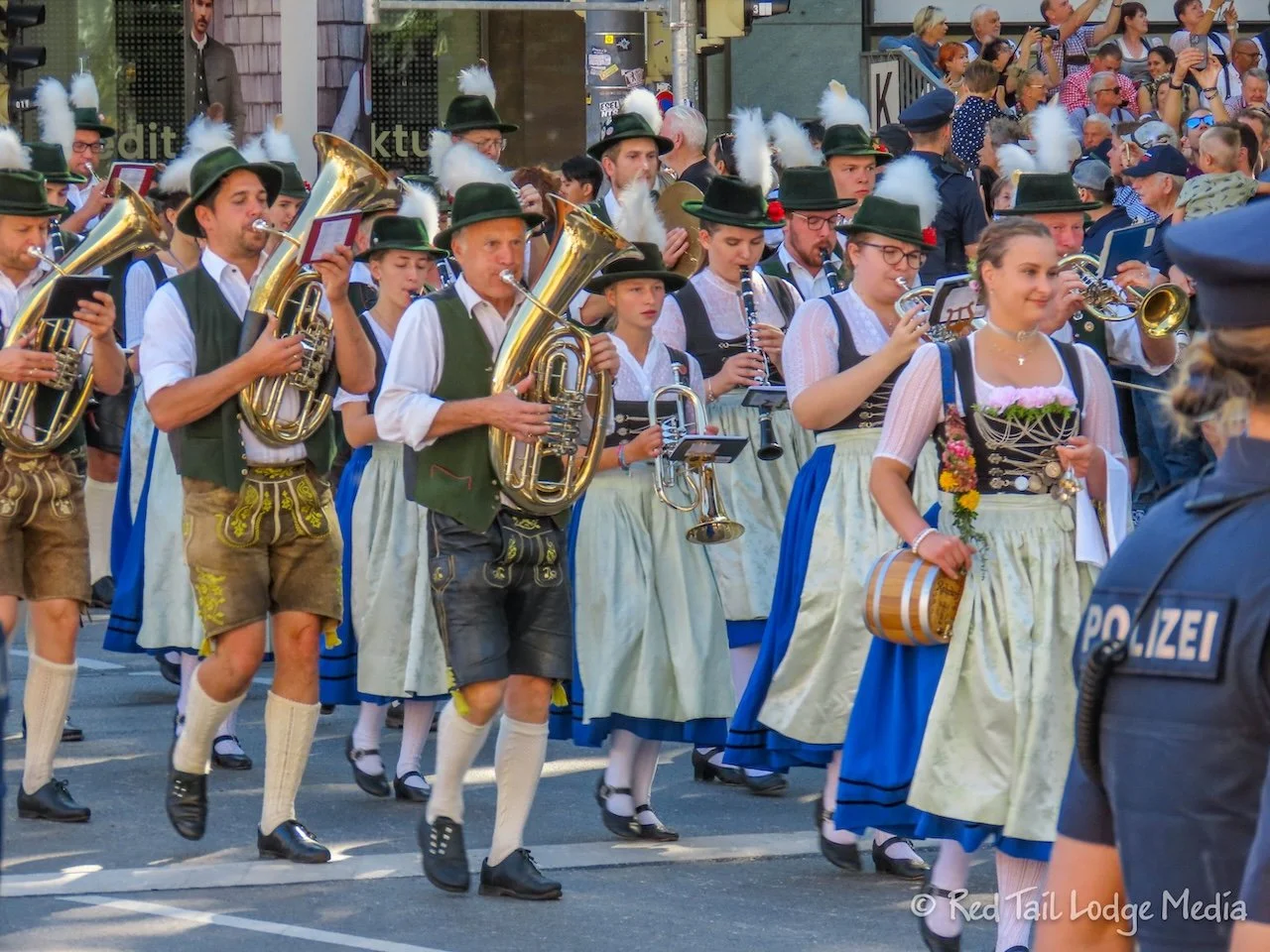
The parade ended in the festival grounds, where the opening ceremonies occurred at noon. The ceremony took place in the Schottenhamel tent, where the Lord Mayor of Munich taps the first barrel. We’ve heard that half of the tent is reserved for the ceremony and the other half fills up by 9 am, three hours before the ceremony begins. We didn’t even try to go over to the festival grounds after the parade.
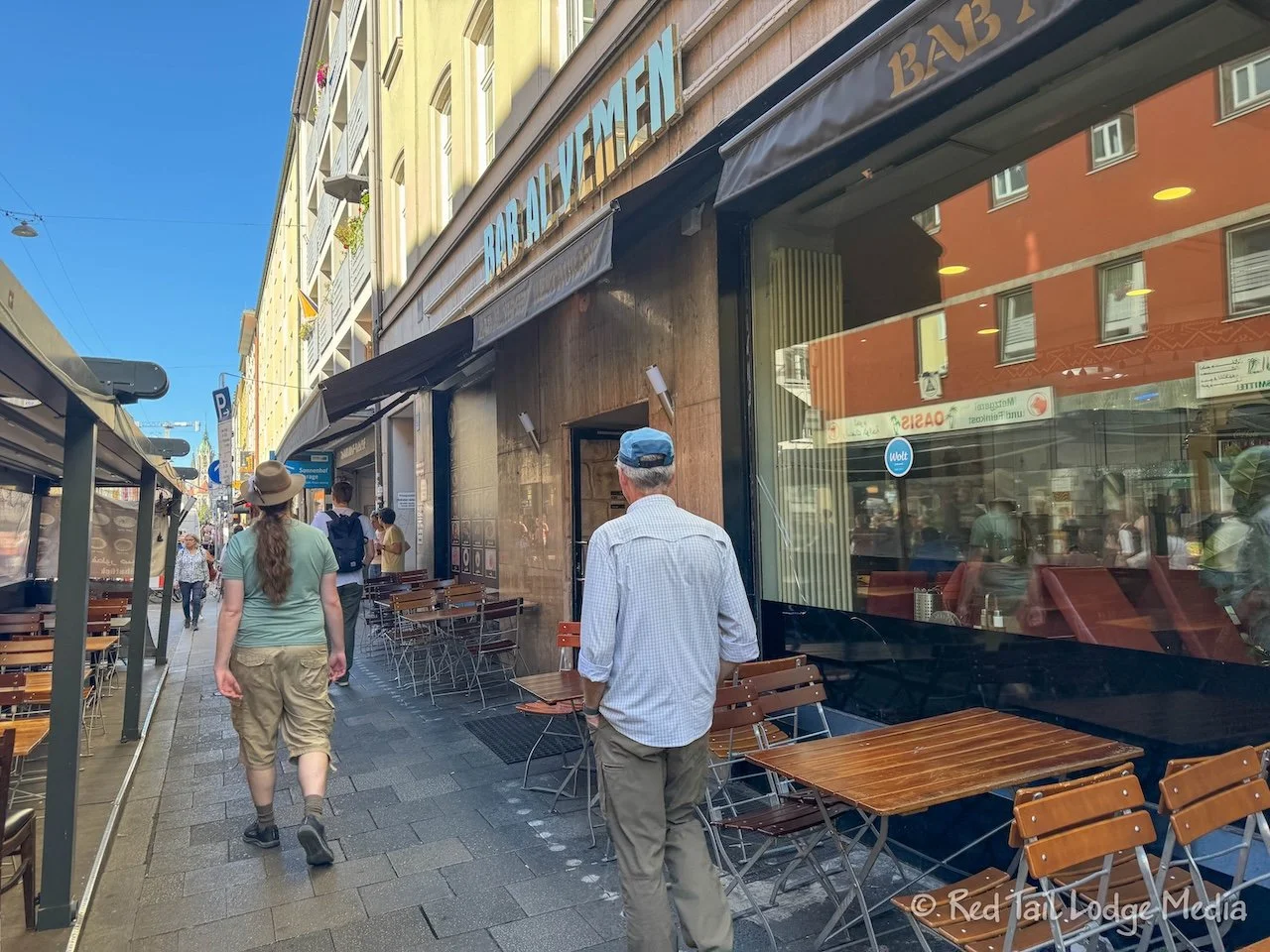
Instead, we made our way over to the restaurant we saw the day before to have lunch. The restaurant was called Bab Al Yemen. We were not familiar with Yemeni food, but luckily, there were pictures of each item along with descriptions, in German, in addition to the names in Arabic.
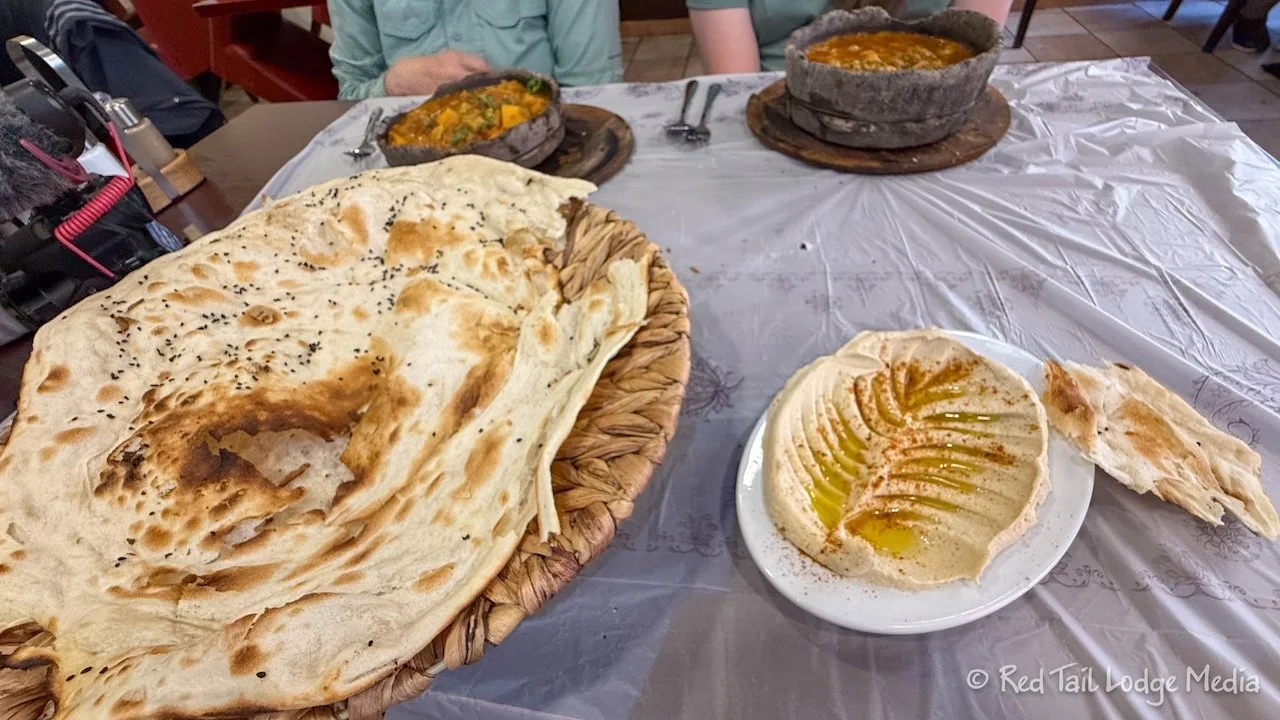
Keith wasn’t very hungry, so he just ordered spicy hummus with bread (Moualwah Brot). The bread was flatbread, baked in a tannur (or tandoor) which is a vase-shaped clay oven. It looked like they seasoned it with black cumin seeds. And the hummus was very spicy.
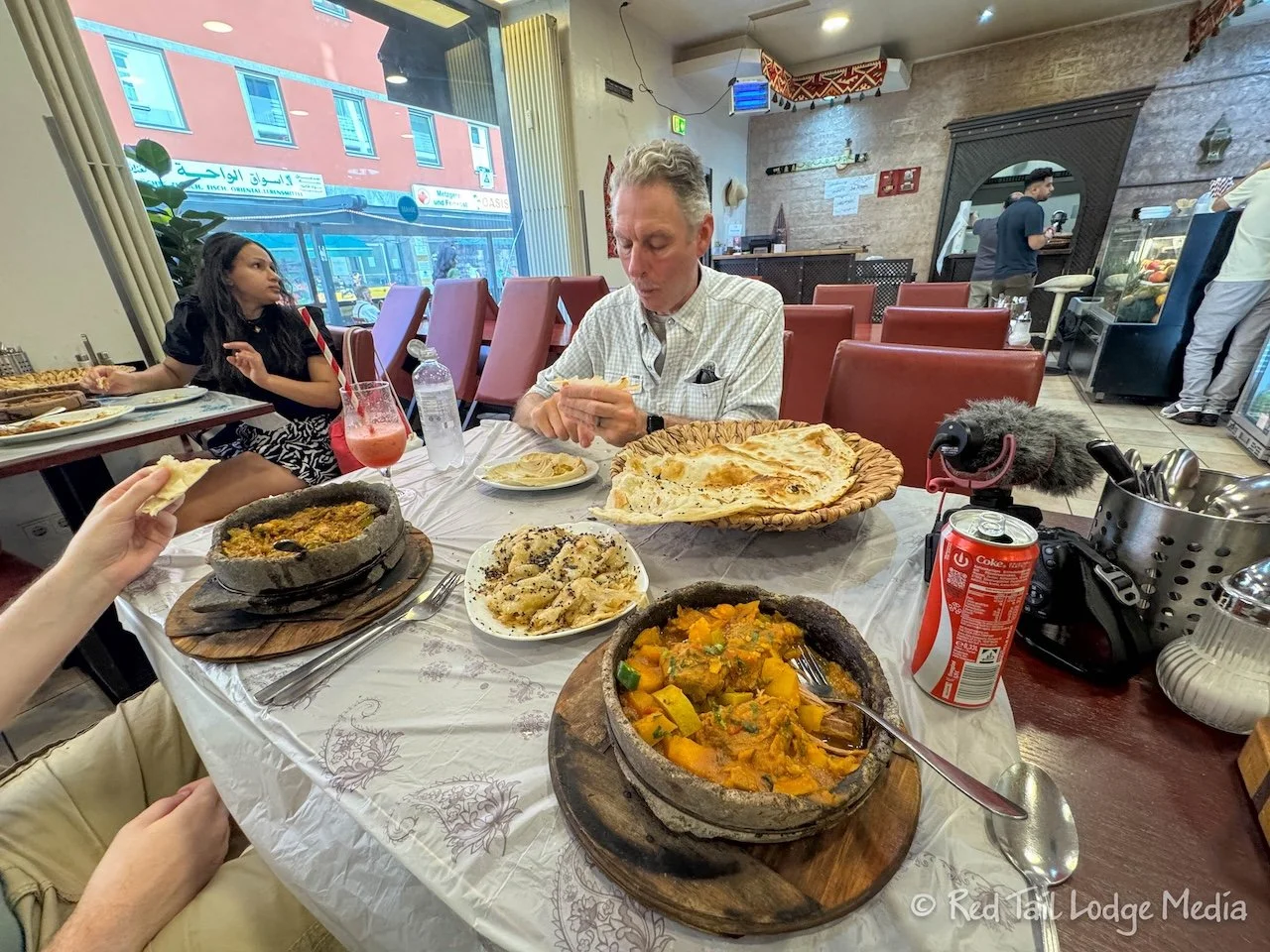
Justin ate the Saltah, which was beef with vegetables and rice. It was also pretty spicy. Ann ordered the Lamm Sanouna, which was lamb cooked in a tomato sauce with spices. It wasn’t as spicy. Both dishes were served in a clay pot and were brought out bubbling hot. We also split a Ratib mit Hönig (ratib bread with honey). The bread was similar to the Moualwah Brot, but cut up and covered with ghee (clarified butter) and honey. It was a tasty ending to our meal.
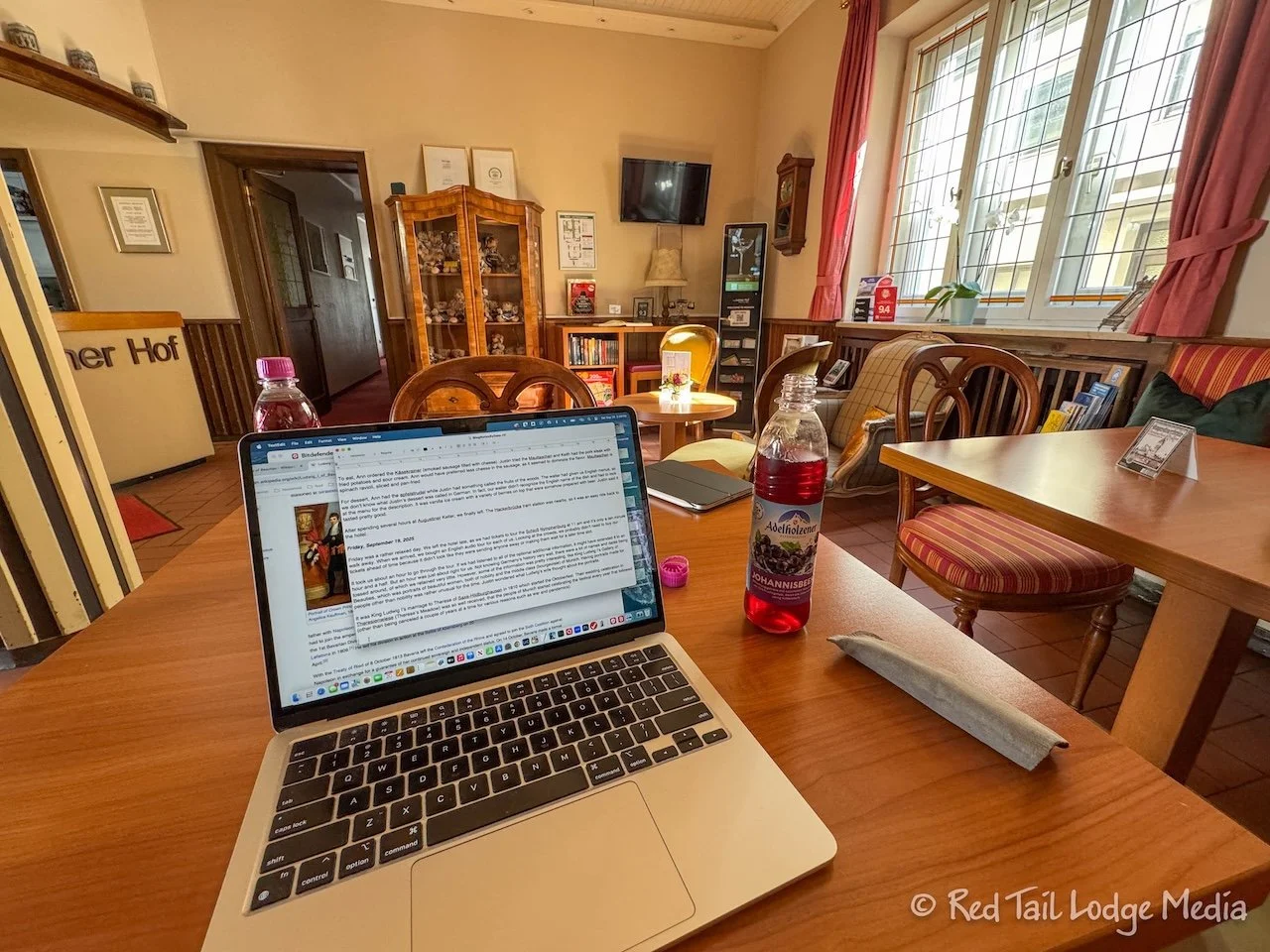
After our wonderful meal, we took the S-Bahn back to our hotel. Justin needed to do some laundry. So Ann and Keith hung out in the lobby while Justin went to the laundromat. Later, Keith went for a walk through the Schloß Nymphemburg grounds.
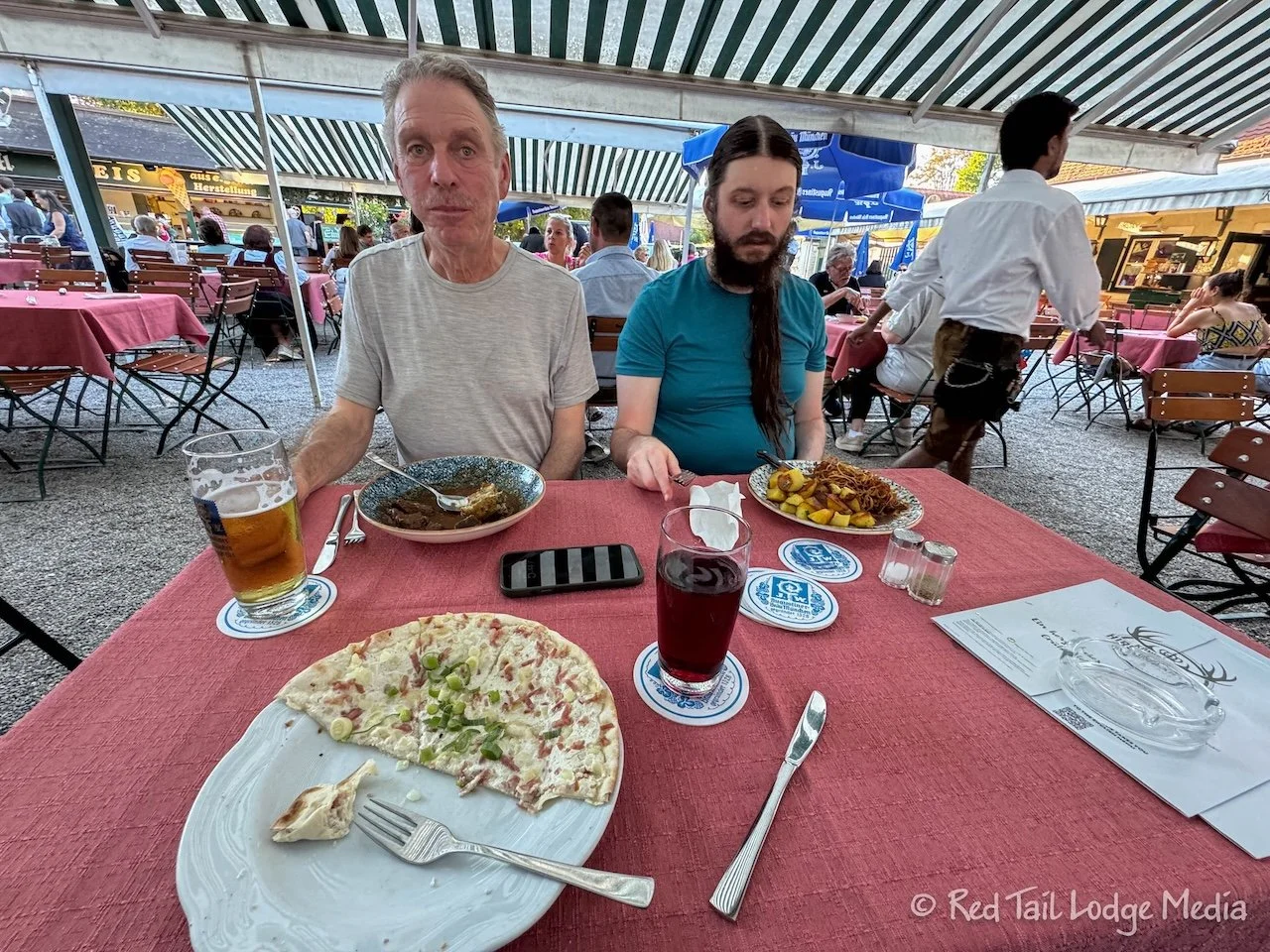
After showers, we walked over to Hirschgarten for dinner. The forecast called for rain for Monday and Tuesday, so we decided to take advantage of the nice weather while it lasted and eat outside. Keith had Gulasch soup with a Knödel, Justin ate Zwiebelrostbraten (beef tenderloin with onions), while Ann tried the Flammkuchen. Flammkuchen is like a pizza or flatbread. This one was topped with crème fraîche, ham, and green onions. Pretty tasty.
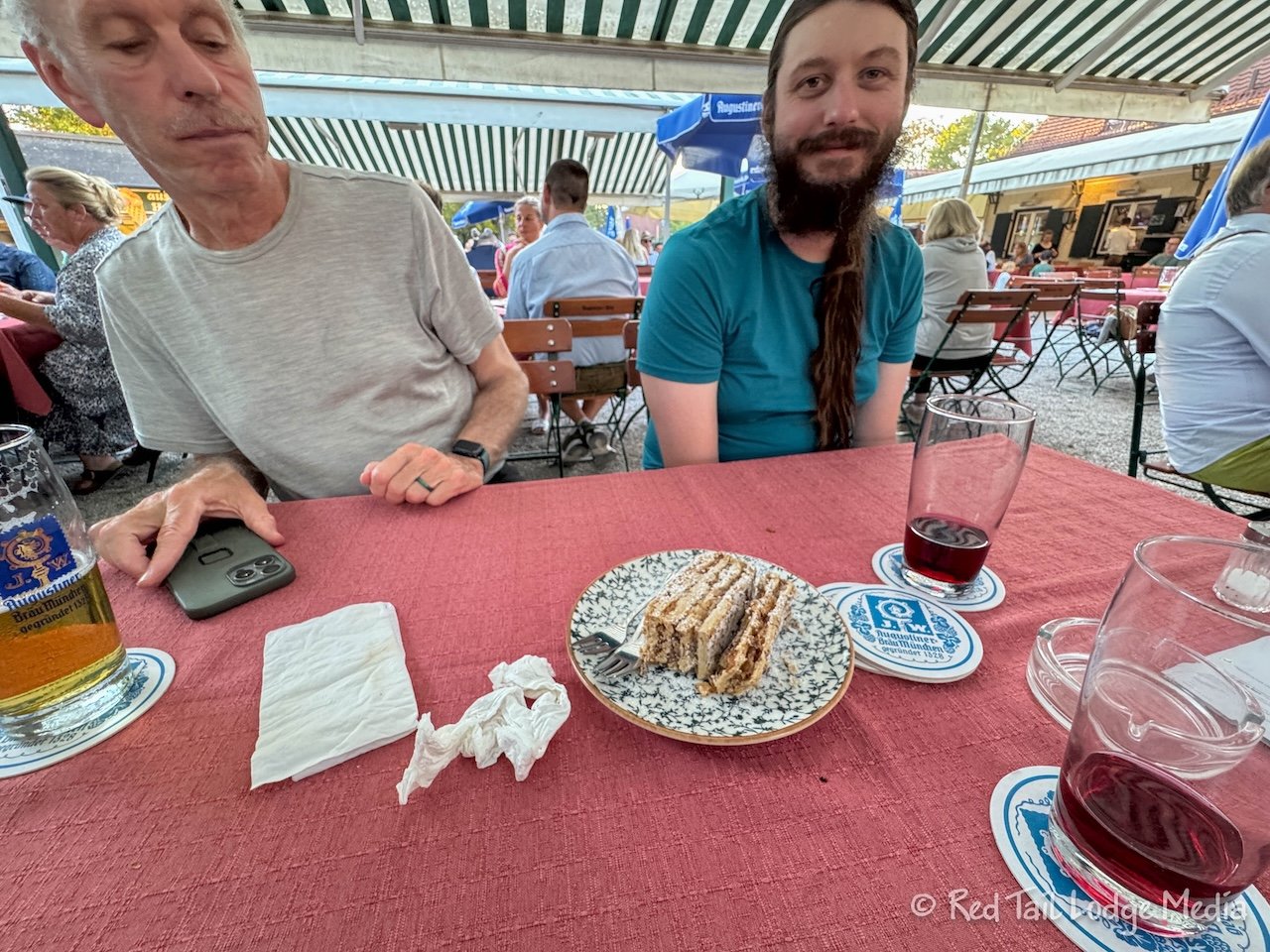
We all split one dessert, a slice of Agnes-Bernhauer Torte. It is a Bavarian almond meringue layer cake filled with coffee buttercream. It was delicious, but also rich. So we were glad we were splitting it.
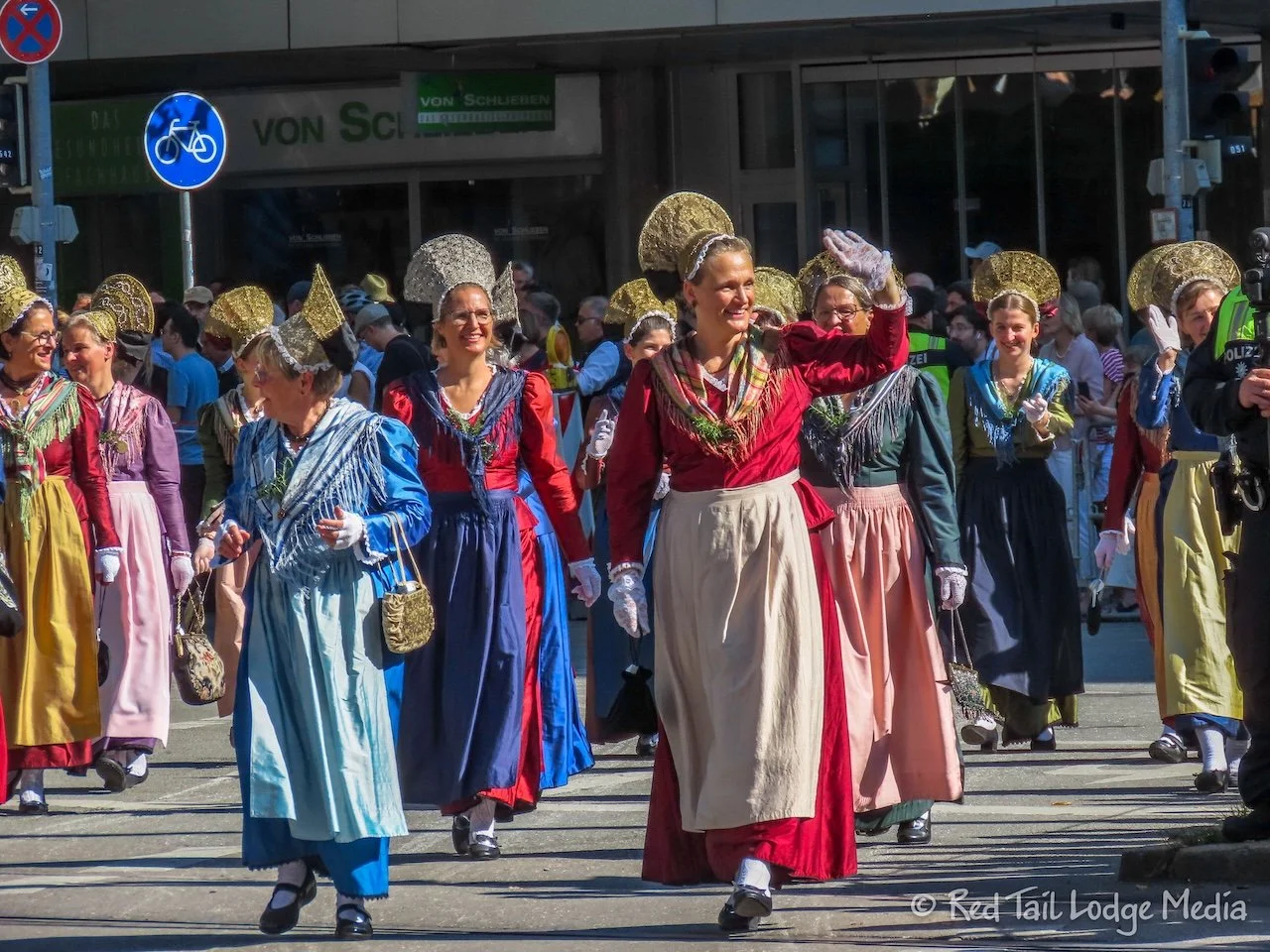
The second parade was on Sunday morning, starting at 10 am. This parade was Trachten und Schützen-zug (traditional costume and hunting club parade). Keith and Justin didn’t feel like going to another parade, especially one that was longer, about two hours long. So Ann went by herself.
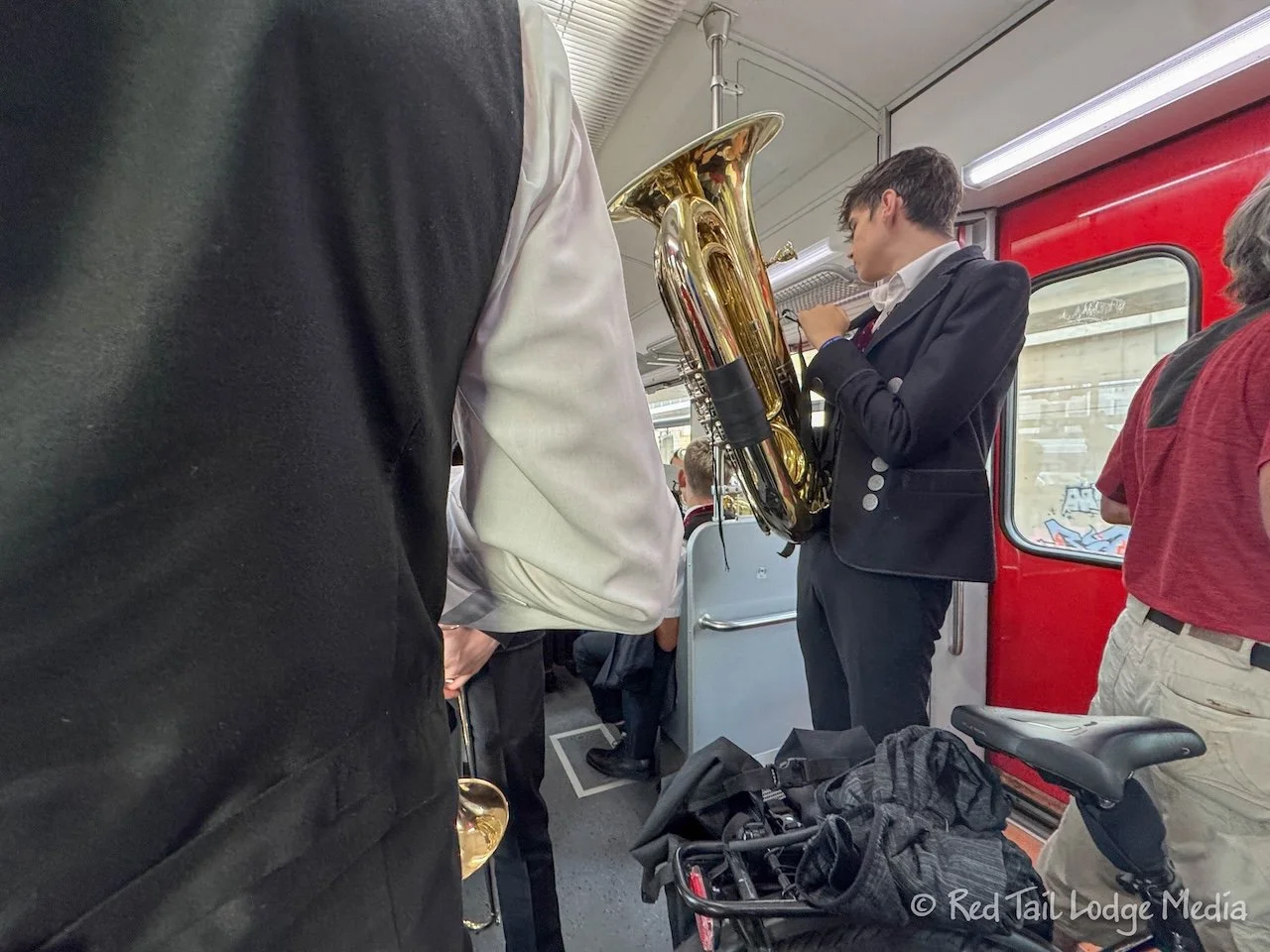
Ann took the S-Bahn to Karlsplatz. The car she got in was full of band members. It was hot and humid, with the windows fogging up. She debated about getting out at the next stop and switching train cars. But then the band started playing. OK, the music was worth all the sweating.
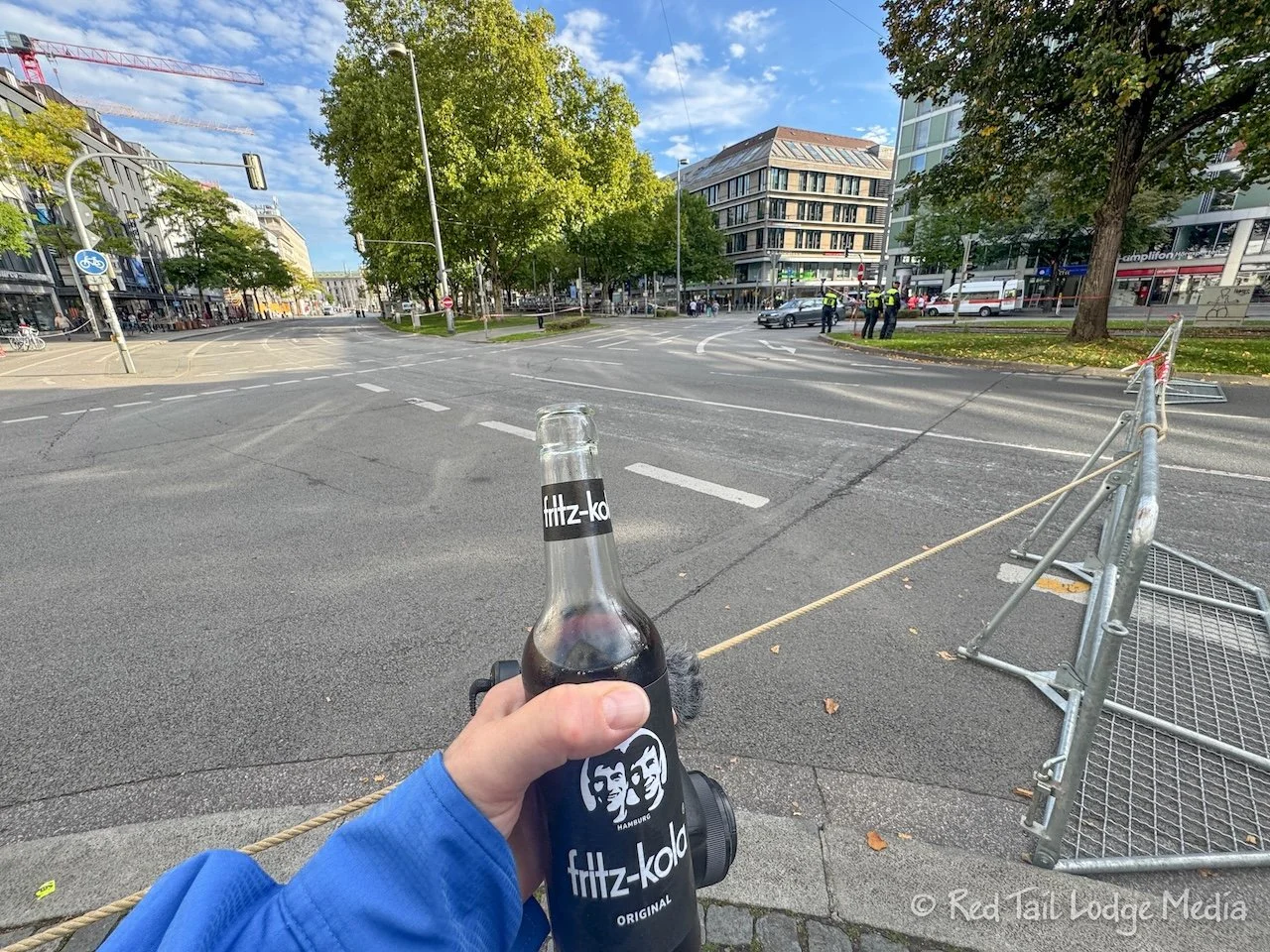
Ann found a spot just a block away from where we watched the first parade. The parade route was a little different from the first parade. It was longer. Ann arrived about 9 am and was surprised to see that no one else was lining up for the parade yet. She was able to get a prime spot, in the shade this time, right where the parade made a turn. Ann popped into a nearby hotel and restaurant to buy a cola to drink while she waited. It wasn’t long before others started showing up.
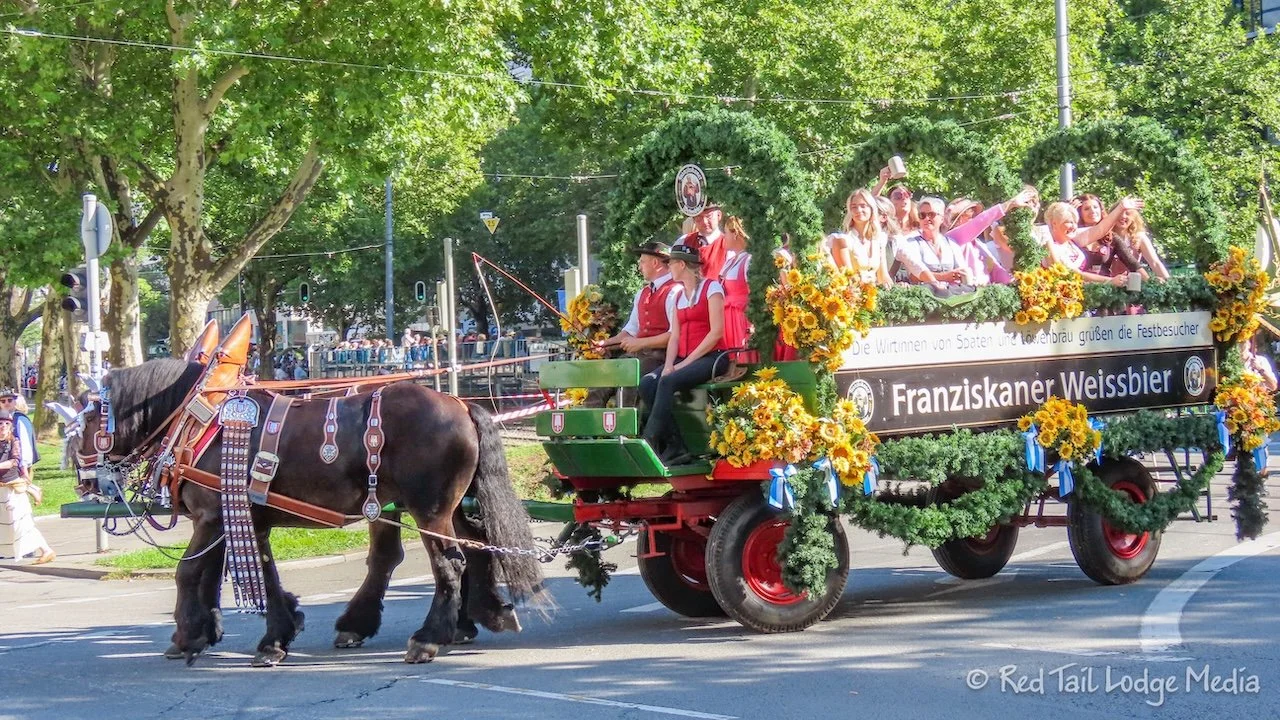
It seemed like it was easier to find good spots along the route for the second parade than the first. That was probably due to several factors. First, the first one was shorter, both in route length and in time duration. Another reason might have been that the beer tents didn’t open up until after the first parade and they were already open Sunday morning. Maybe yet another reason might have been that people were out late the night before at Oktoberfest and didn’t want to get up early.
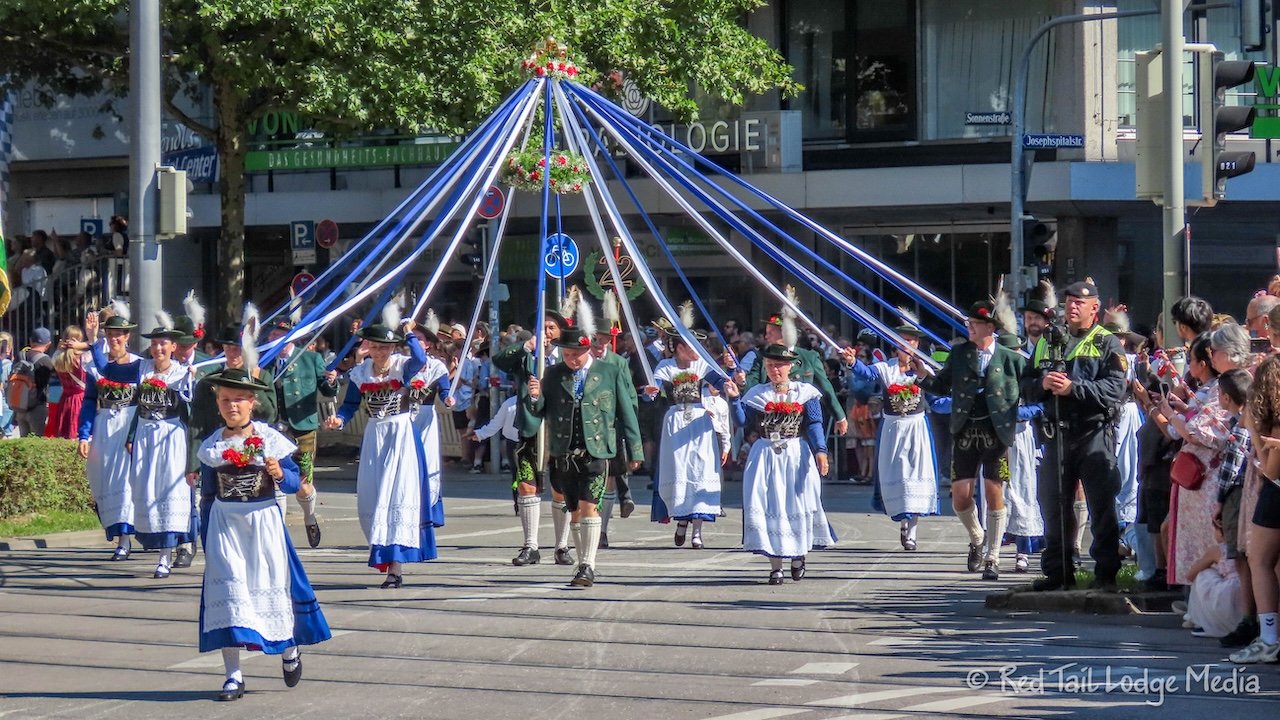
Ann enjoyed the parade. It seemed more family friendly than the day before. People in the parade were passing out treats for the kids, such as pretzels and heart-shaped lebkuchen cookies. There are around 9000 participants in the parade, in 60 groups. Besides the clubs with traditional costumes and hunting weapons, such as cross-bows and rifles, there were marching bands and beer wagons from the major breweries. The jester that we saw the day before was also there again. Again, the parade was colorful and festive. All of the different costumes, including some in knights’ armor, was very interesting to see.
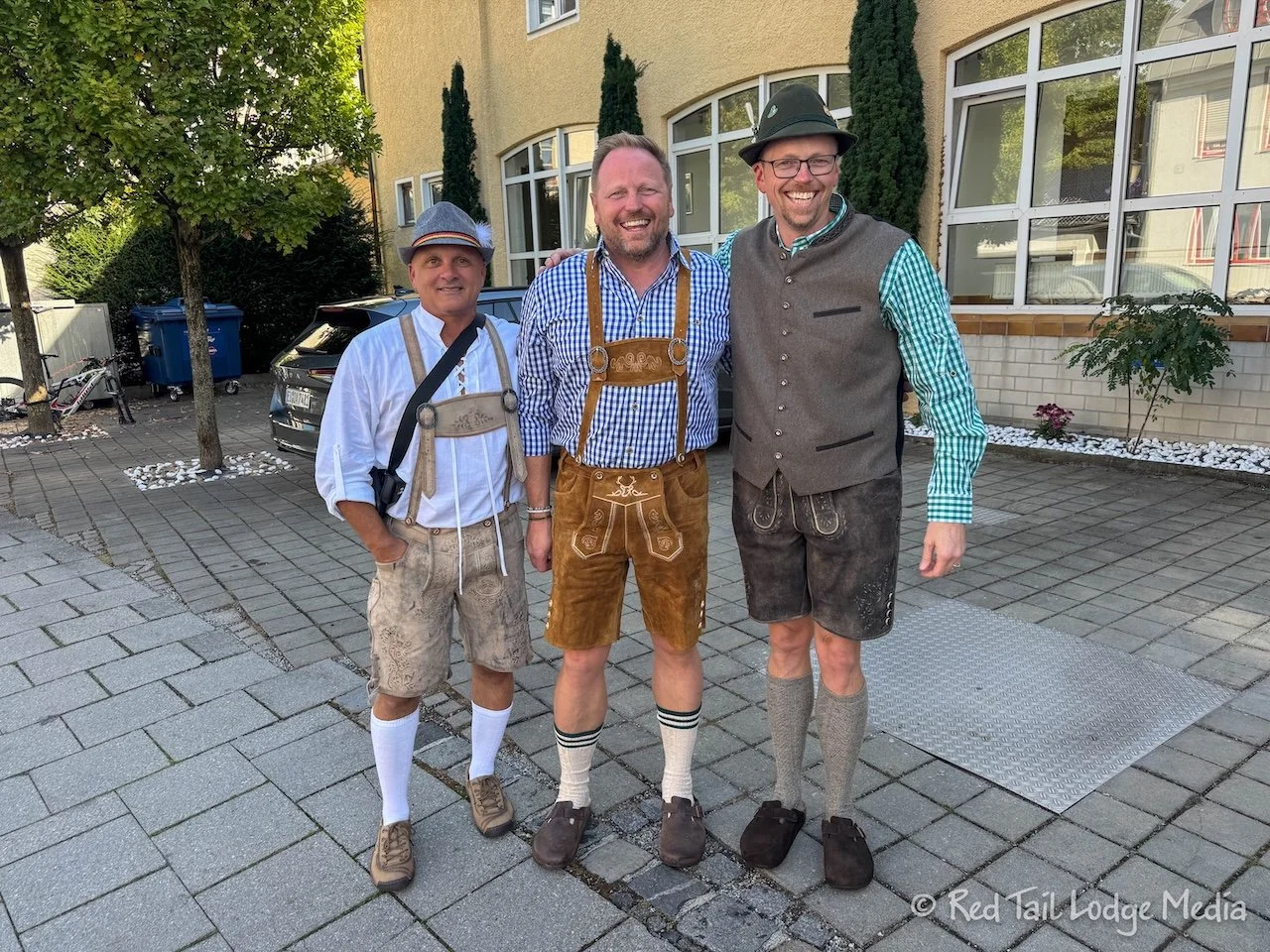
Jeff, Brad, and Kevin were arriving from the United States that morning to meet up with us. Ann got a text from Keith that they had arrived, so she left the parade around noon, after only about half of the sixty groups of the parade had gone by, so she could meet everyone back at the Hirschgarten beer garden for lunch. She got off the S-Bahn at the Hirschgarten stop, but it was still about a 15 minute walk from there to the beer garden.
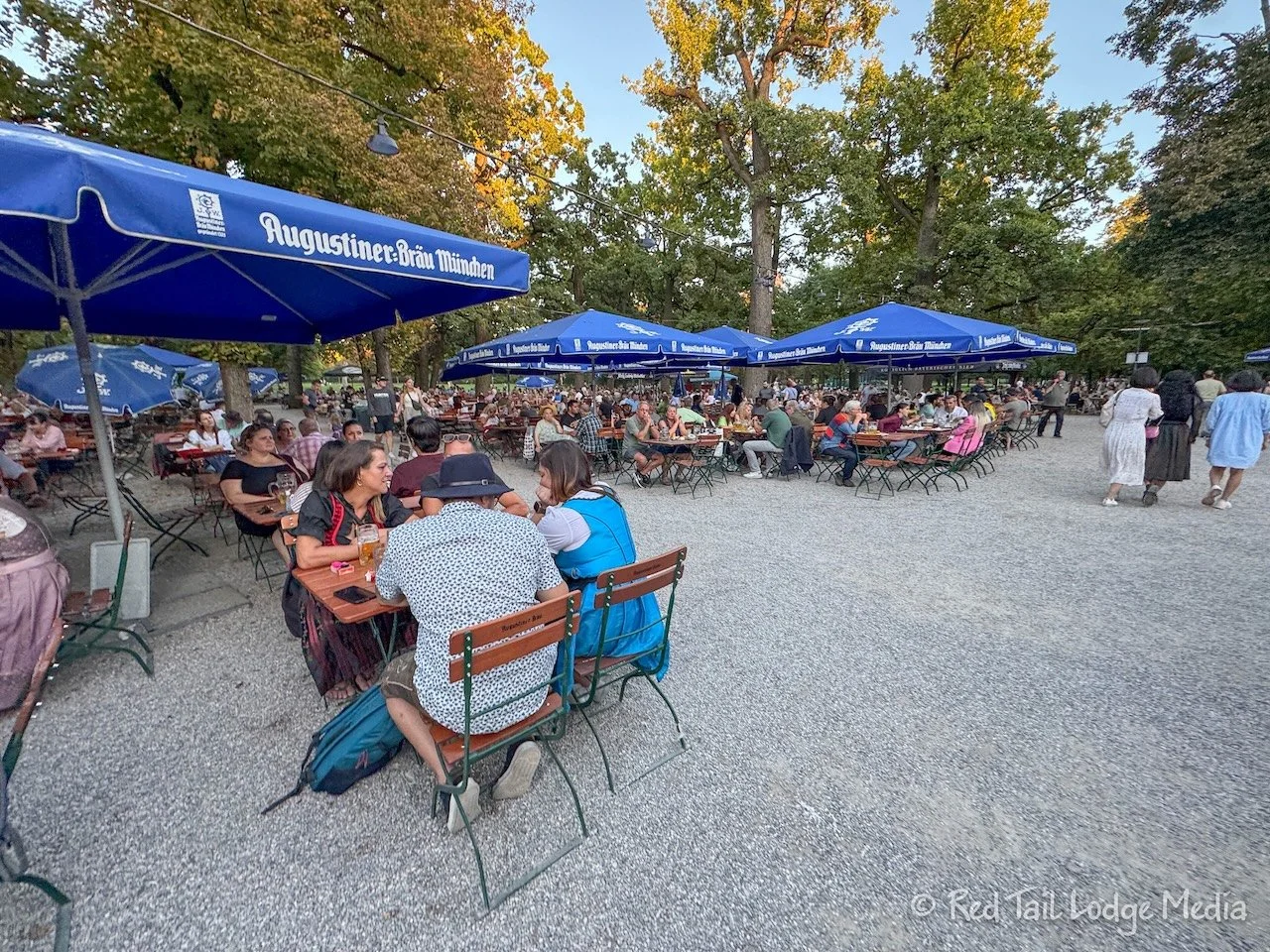
There was a band playing at the beer garden, just like the evening before. We’ve been to the beer garden before when there was no band. Perhaps there is only one there on the weekends, or just during special times of the year, like Oktoberfest.
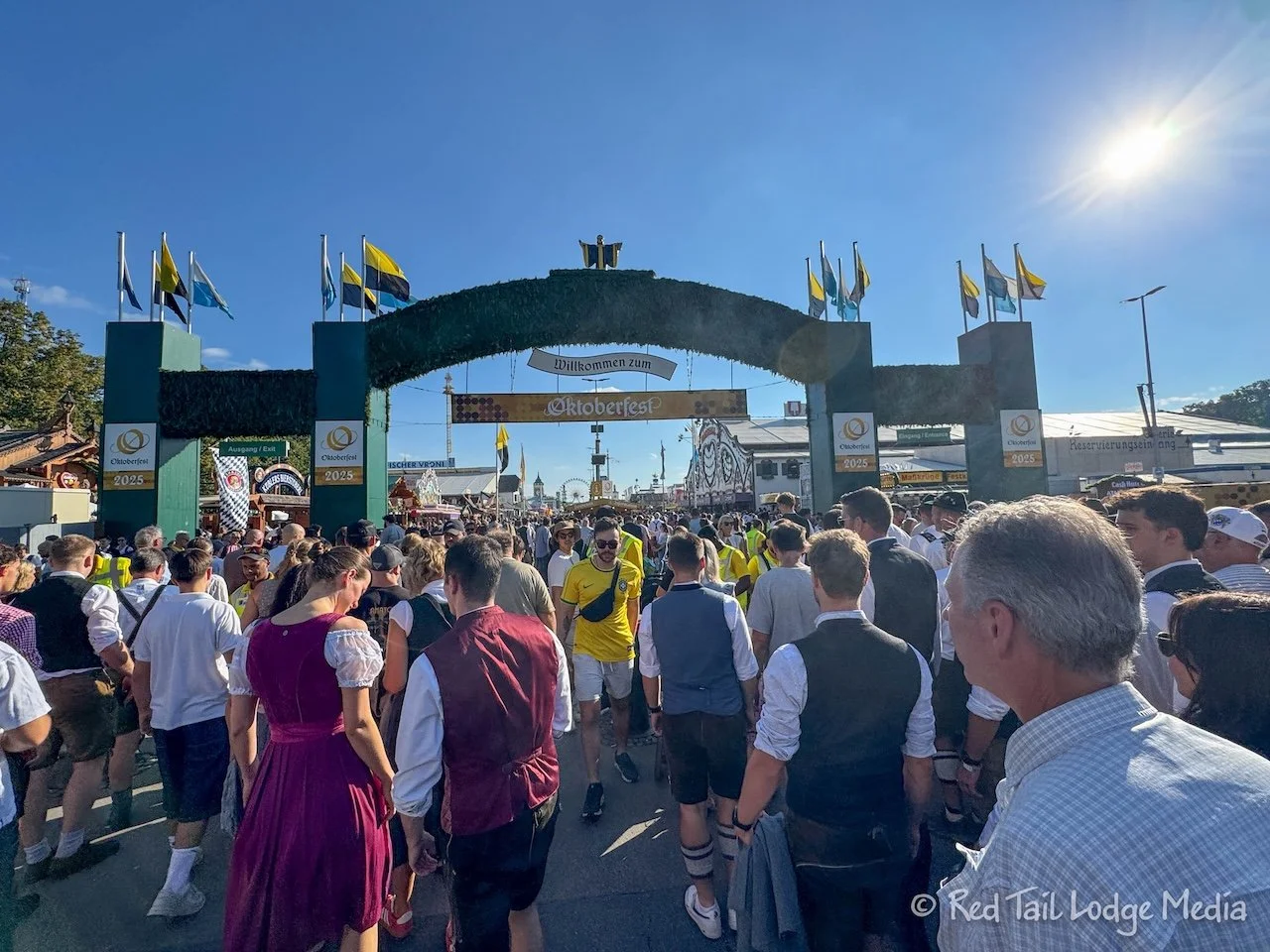
After enjoying our lunch and catching up on each others’ lives, we headed back to the hotel so the others could check in and take showers. Then we were off to the Oktoberfest. We had a table reserved from 6 pm to 10:30 pm in the Boandlkramerei Zelt, a tent in the Oide Wiesn (Old Meadow) area. We thought we left the hotel in plenty of time to get to the tent in time, but due to all of the crowds of people, we arrived just in time. Apparently, they will give away a reserved table if you don’t show up in the first fifteen minutes. We left the hotel around 3:40 pm and reached our tent almost exactly at 5 pm. It was about a 15 minute walk to the S-Bahn station, only about a 5 to 10 minute ride to the Hackerbrucke station, then the rest of the time was spent walking from the station over to the festival grounds and through the crowds of the grounds to reach our tent. About five to ten minutes of that was spent just trying to leave the S-Bahn station, as the crowds of people were funneling through one set of stairs up to the road.
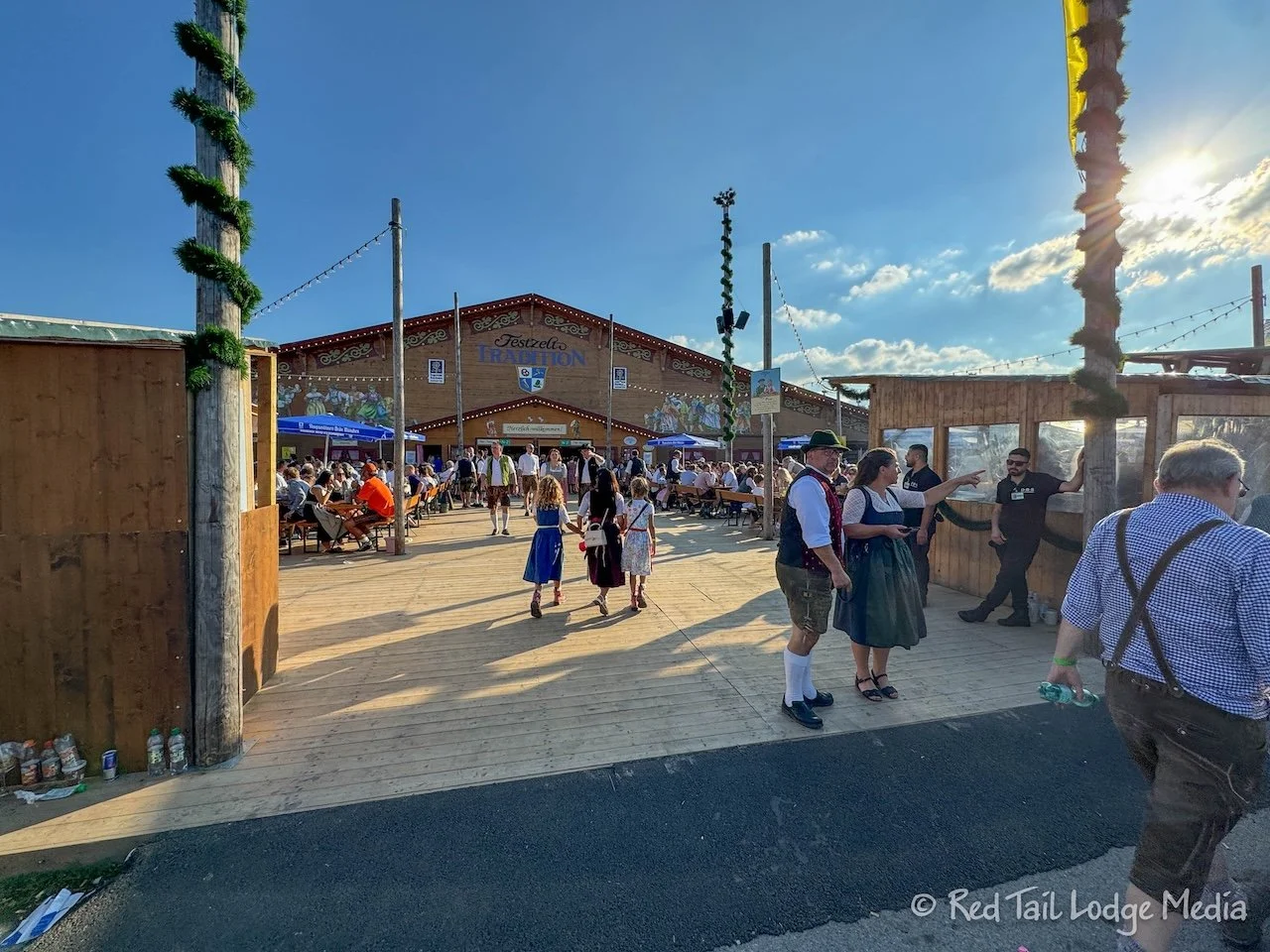
The Oide Wiesn is a small corner of the festival meant to be a little quieter, with smaller beer tents, and more traditional. Although most of the festival grounds are free to enter, there was a small fee to enter the Oide Wiesen. Brad, who had arranged all of our table reservations for us, had arranged for wrist bands to get us into Oide Wiesen.
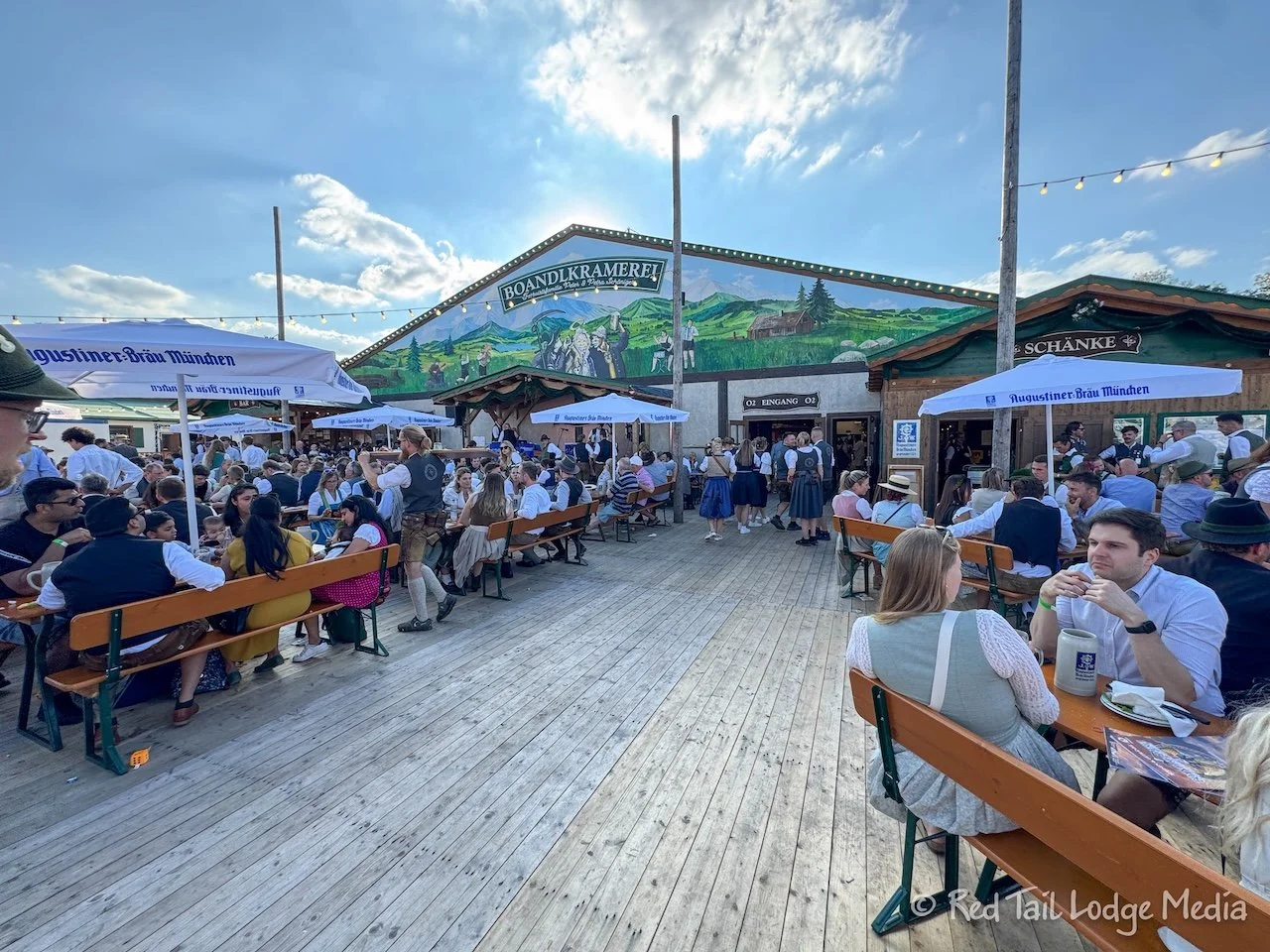
Four friends of Jeff’s met us at the entrance to Oide Wiesn to join us at our reserved table for ten people. The reserved area for our tent never did fill up, so we probably could have gotten a table without a reservation.
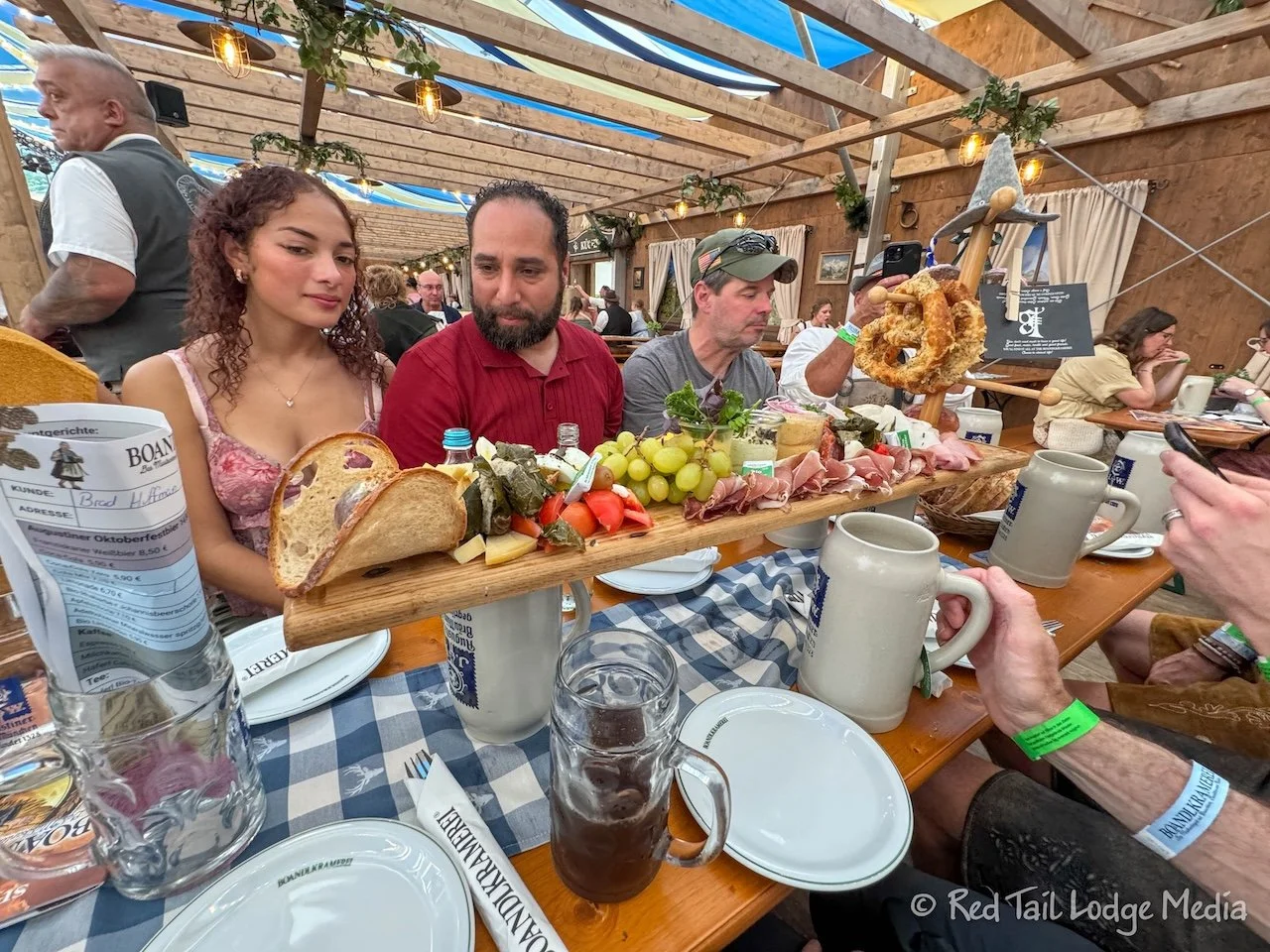
Part of our table reservation included a three course meal in addition to a couple liters of beer per person. The first course was a large charcuterie board (Vorspeise). For the main course, we had several choices such as half a chicken or wurst with potato salad and sauerkraut. For dessert, they brought out a large pan of Kaiserschmarrn (cut up fried pancakes) with raisins and apple sauce. All of the food was pretty good. Keith enjoyed his half chicken, as that is what he remembers eating at the festivals when we lived in Germany 35 years ago. The chicken was nicely cooked, moist and falling off the bone, with a salty, crispy skin.
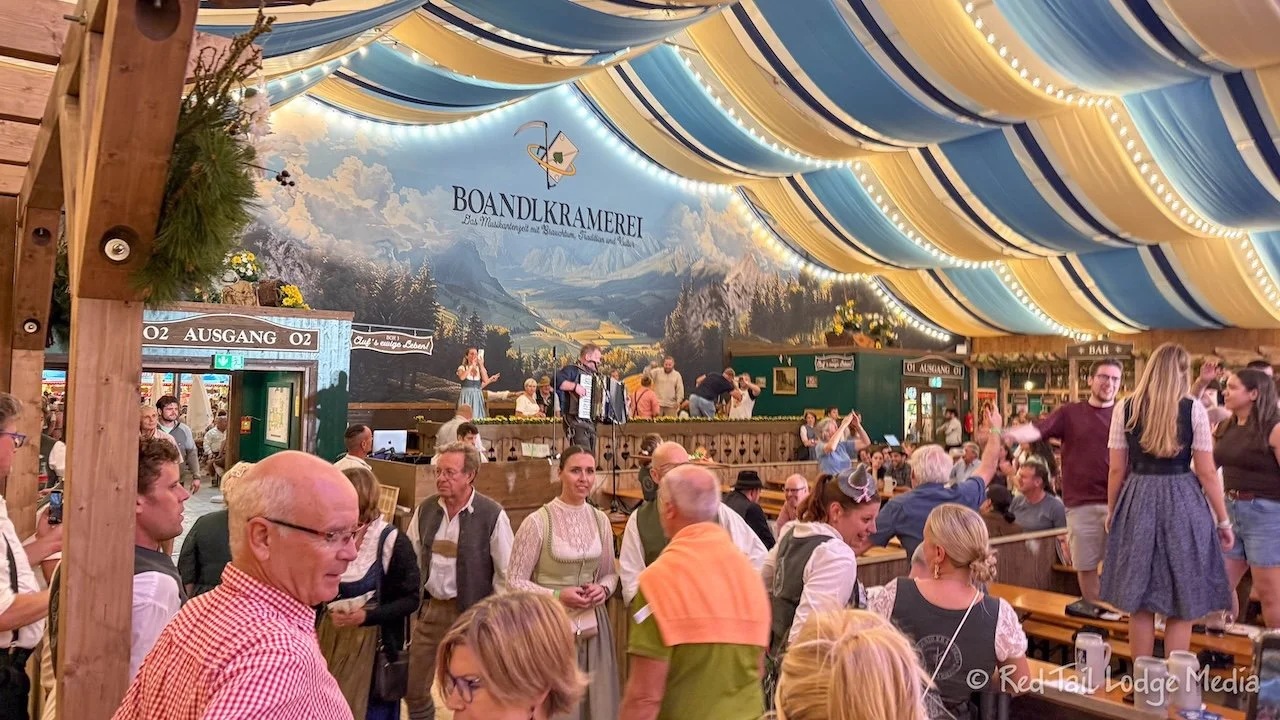
There were several different bands while we were there. An accordion player started picking up the pace and tempo around 8 pm. The band after that had a very talented tuba player who also played trombone. People were standing on the bench seats (standing on the tops of the tables is not allowed), clapping their hands to the strong beat and singing along with the songs that they knew.
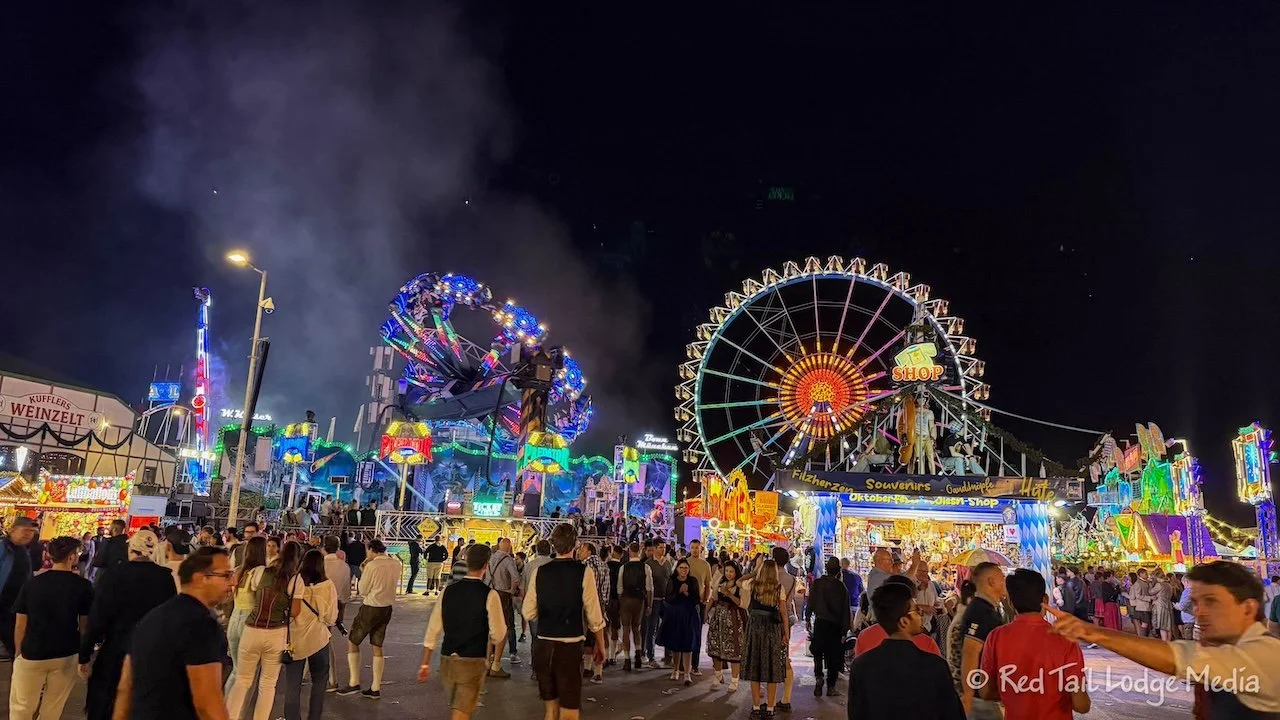
It was dark when we left, but all of the carnival rides, beer tent signs, and booth signs lit up the festival grounds. The crowds down the main street of the festival were not quite as dense as when we arrived. However, we had no problems finding our way back to the Hackerbrucke S-Bahn station, as we just followed the flow of the crowd, making sure we followed the crowd heading to Hackerbrucke instead of the branch that went over to the Hauptbahnhof station.
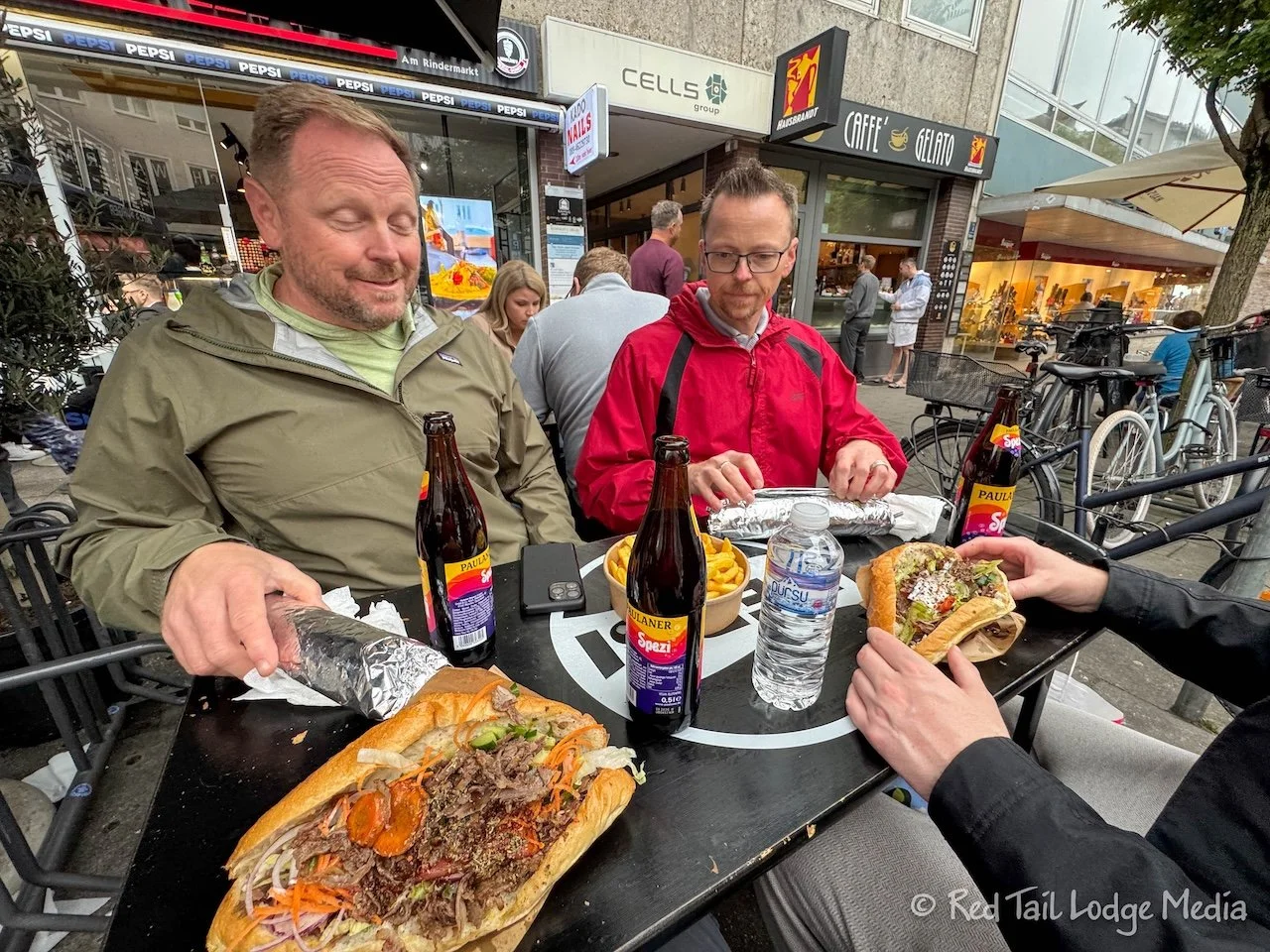
Monday was another day at the Oktoberfest. However, in the morning, we went to the old town, so Kevin could see some of Munich and the others could do some souvenir shopping. We took the Tram to Karlsplatz then walked over to Marienplatz to watch the Glockenspiel play at noon. Then we caught a quick bite to eat at Sendling’s Spezial Döner. This one had calf meat in addition to chicken meat for their döner kebabs and dürhüms.
We returned to the hotel so Jeff, Brad, and Kevin could change into their lederhosen for the festival. When we reached the S-Bahn station, the trains were stopped. It took us a few minutes to find out that there was a medical emergency a couple of stops away, so the trains were temporarily shutdown. There was no indication of how long that would take, so we left the station and contemplated our options. We looked for a taxi stand and looked at ordering an Uber. Then we saw that there was an U-Bahn station at Laimerplatz, about a 20 minute walk south from the S-Bahn station in Laim. The 20 minute walk didn’t cost us much time, as the U-Bahn went directly to Theresienwiese, saving us the 20 minute walk from the Hackerbrucke station.
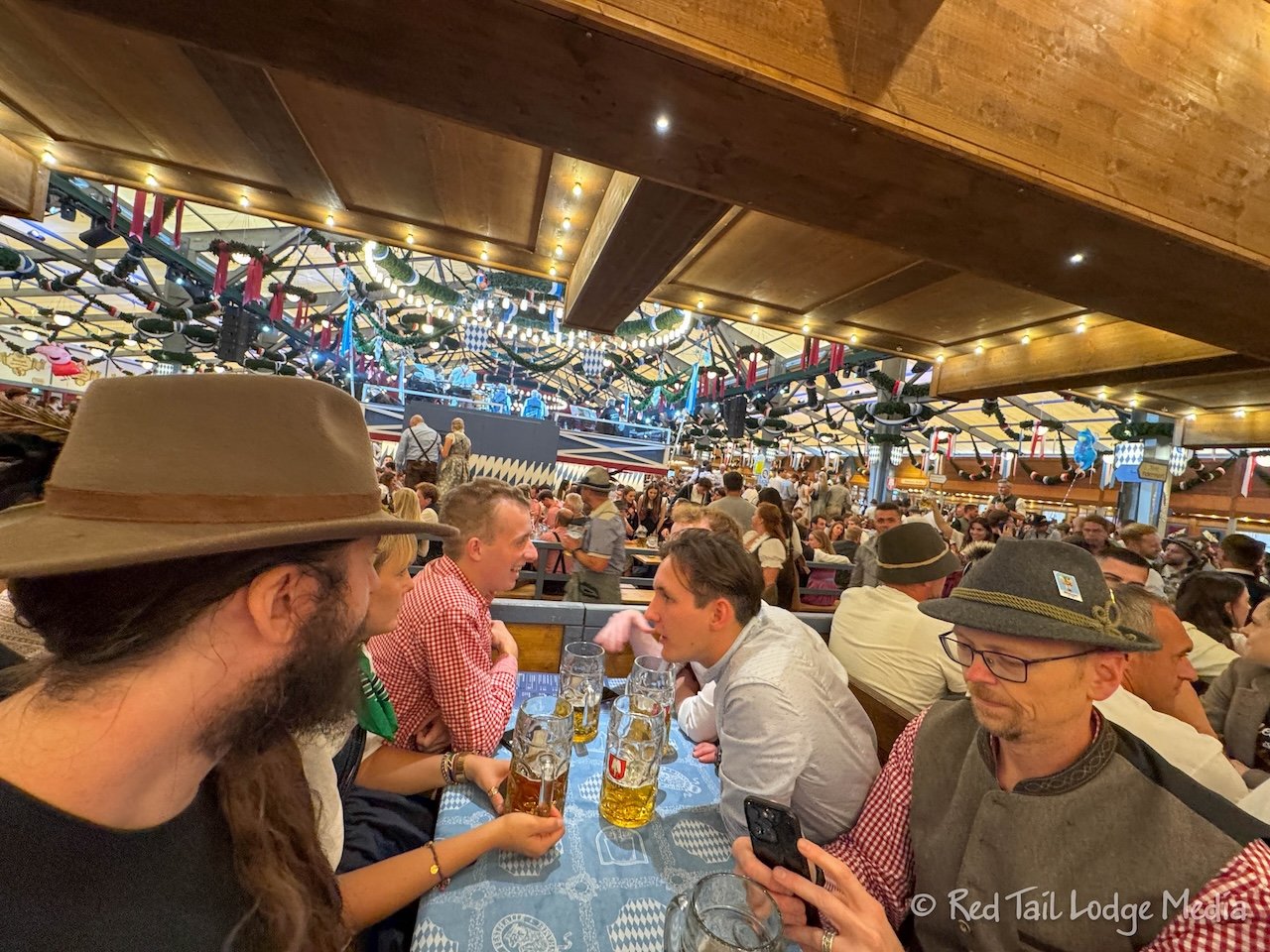
Again, we had a table reservation, from 3:15 pm to 6:15 pm, this time at the Schottenhamel Zelt, one of the large tents in the main Oktoberfest instead of in the Oide Wiesn. Luckily, Brad had four friends from Austria who were completing our table of ten, so they were able to secure our table, as we were a little late arriving.
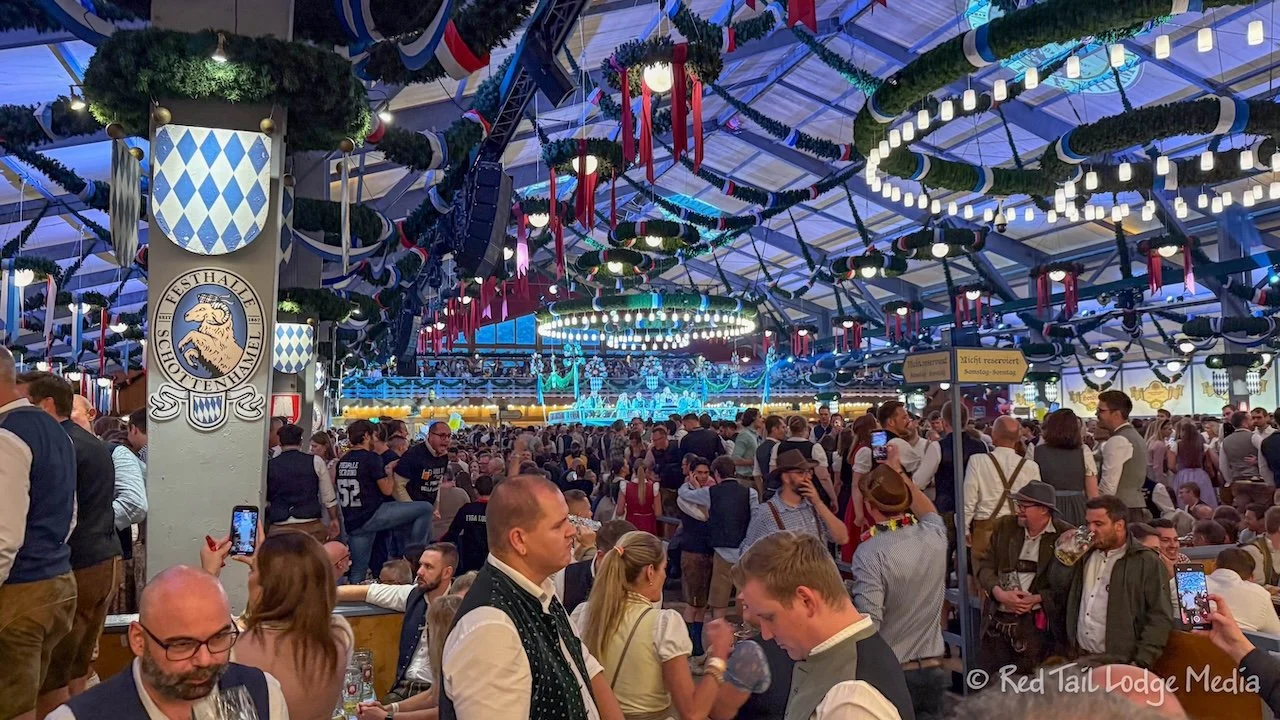
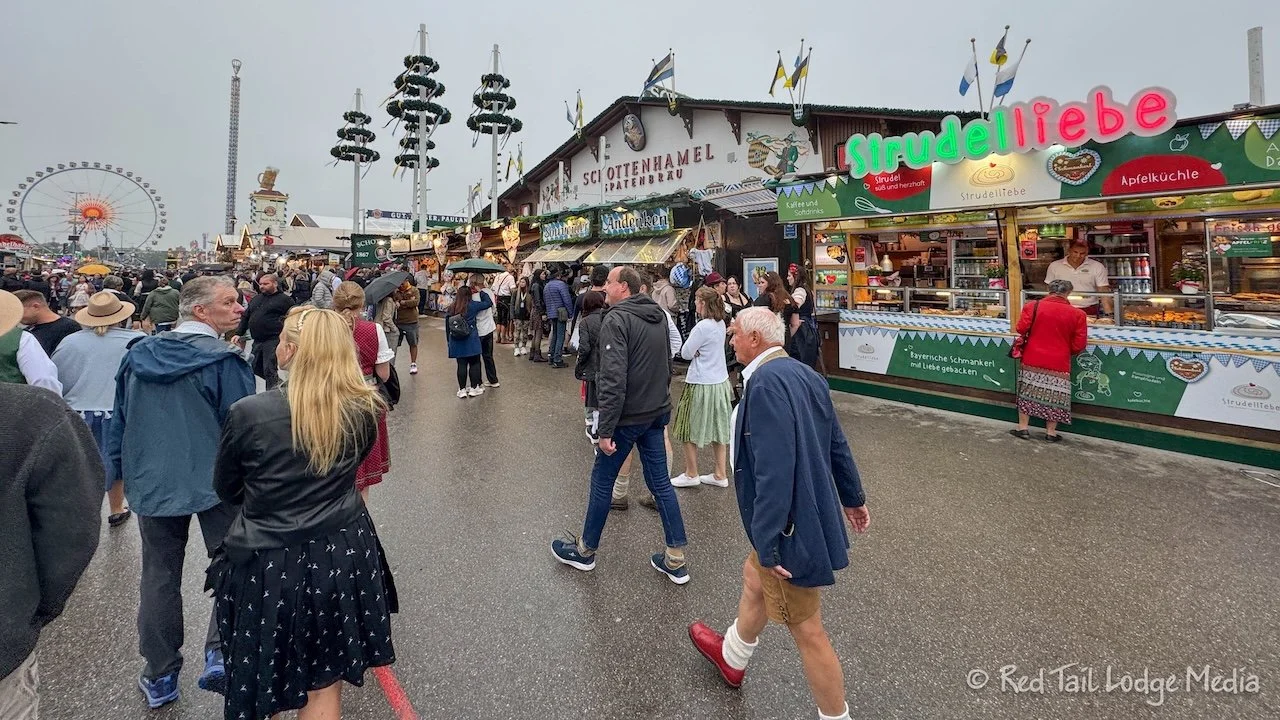
The crowds in the streets of the festival grounds were much thinner than the day before. It was a weekday instead of the weekend and raining instead of sunny. However, the opposite was true inside the Schottenhamel Zelt. The place was packed, with all of the tables full. It took us a while to find our table. A large band on top of a raised stage was playing in the middle of the tent towards one end. Our table was behind the band, although the singers would sometimes turn around and face us. We didn’t have to wait until 8 pm for the tempo to pick up. It was high energy from the start. There were always people standing on the benches. Most of them never sat down.
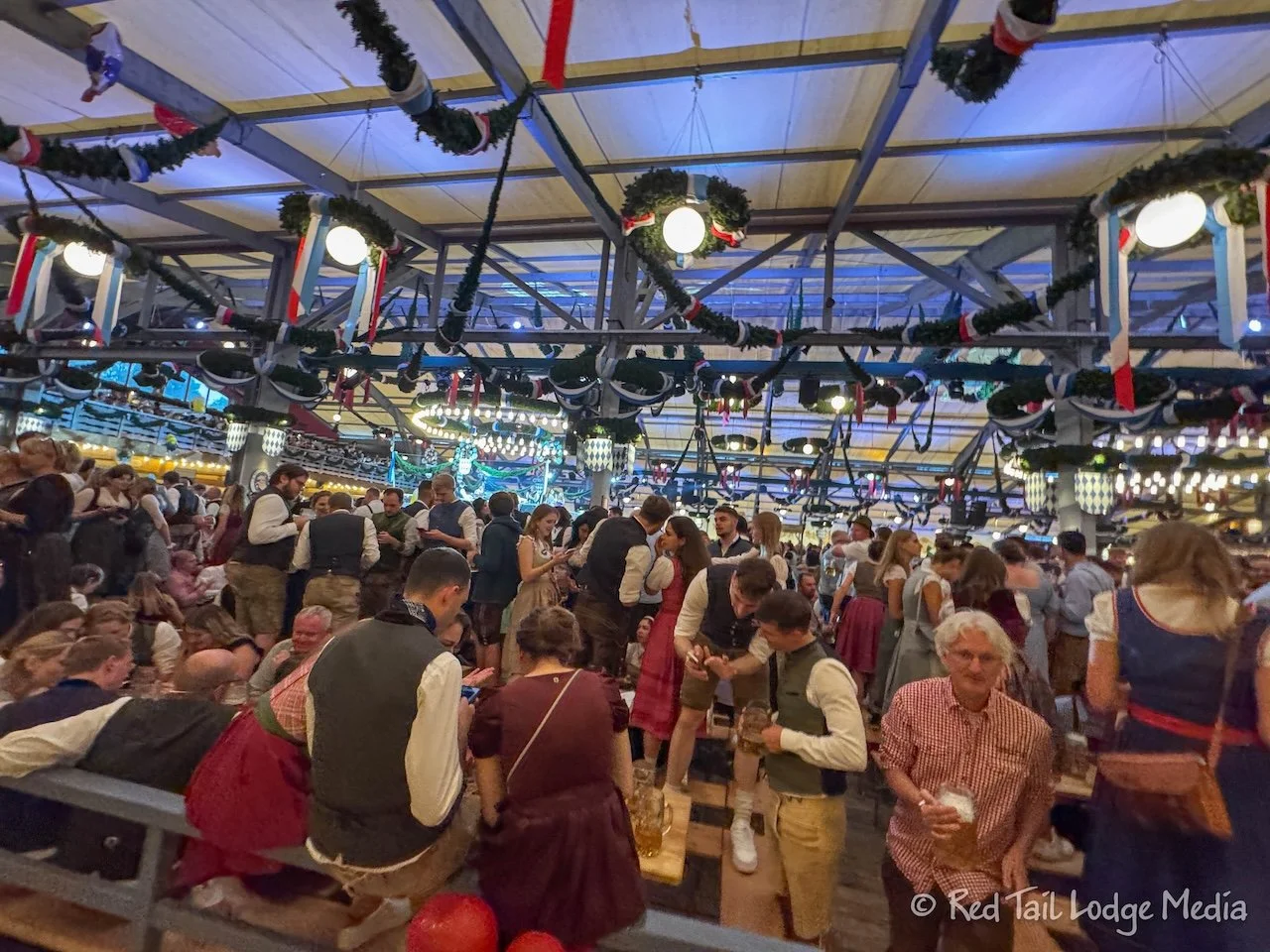
Our table reservation this time included drinks and a main food item. Some of us had half a chicken again, while others had schnitzel or curry wurst. Right at 6:15 pm, security came through and cleared us out from our section of reserved tables, as they needed to clean up and get the tables ready for the next set of reservations.
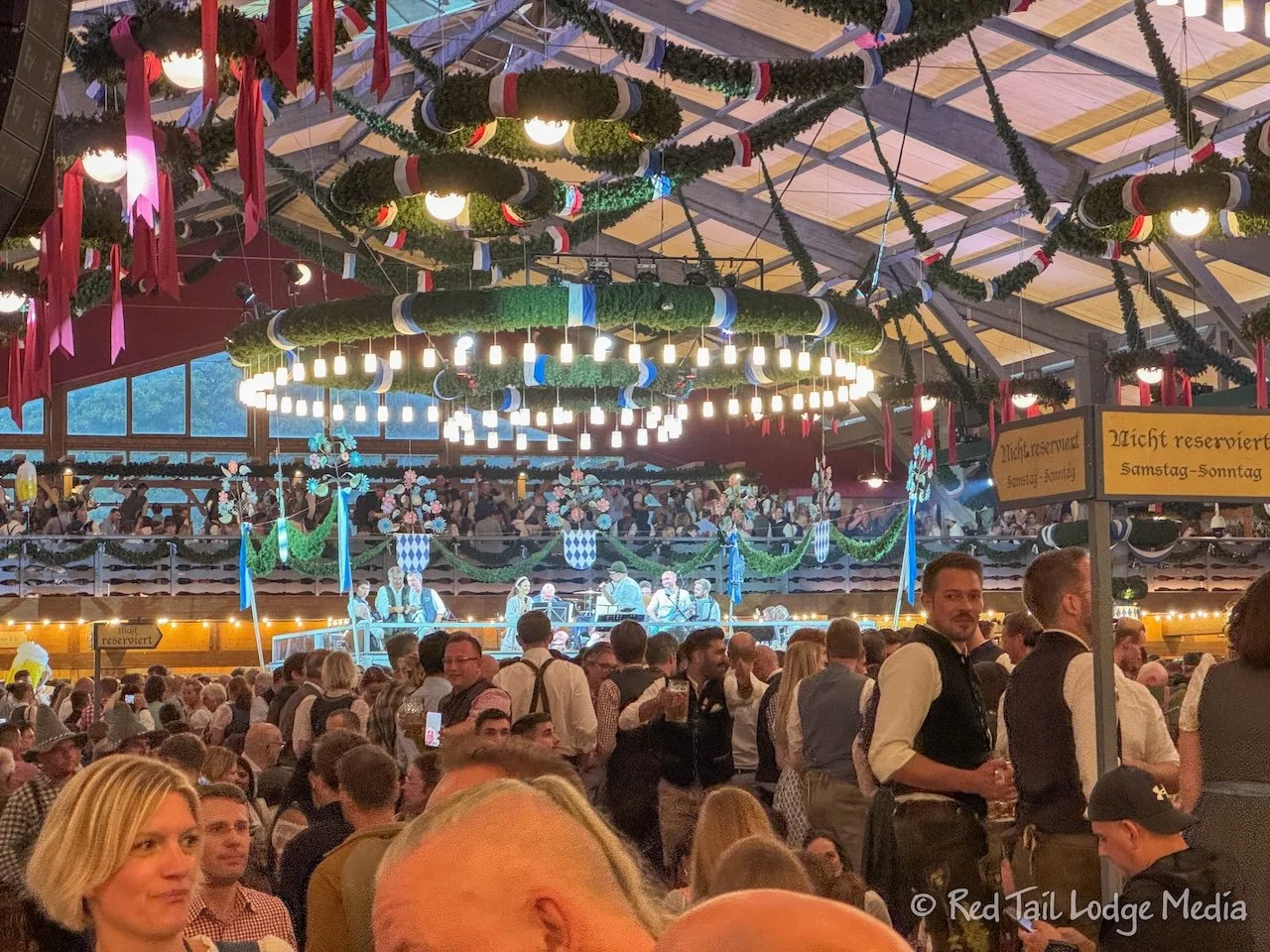
We stood in an aisle near the band while some people from our group finished their beers, then we went outside and walked around the grounds.
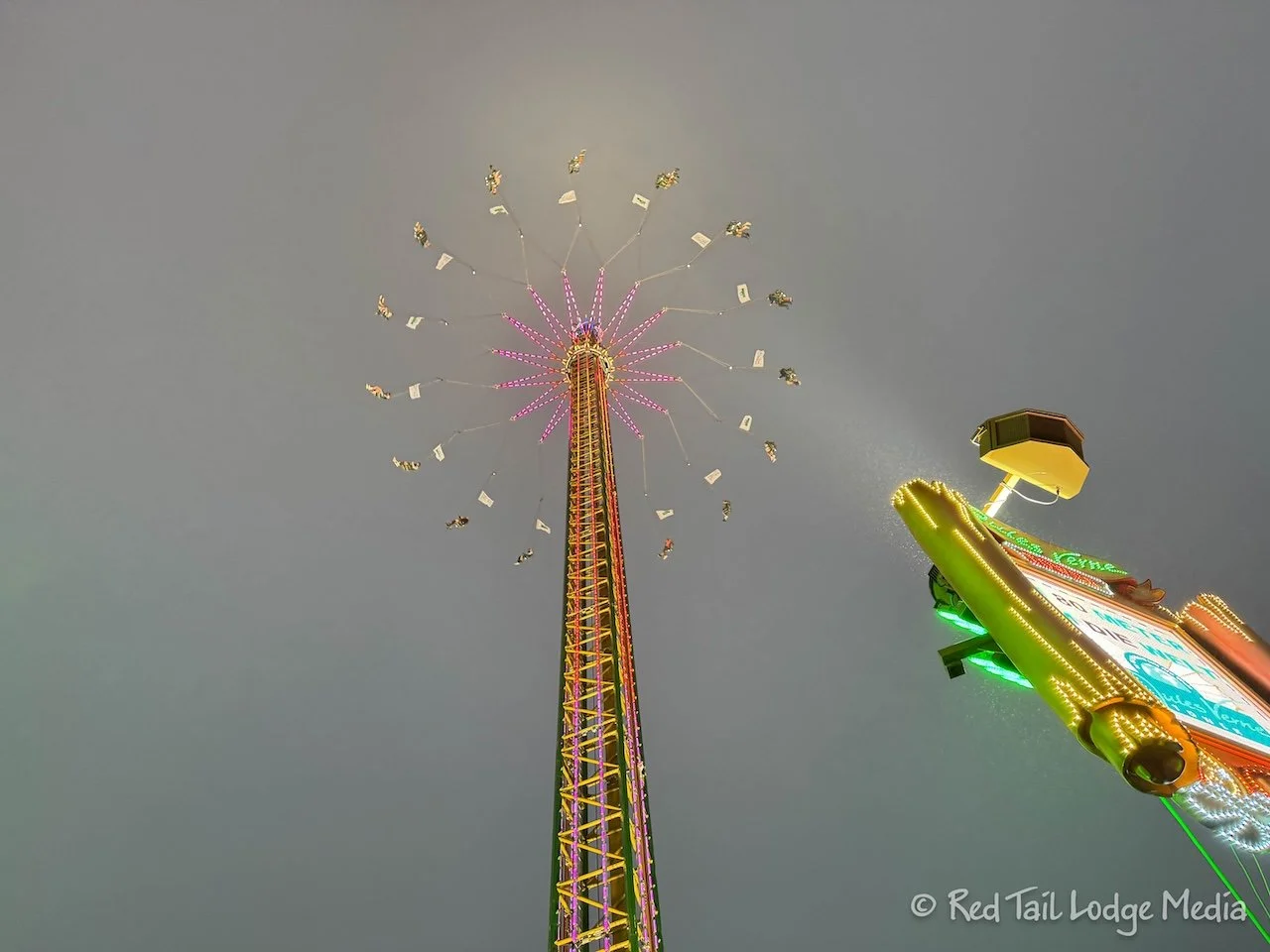
About half the group rode the swinging chairs up to the top of the 80 meter tower, including Keith and Justin. We tried finding another table in another beer tent, but we were unsuccessful as it seemed even crazier than the Schottenhamel Zelt, so we headed back to the hotel via the S-Bahn, as it was running again.
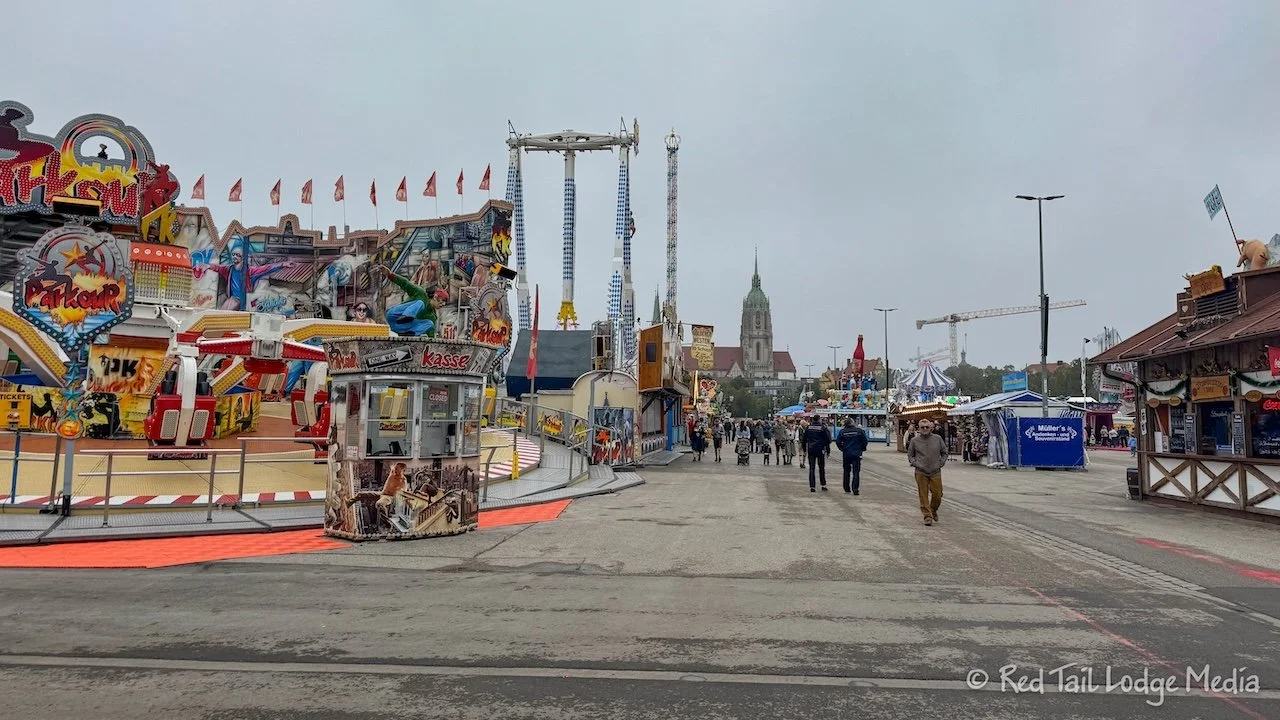
Tuesday, our tent reservation in the Schützen Zelt was not until noon. We were in no hurry to return to the Oktoberfest, but we did want a little time to walk around the grounds, so we left the hotel around 10 am.
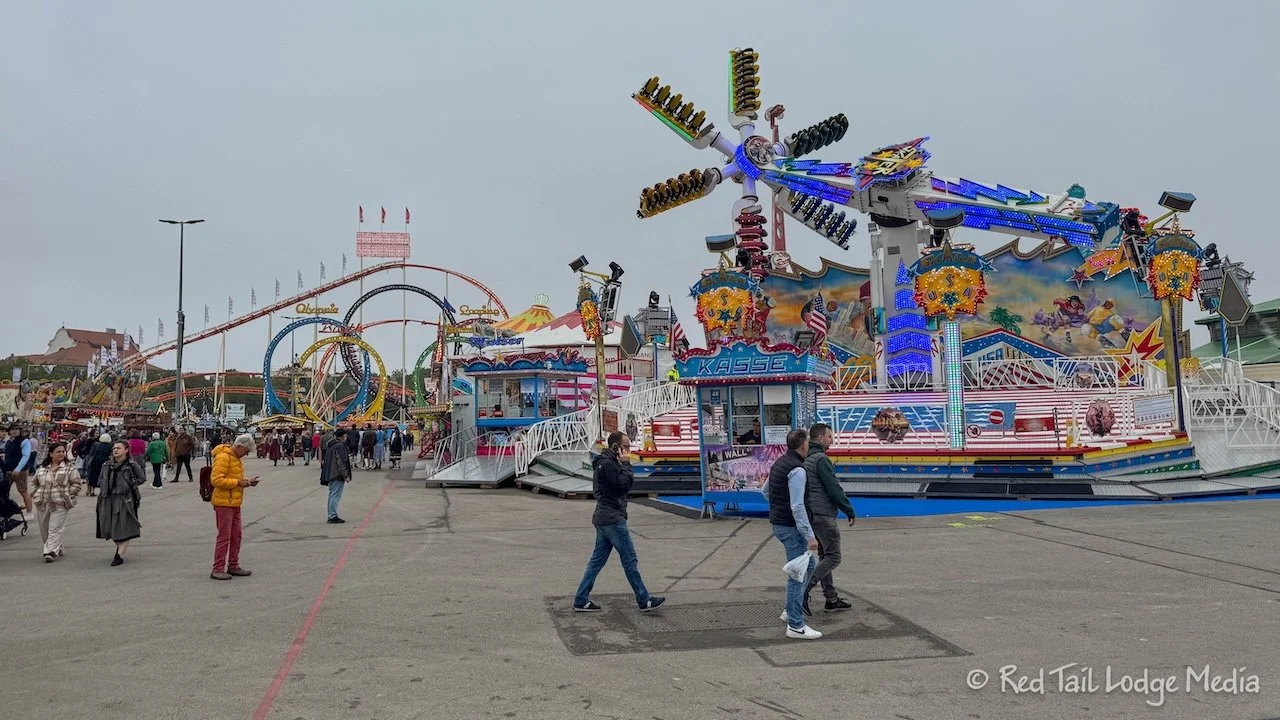
We arrived at Theresienwiese around 11 am, so we had about an hour to wander around. Being a weekday morning meant that the crowds were pretty thin. There are a lot of carnival rides and games, both for the youngsters and the older crowd. A ferris wheel, a couple of roller coasters, spinny rides, and scary fun houses could keep kids occupied for a while. Of course, each one had a separate ticket to purchase since getting into the festival grounds was free.
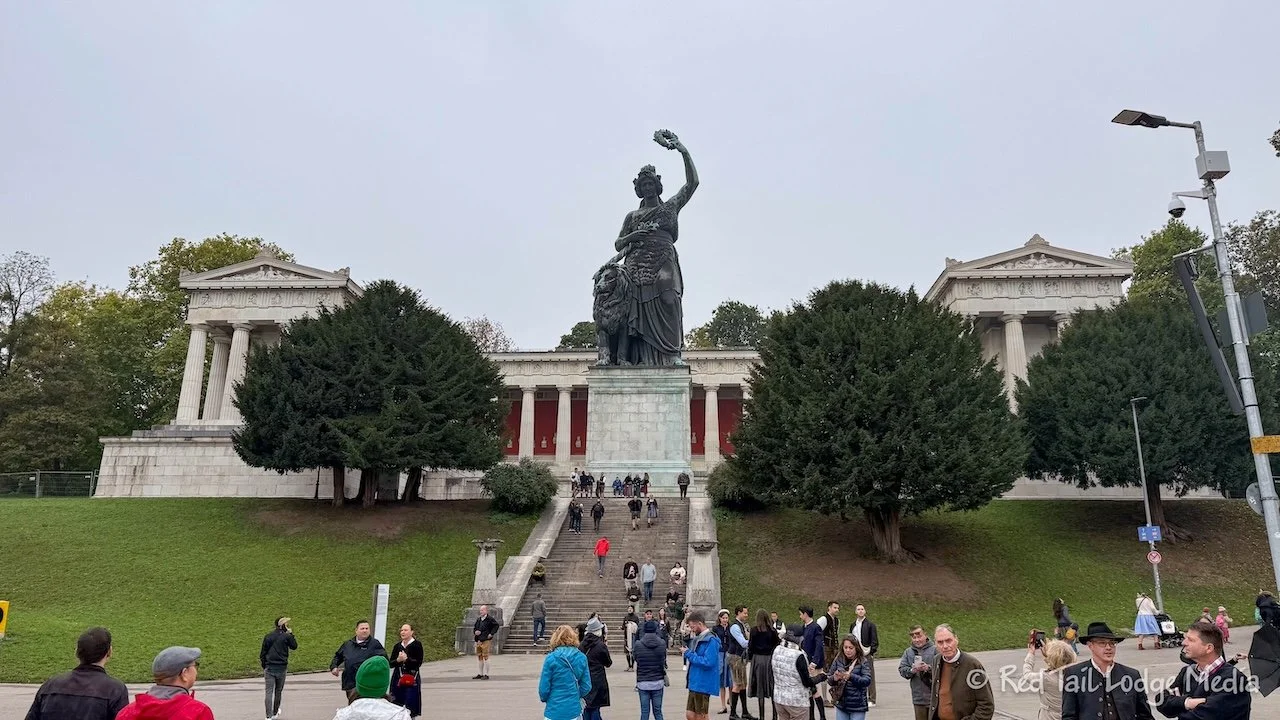
We found our way over to the Bavarian statue. You can climb up inside the statue to the top, for a price, of course. However, none of us went up. Ann remembered climbing the statue before, about 35 years ago, and all she could remember was that it wasn’t that pleasant of an experience, as it was claustrophobic and hot, with a very limited view out a small opening at the top.
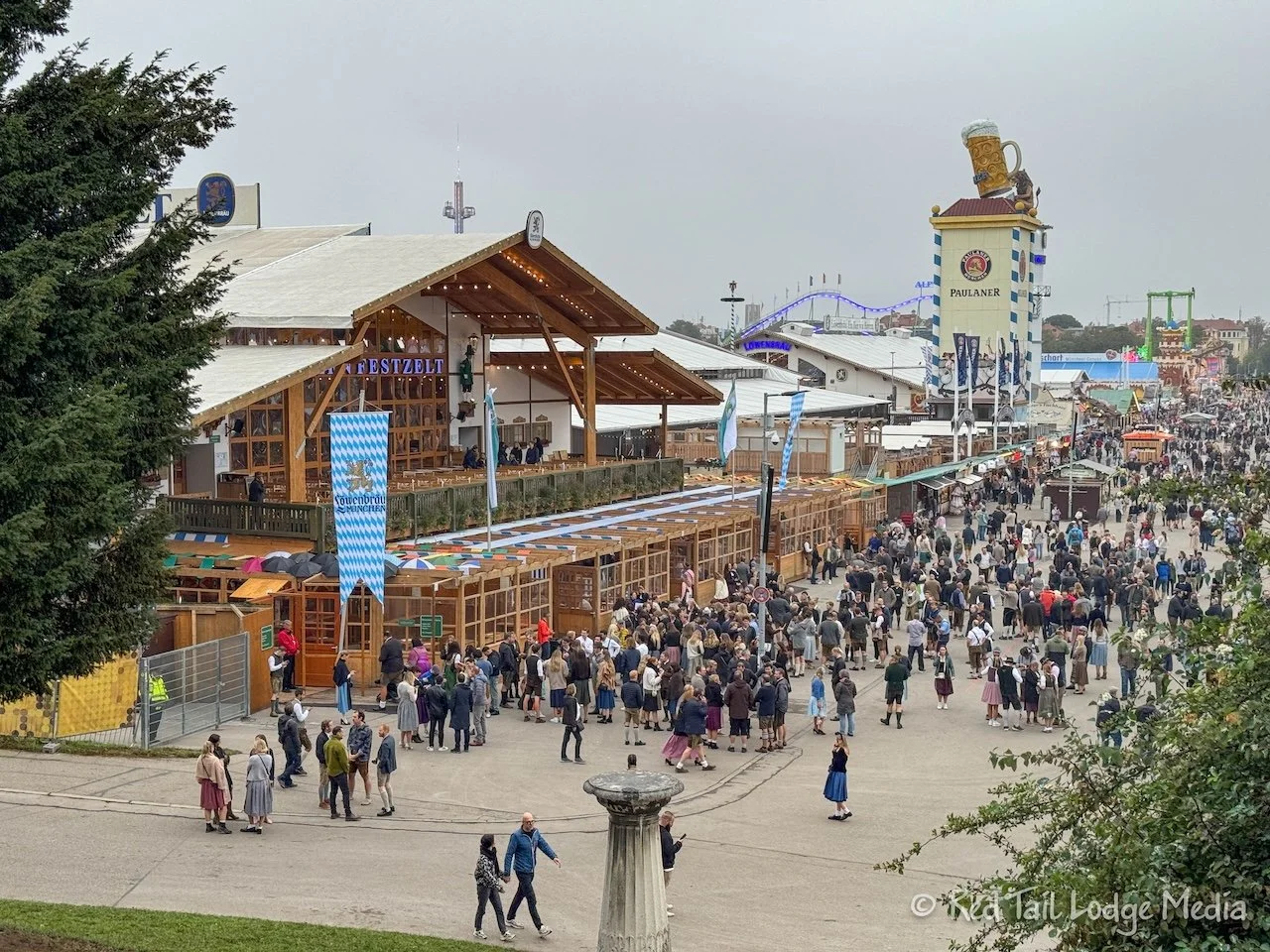
Our tent was right next to the statue. There was a crowd of well-dressed people standing outside the tent. We’re assuming they were waiting to go in. It was the only tent that we saw with people gathering out in front of it.
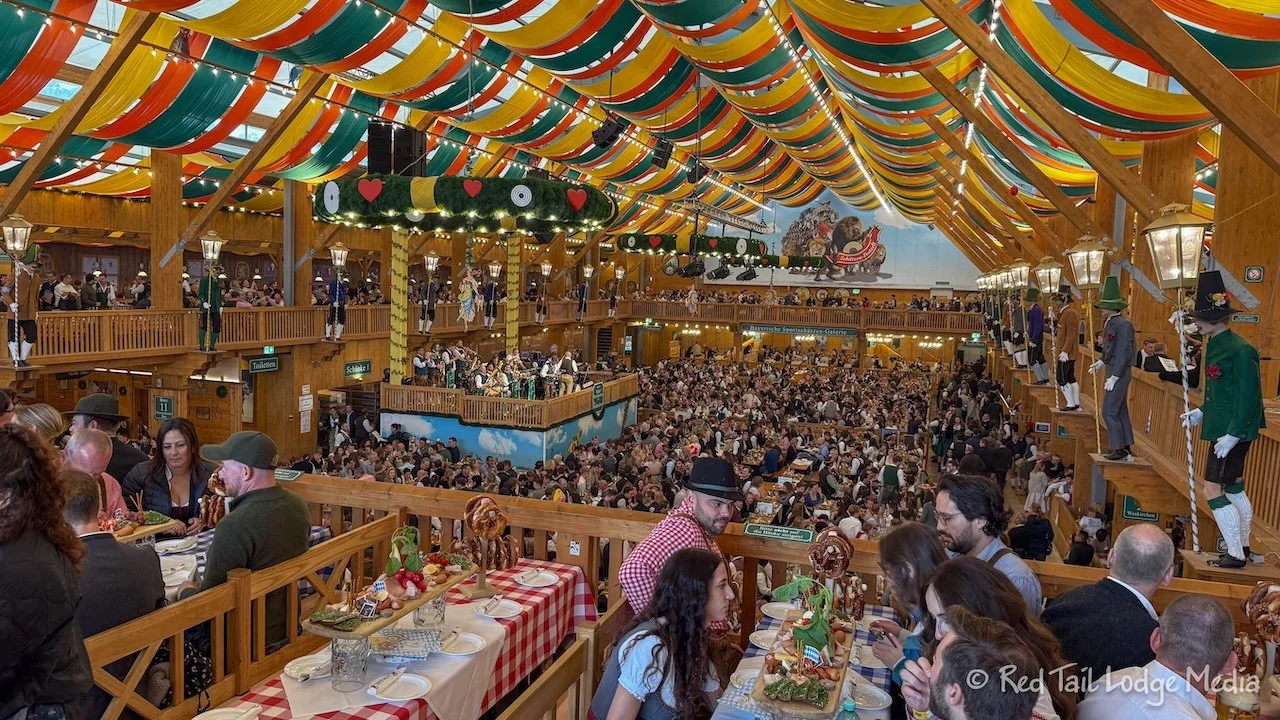
At noon, we went inside. There was a separate tent entrance for the reserved tables. Our reservation was up in the balcony of the tent. The tent was much quieter than the tent we were in the day before. Of course, it was earlier than the day before which might have been a factor, but it also seemed like this tent had a different vibe.
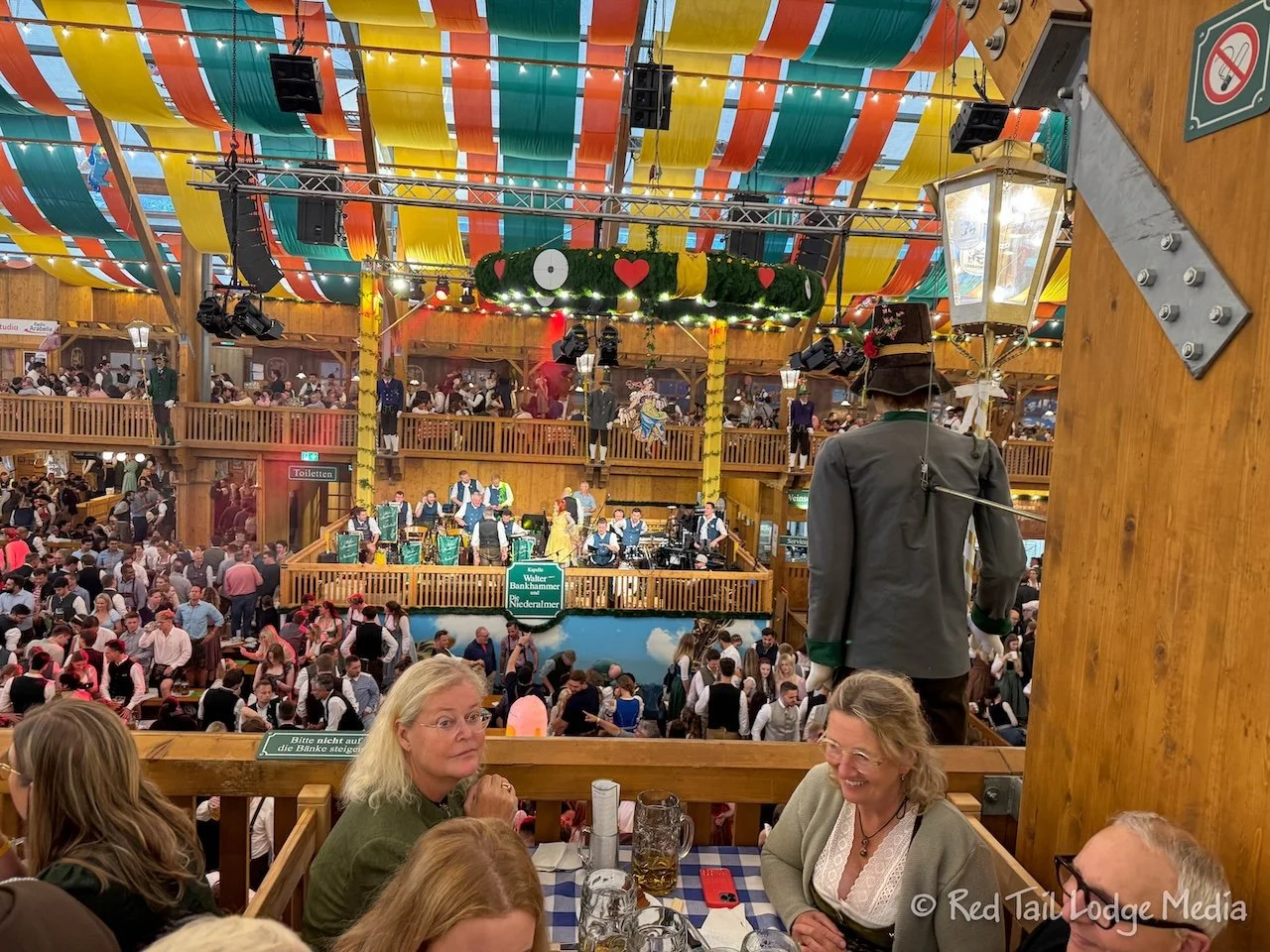
The first band was playing more traditional German music. It was quiet enough to be able to carry on a decent conversation at our table. The music was very enjoyable. We all agreed it was our favorite tent of the three we had reserved.
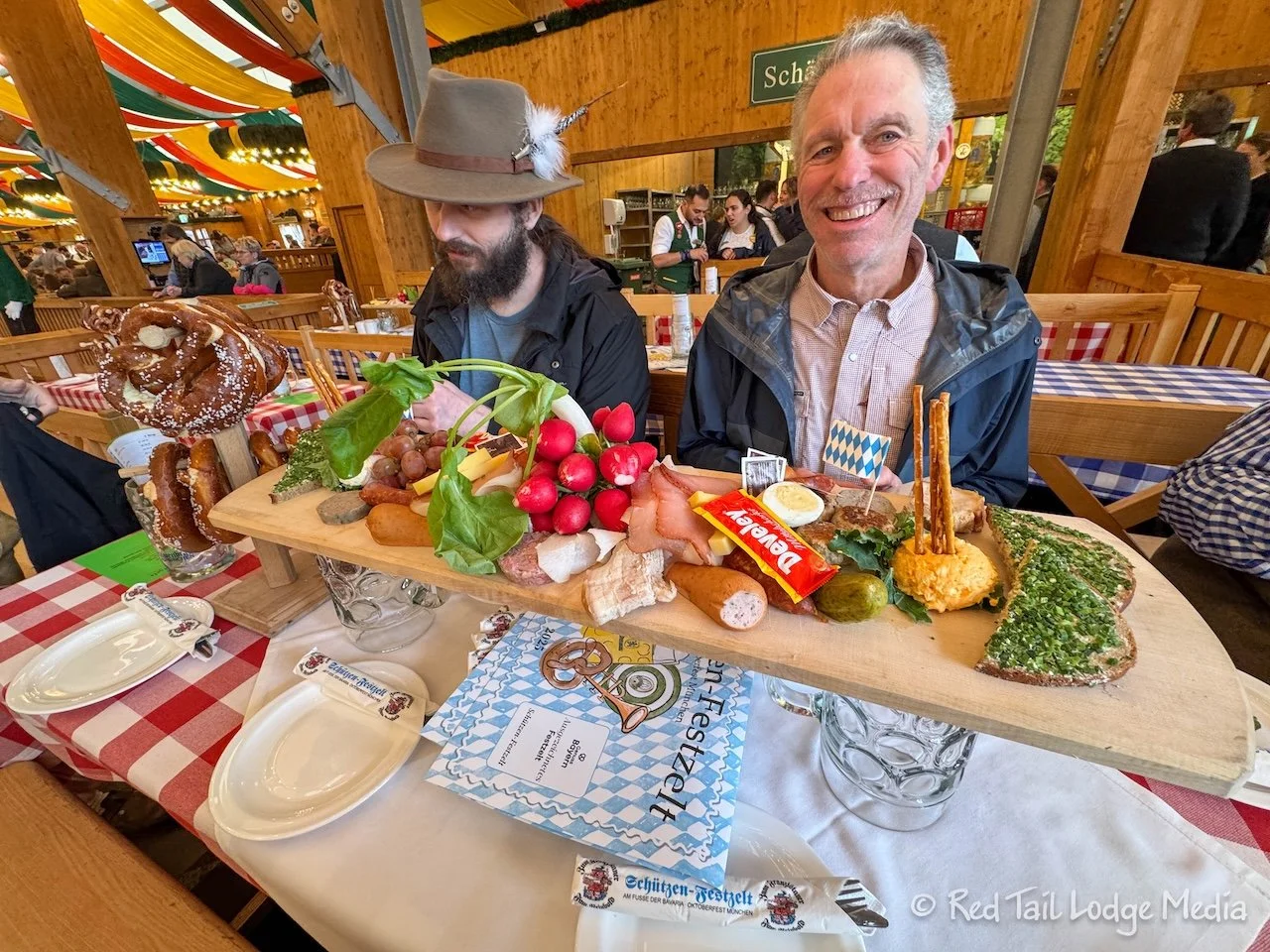
Brad’s four Austrian friends joined us again, but they showed up a little later. They are younger than the rest of us and had stayed much later at Oktoberfest the day before than we had. When we arrived, there was already a large charcuterie board (Vorspeise) waiting for us at our table. It was just as delicious as the one we had the first night.
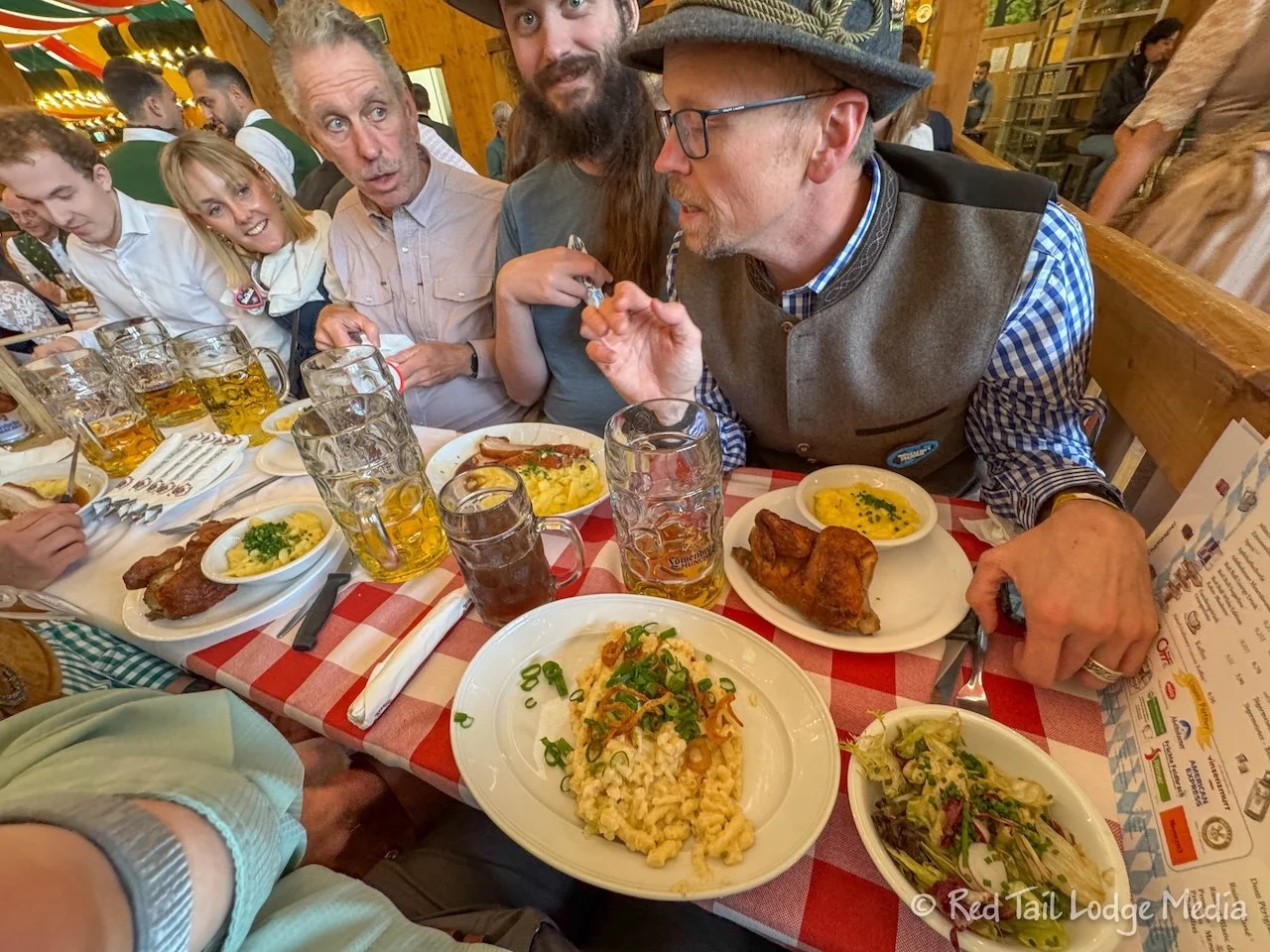
For our main course, some of us ordered the half chicken while others had Käsespätzle (small egg dumplings with cheese). Justin tried the special for the day, the Bierbratl. It came with pork belly (Schwiensbrust) and Krusterl (a type of bread) with a caraway seed sauce and potato salad.
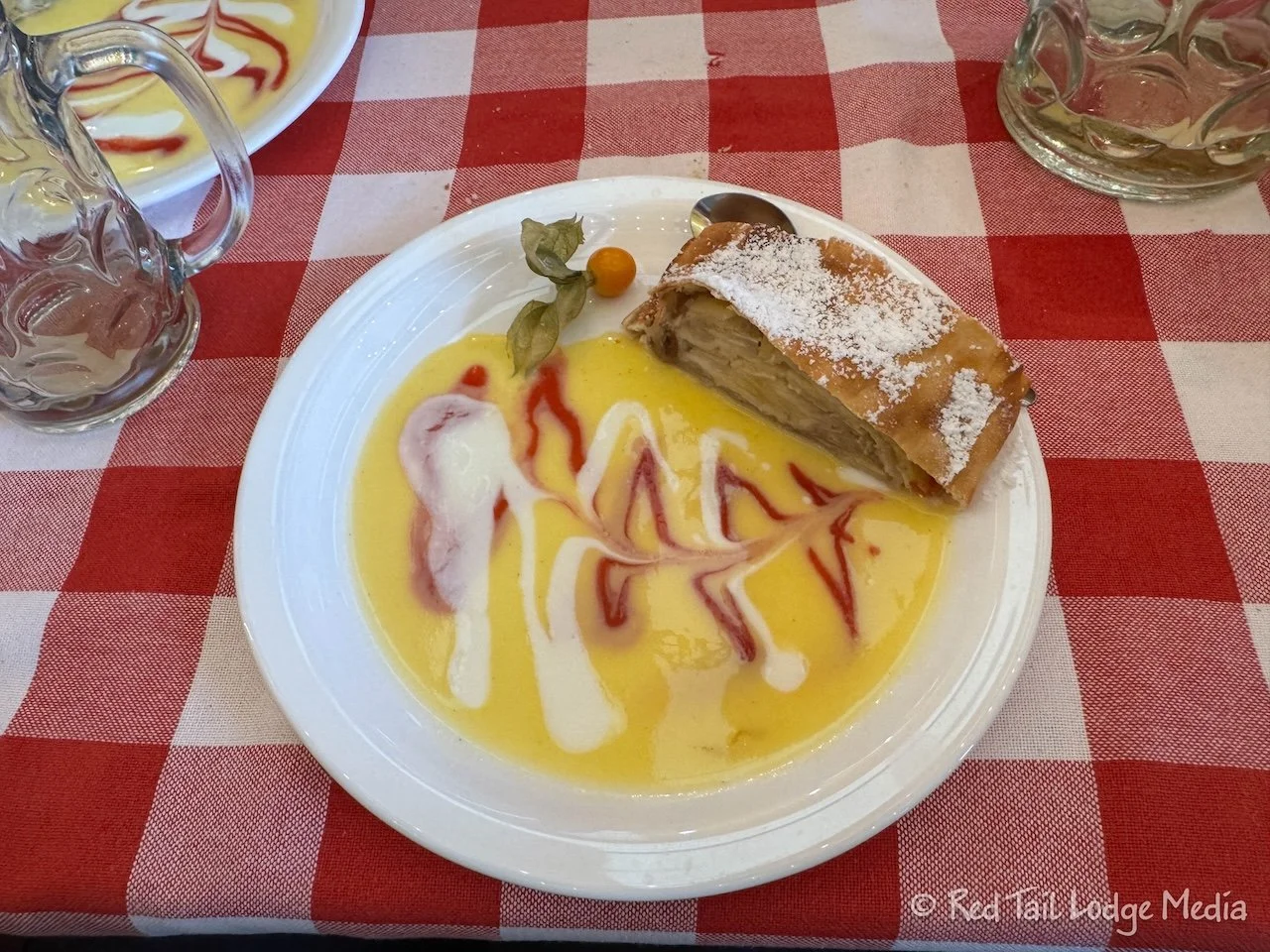
For dessert, we had Apfelstrudel. It was served with decorative and colorful swirls mixed into the vanilla sauce. Very festive. And it tasted as good as it looked.
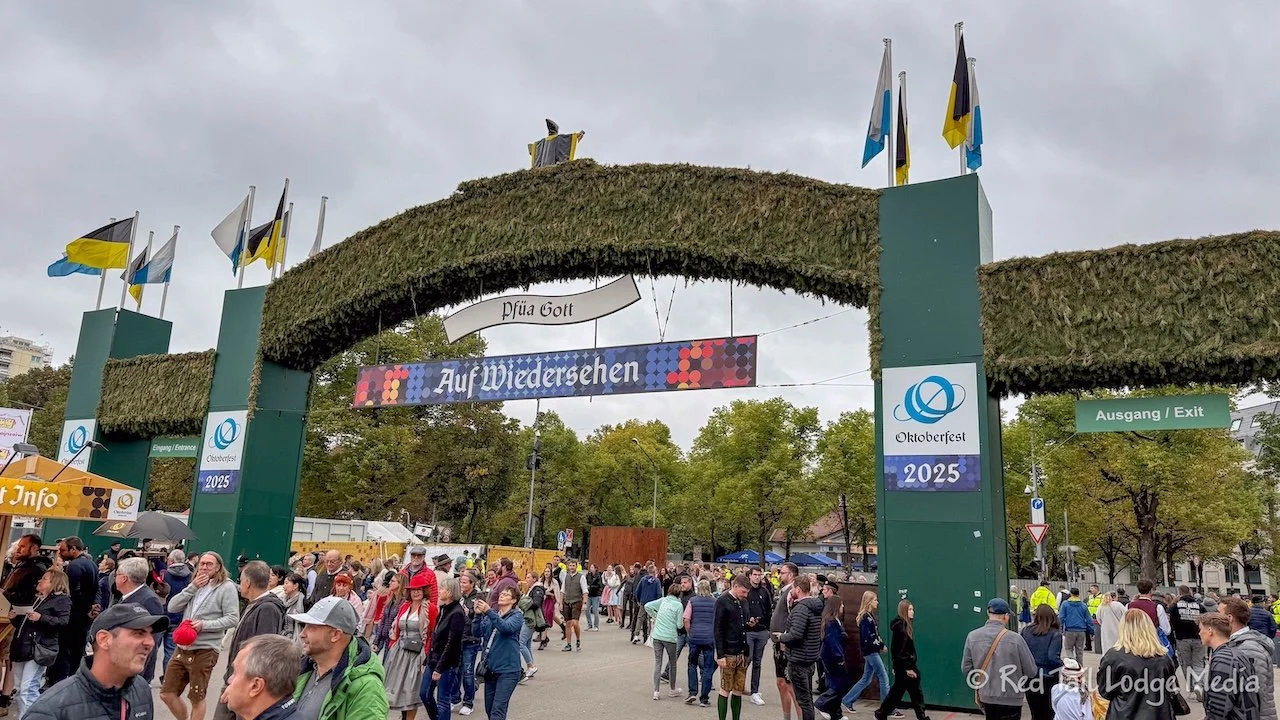
Our reservation lasted until 5 pm, but we didn’t stay that long. The four from Austria had to leave around 3 pm to catch a train back to Austria. The rest of us decided it was time to leave as well, as we had our fill of the Oktoberfest after three days. So we made our way back to the hotel.
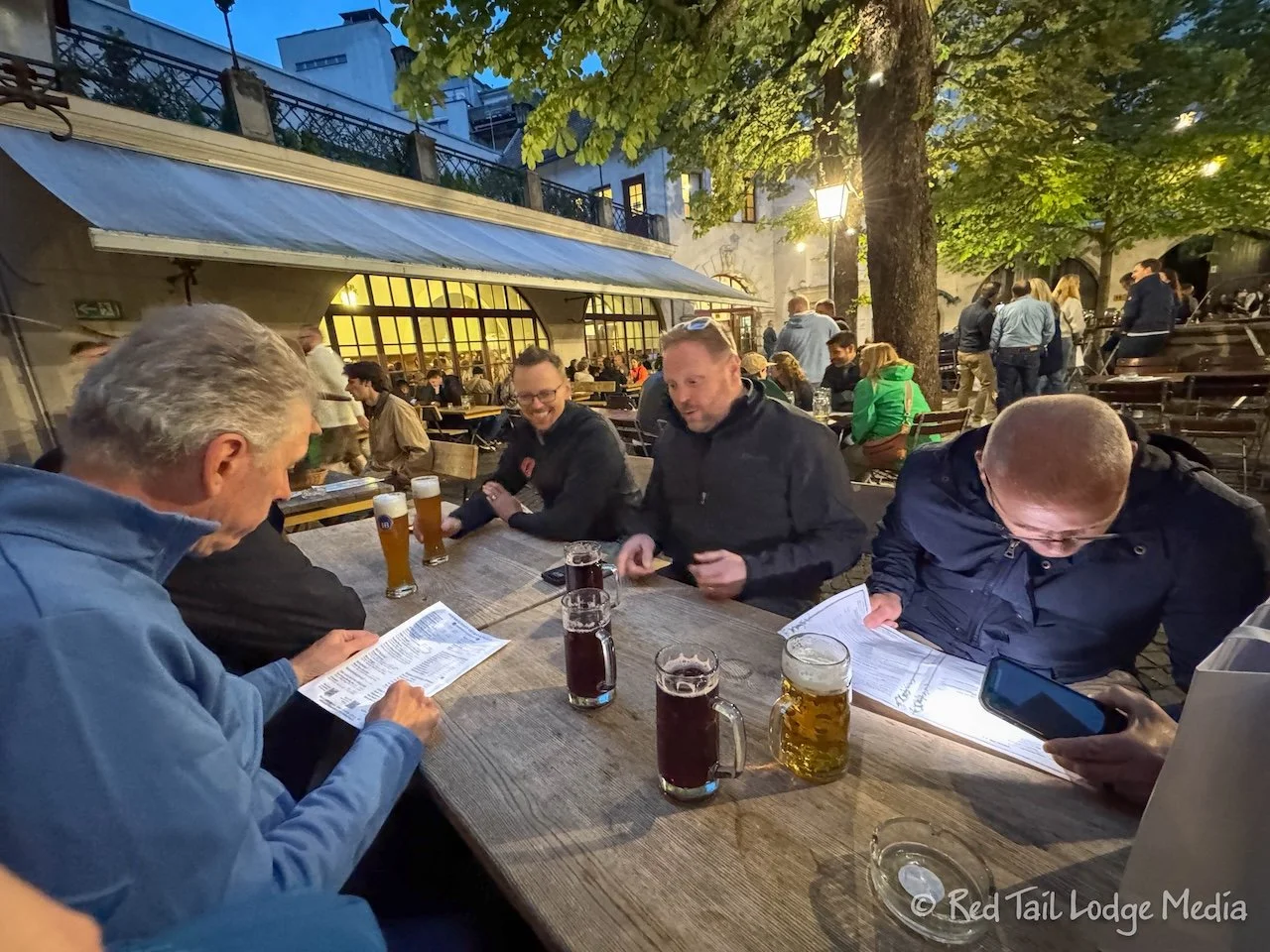
After the others changed out of their lederhosen, we took the tram into the Altstadt again. Some of us had more souvenir shopping to do. Then we walked over to the Hofbräuhaus for dinner. Kevin had never been to Munich before, so we wanted to let him experience more of it.
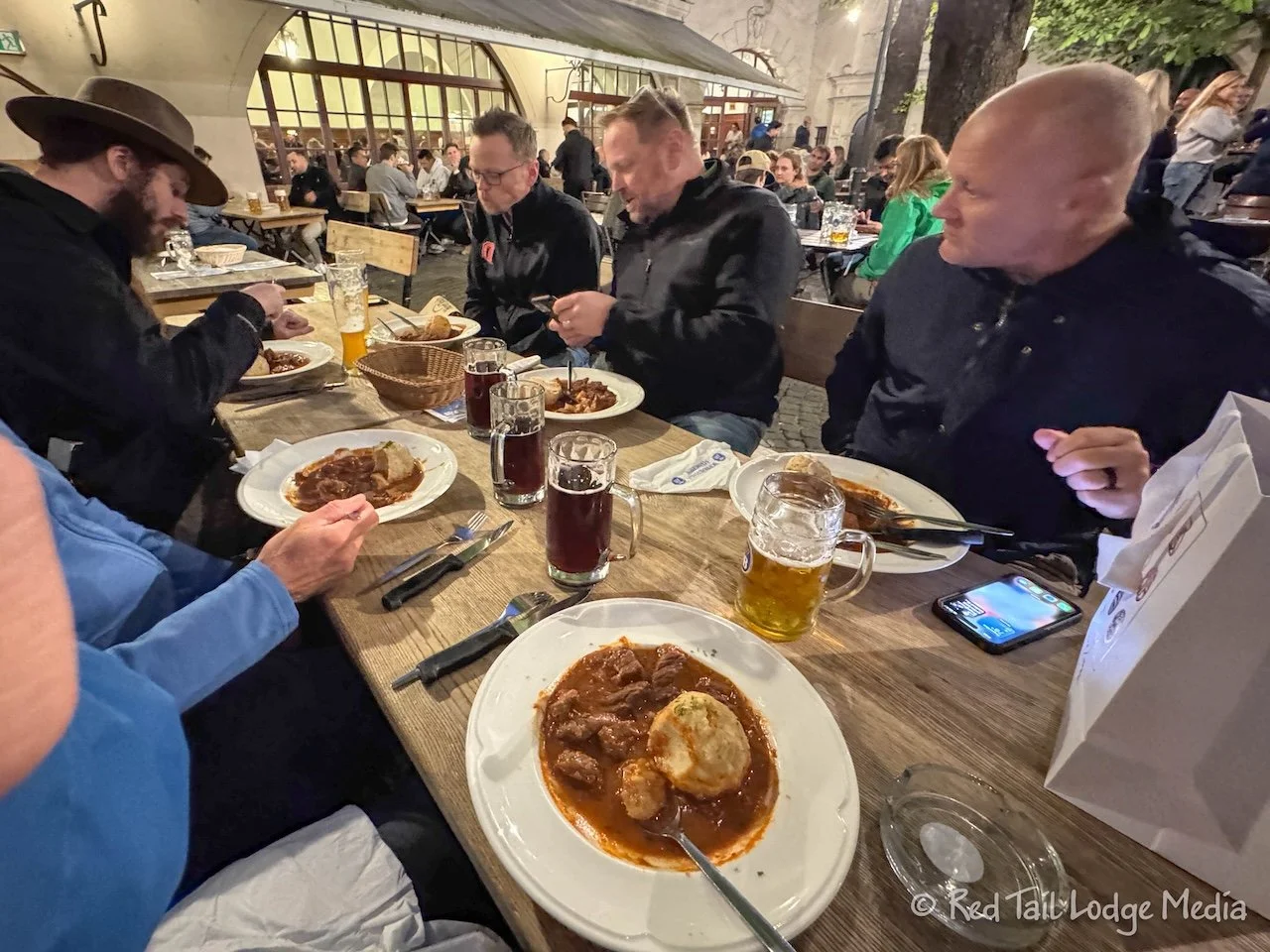
Inside the Hofbräuhaus beer hall, all of the tables were full. However, there were plenty of open tables in the beer garden, as it was rather chilly outside. We braved the cold and sat in the beer garden. All of us ordered the Rindergulasch (beef goulash), as it sounded like good food to warm us up.
On the way back to the hotel, we took the S-Bahn from Marienplatz, as the station was closer than the tram station at Karlsplatz and going underground seemed like it would be warmer. We made it back to the hotel by 9 pm. We were ready to call it a night, as we all were traveling the next day. Ann, Keith, and Justin were flying back to Colorado and needed to leave the hotel by 7 am. The rest were hopping in a car and driving to Austria. We hope they had a safe and enjoyable journey.
Wednesday morning, we didn’t have time to eat breakfast at the hotel before leaving for the airport. It was raining and Brad offered to drive us to the airport. Thank you, Brad! That was better than walking 15 minutes to the S-Bahn station and getting our luggage and ourselves wet along the way.
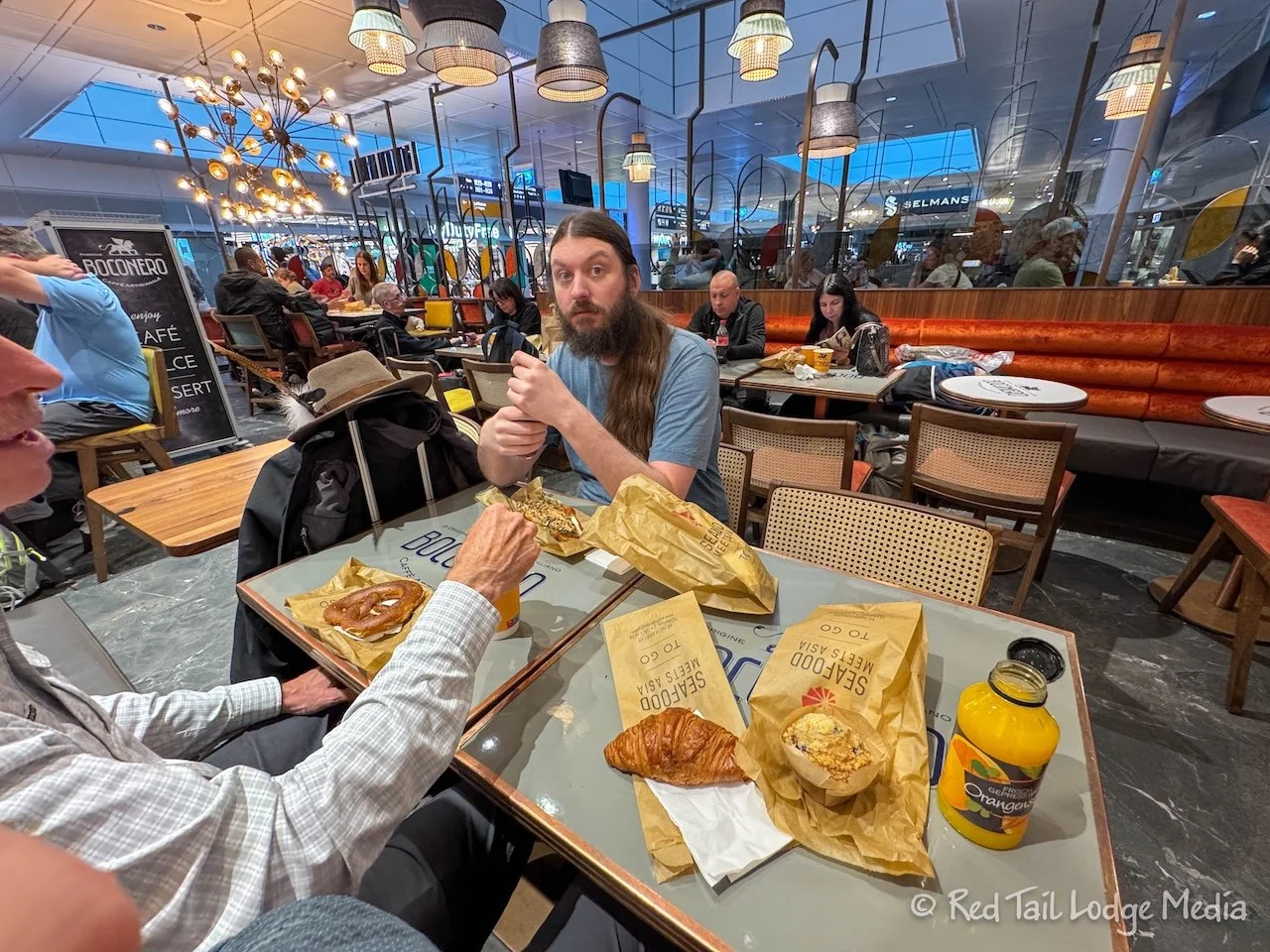
It was about a 40 minute ride to the airport. We arrived over three hours before our flight. We had heard of people who were running to their gates after taking over three hours to get through security and the passport controls. However, that was not our experience. Ann and Keith checked their bags in at the automated luggage drop off. Then all three of us breezed through security in a matter of minutes, even with them pulling aside some of our bags and inspecting them more thoroughly. Then we were through the first passport control checkpoint in about 15 minutes. Our boarding passes said gate H, with no number. We still had over two hours before our flight, so we sat down at a self-service café and ate some breakfast. Keith had a cappuccino with a butter pretzel. Ann had a croissant and blueberry muffin with orange juice. Justin had a baguette sandwich with spicy salami, a chocolate muffin, and a juice of dark mixed berries.
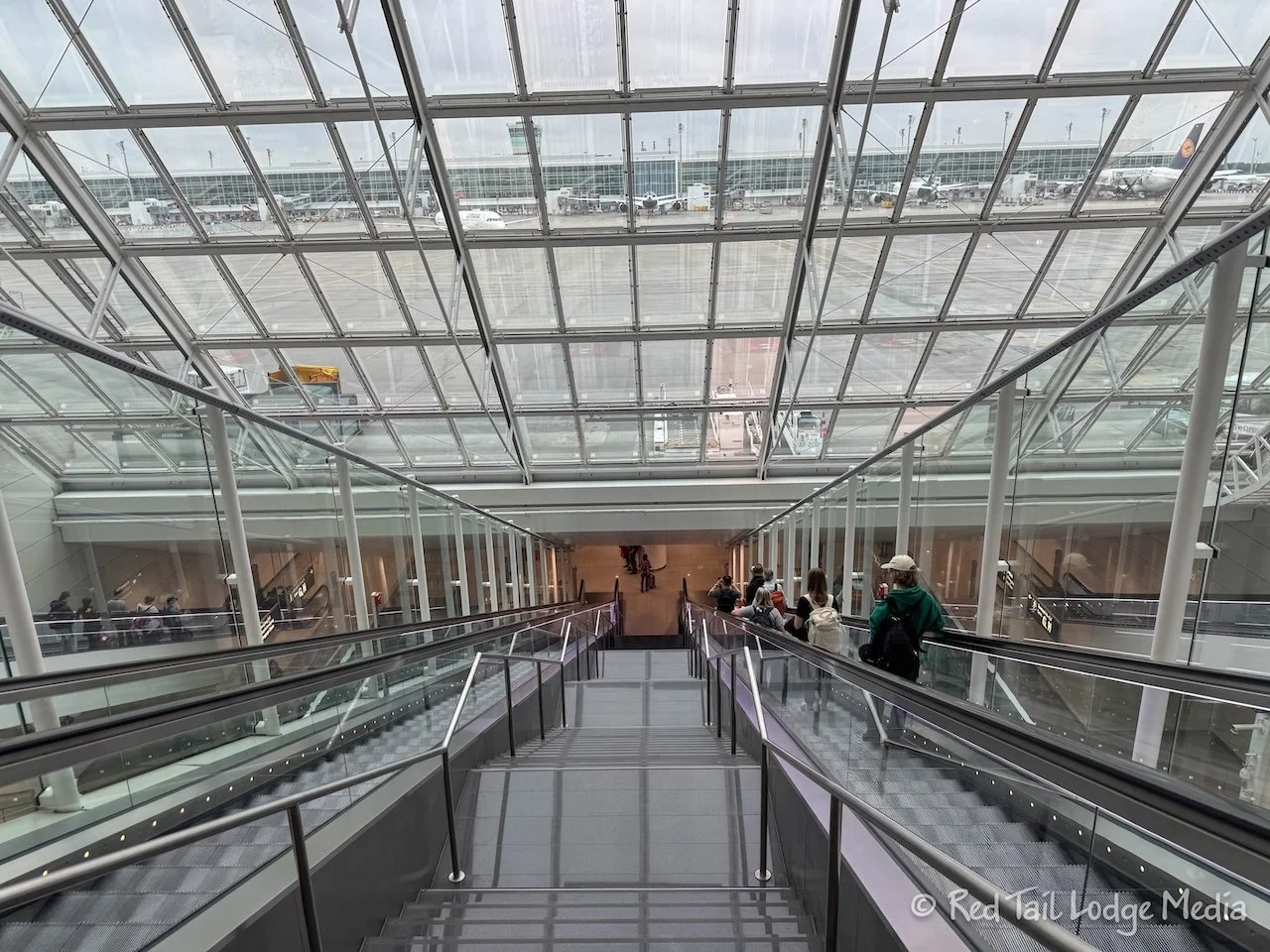
After our breakfast, we checked the departure boards again. Our flight was listed for gate L28. It was about a 15 minute journey to get from concourse H over to concourse L. Escalators and stairs went down the eight flights to the “shuttle” or underground train that transported us to the other concourse. Then another eight flights took us back up to the concourse level. The train was very similar to the one at DIA (Denver International Airport), so it seemed rather familiar to us. At concourse L, we needed to go through yet another passport control checkpoint. The second checkpoint went even faster than the first. We’re not quite sure why there were two checkpoints. Then it was a fairly short walk to reach our gate. Now we only had to wait about an hour before boarding.
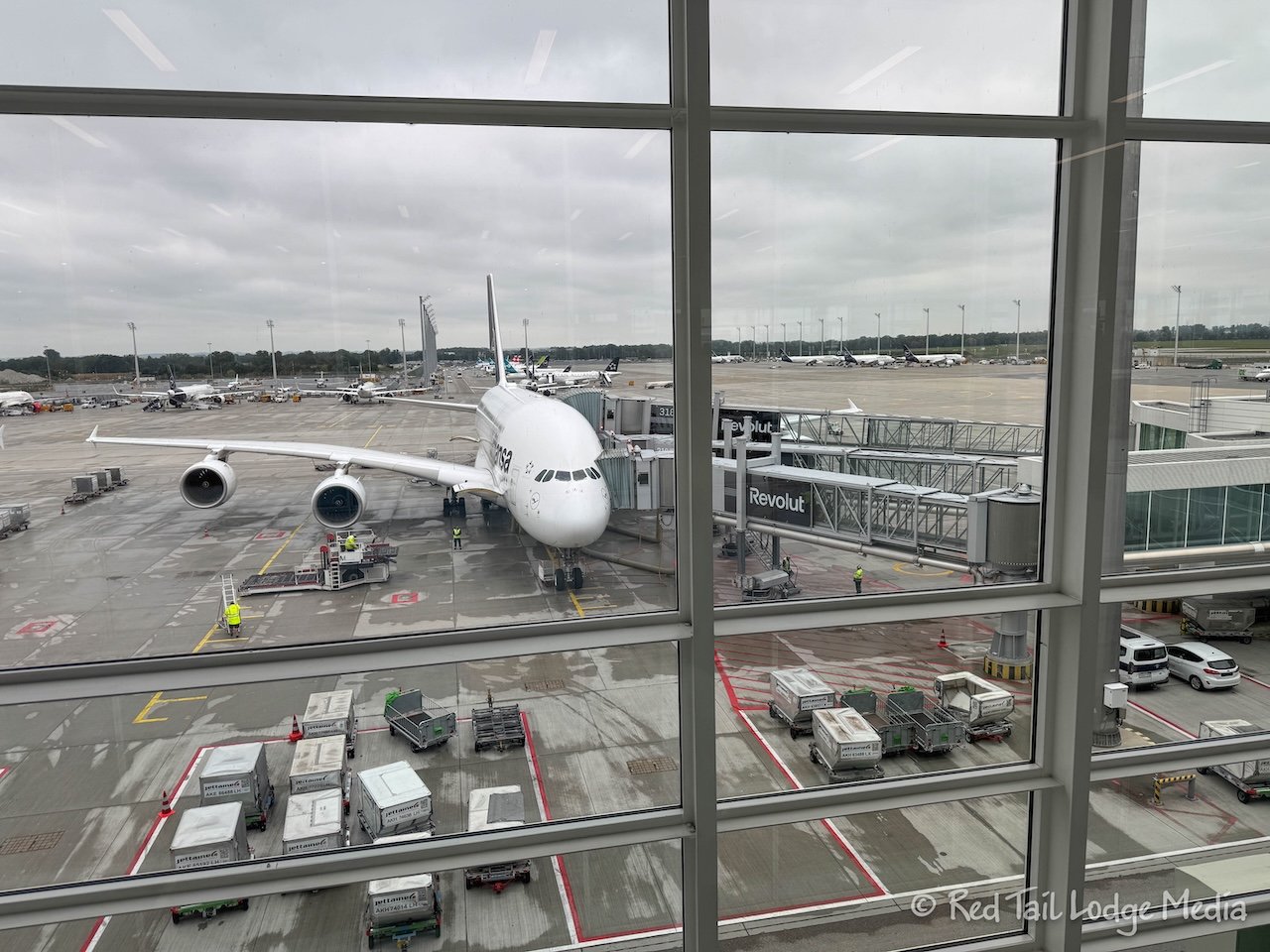
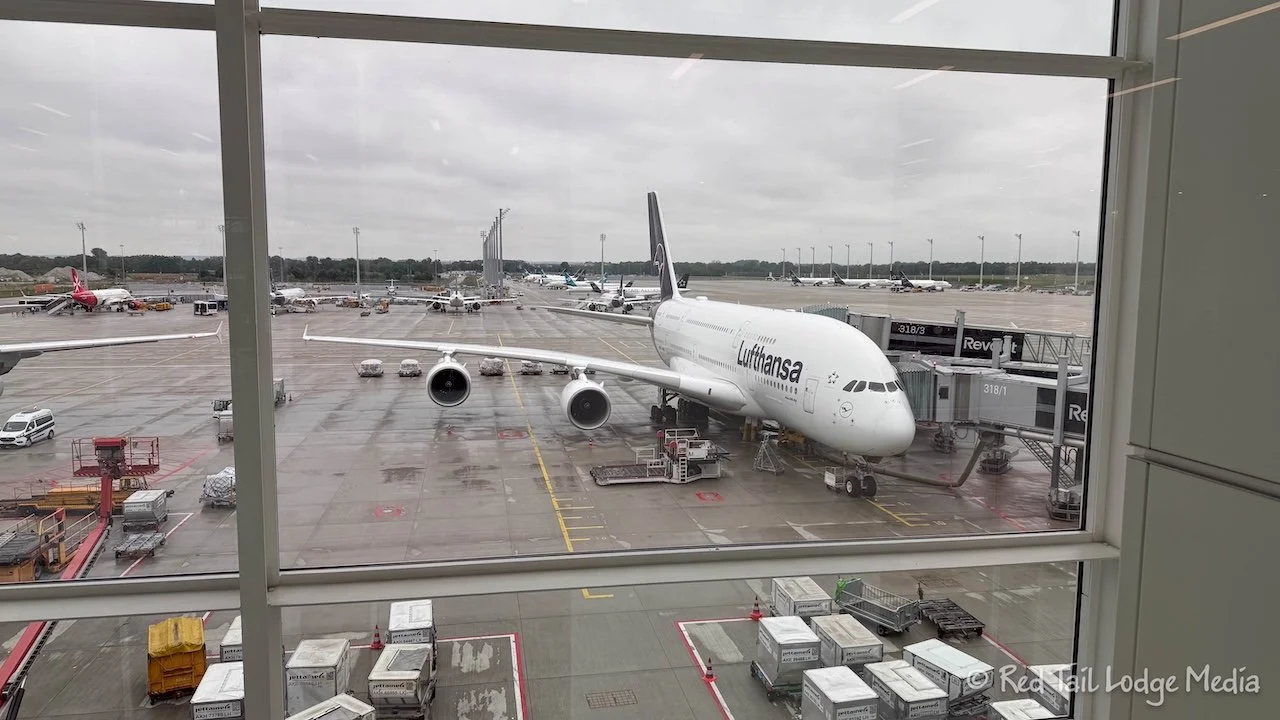
Our seats on the plane were rather comfy. We booked Premium Economy on Lufthansa, a direct flight to Denver on a A380-800 plane, a double decker. We had seats in the first row, which gave us even more leg room. However, the drawback was that we couldn’t store our carry-on bags under the seats in front of us, since there were no seats in front of us.
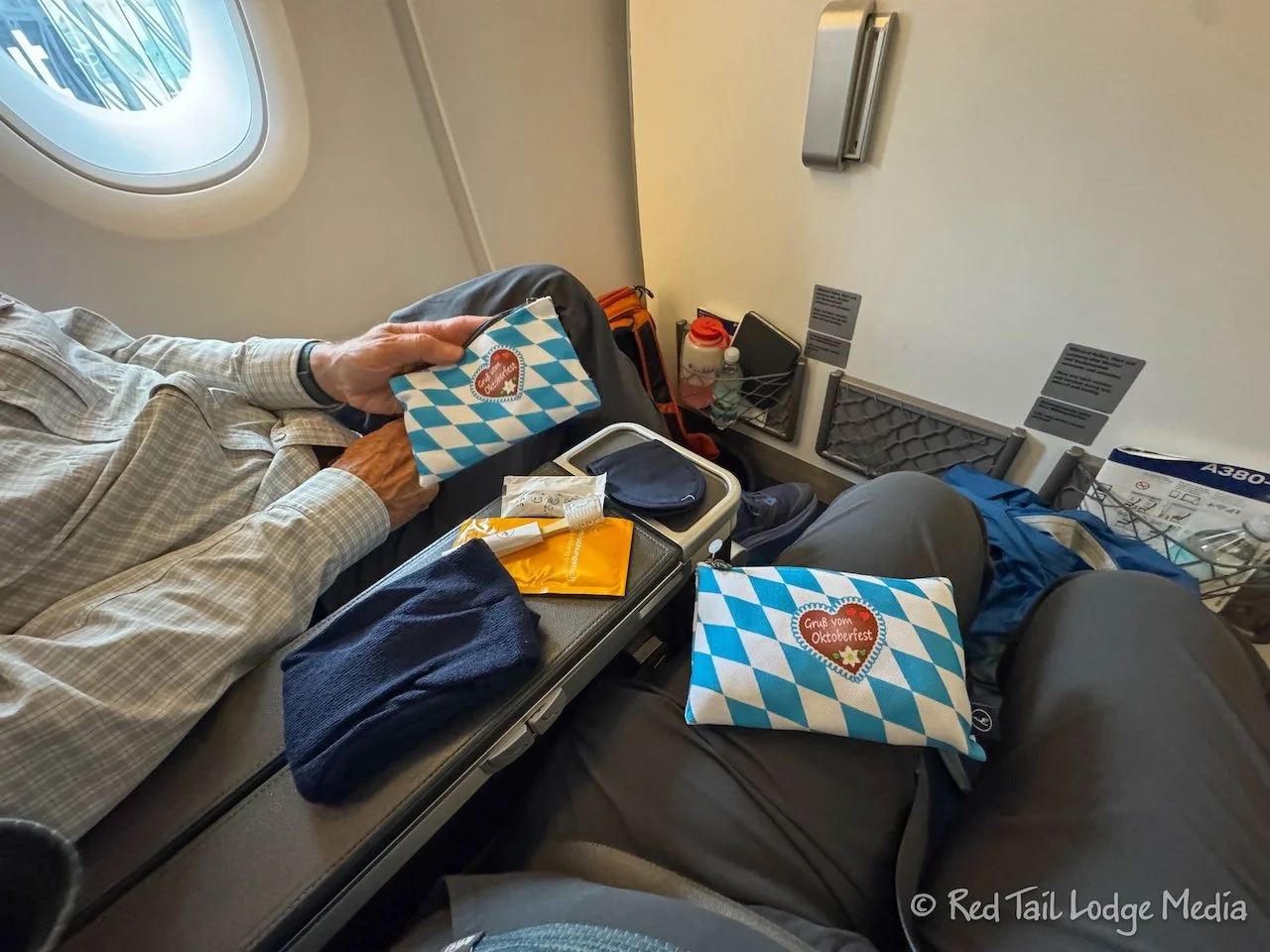
Ann’s legs are really long (36” to 37” inseam), so she doesn’t fit into an airline seat very well. We flew Economy class back in 2018 on Iceland Air (because they have the most leg room) over to Europe. Ann’s hip still bothers her off and on from damage due to trying to sleep on that flight. It was one of the reasons why we didn’t fly over to Europe and took a transatlantic cruise instead (Transatlantic Cruise: Part 1 of 2 - March 9th to 15th, 2025). Since the flight back is during the day and not overnight, Premium Economy was comfortable enough not to cause Ann any problems. However, she still believes that she would need International Business or First Class for an overnight flight where she could lay down flat.
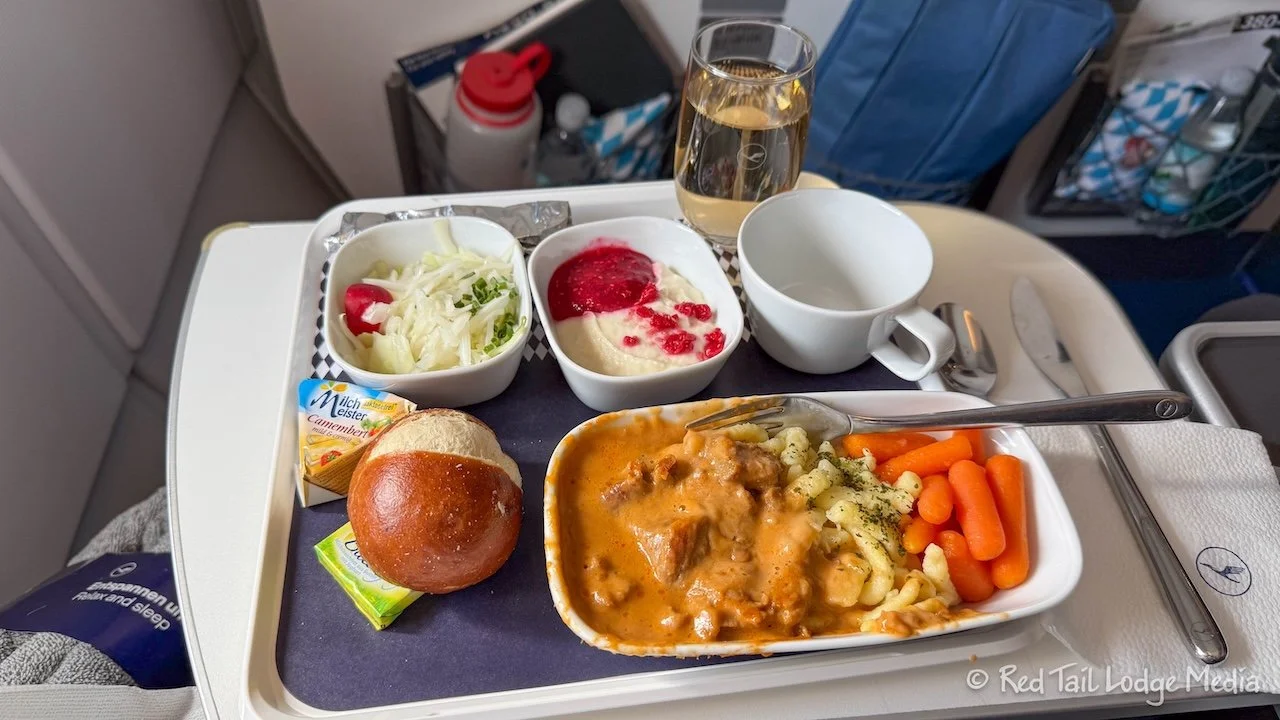
The food we were served on our flight was excellent. We’re not sure if the regular Economy was served the same food or not. For our lunch, we had a choice of pasta or goulash. The goulash came with spätzle and carrots. The pasta was served with tomato sauce and grated cheese. In addition to the main dish, there was Bavarian cabbage salad, Laugenbrötchen (pretzel roll), camembert cheese, and Bavarian creme with raspberry sauce.
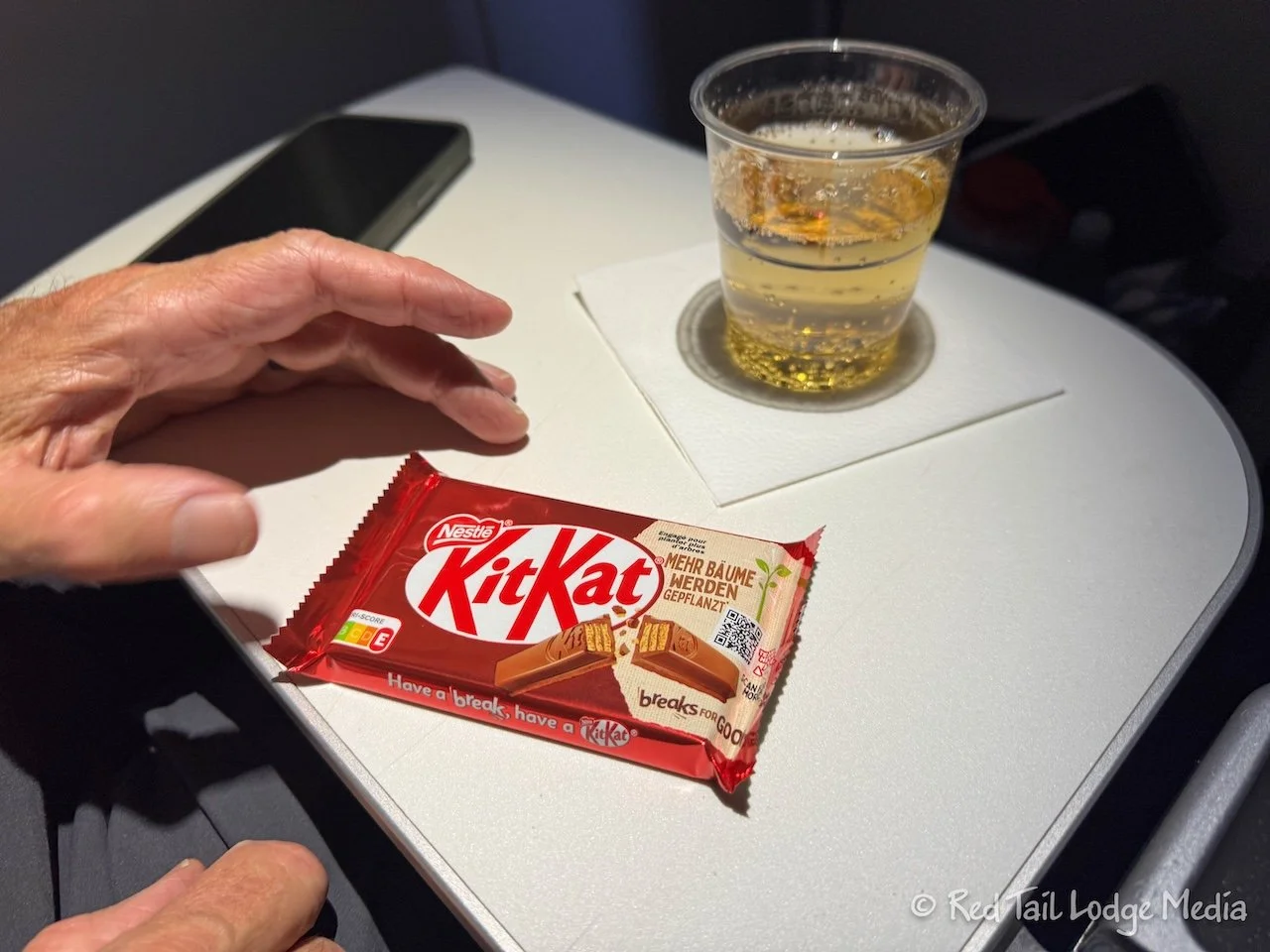
Before our lunch, we had a snack of crackers. After lunch, we had another snack of KitKat bars. Then, believe it or not, they served us dinner. It was a nine hour flight, but we were landing in Denver around 1:15 pm, so having dinner before we landed seemed a little odd. After dinner, they also gave us some Lindt chocolate. We were not hurting for calories on this flight.
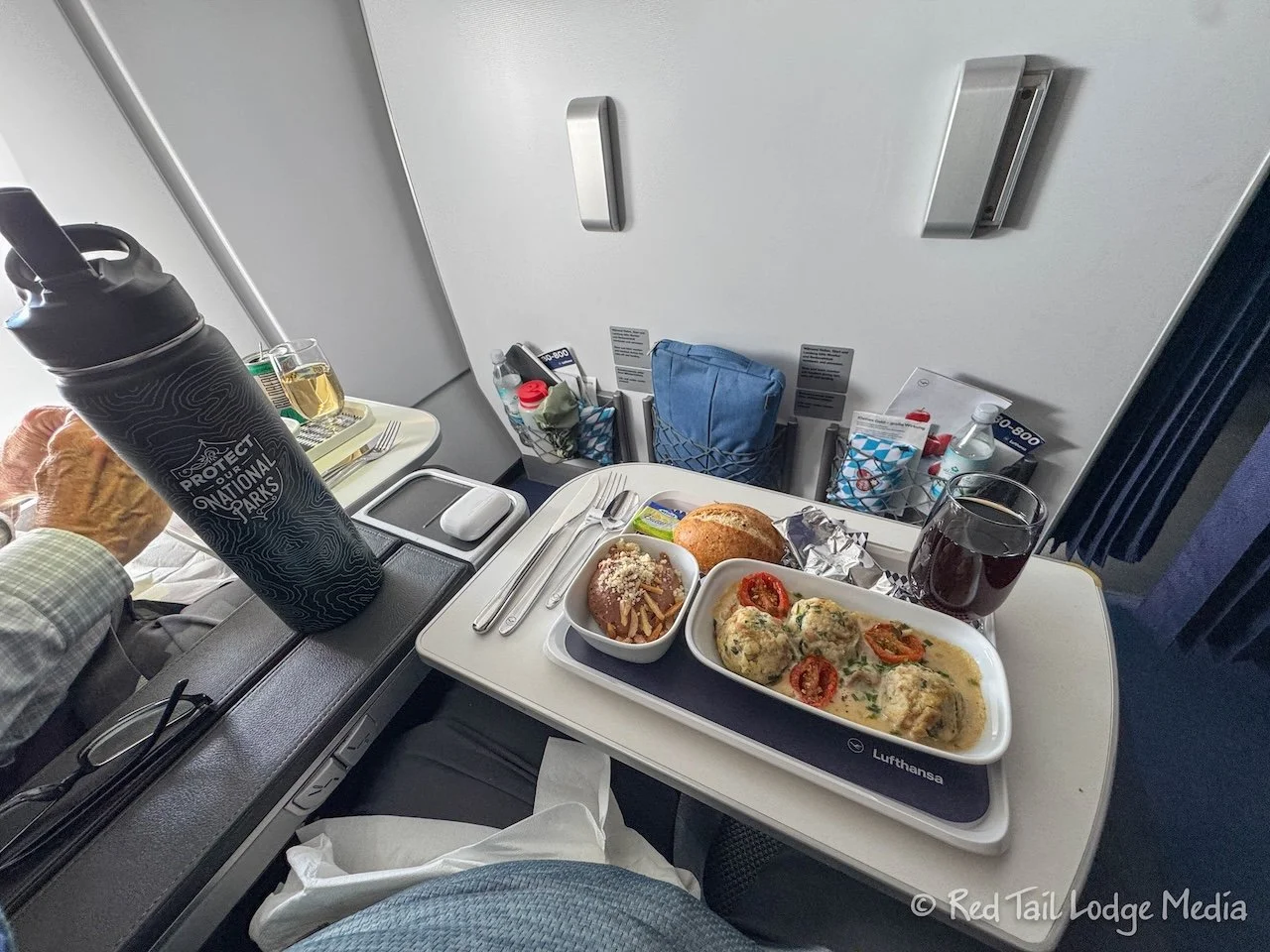
We didn’t have a choice for dinner (although I’m sure they must have accommodated special dietary needs). It consisted of a mushroom ragout with pretzel dumplings along with a roll and butter and chocolate mousse with almonds for dessert. Again, pretty tasty.
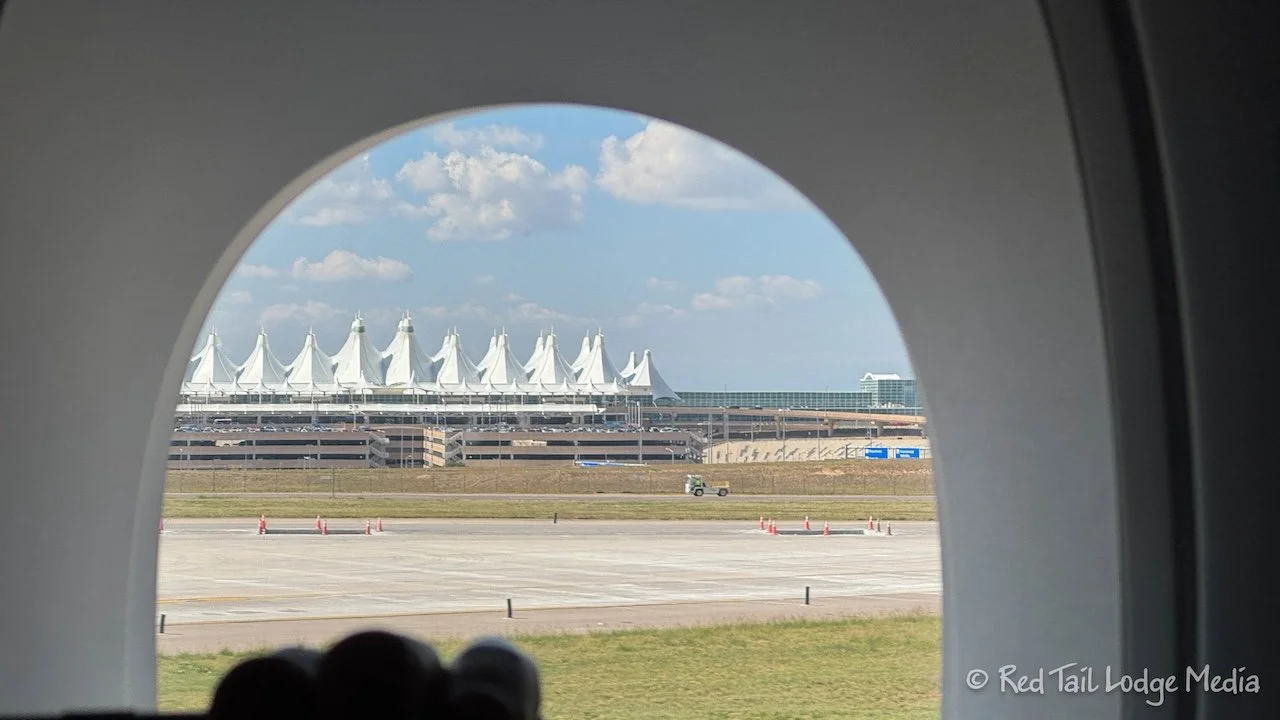
The flight was pretty uneventful. There was a little turbulence at the beginning, so it took a while before they turned off the seat belt signs, but it wasn’t bad. Before we knew it, the familiar white peaks of the DIA airport terminal came into view as we landed in Denver.
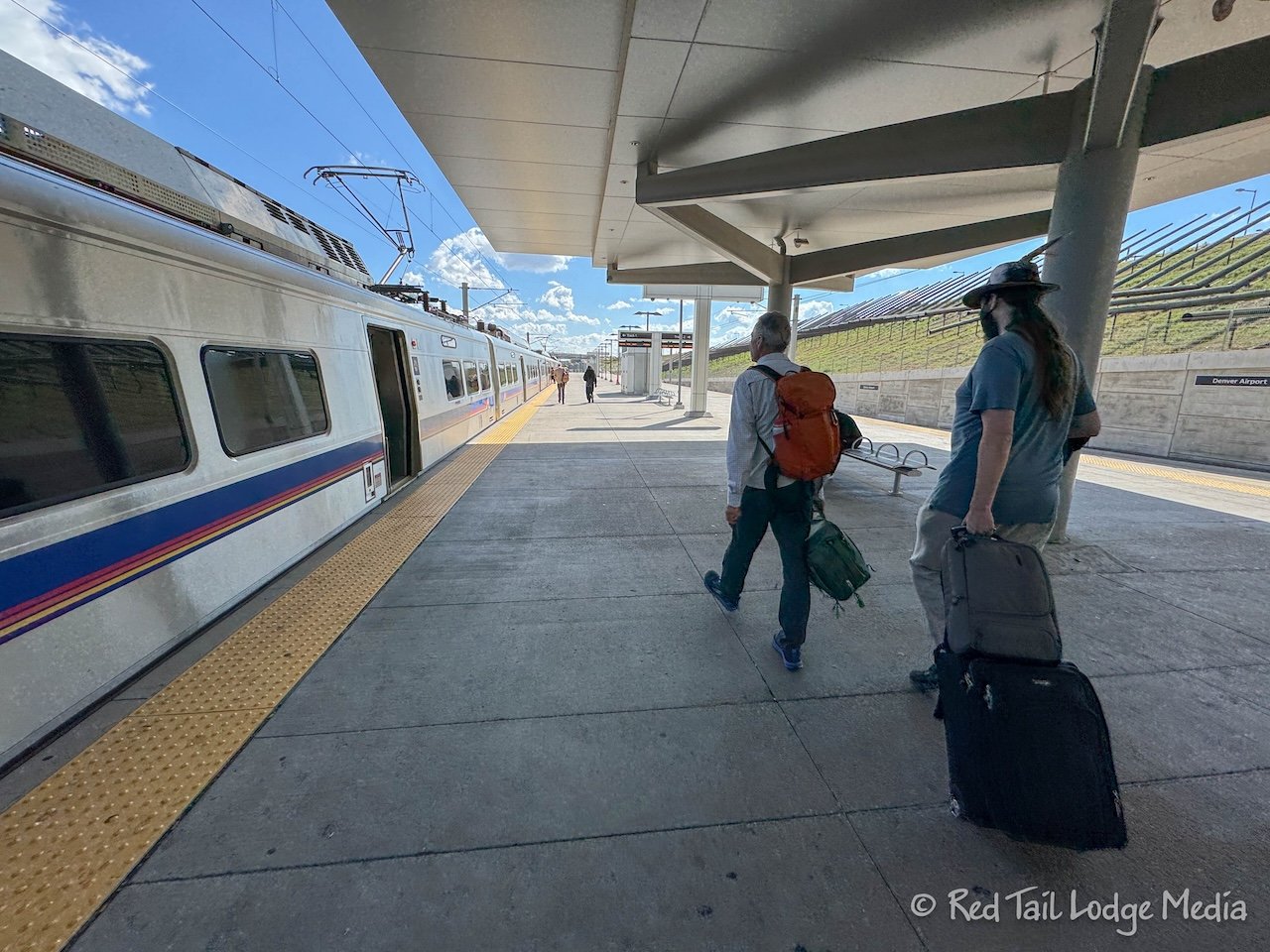
Customs also went pretty smoothly, without long lines. The longest we waited was for our checked luggage to come out. We landed around 1:15 pm and emerged from customs around 2:15 pm. We headed for the A Line light rail, then transferred to the N Line downtown. From the end N line station, we called an Uber. Our daughter was not available to pick us up. The A Line runs every 15 minutes and the N Line only every half an hour. It wasn’t the nice transportation systems of Europe, where they run every couple of minutes, but it got the job done. There were also buses we could have used to get us a little closer to home, but the trains are easier to use when you have luggage.
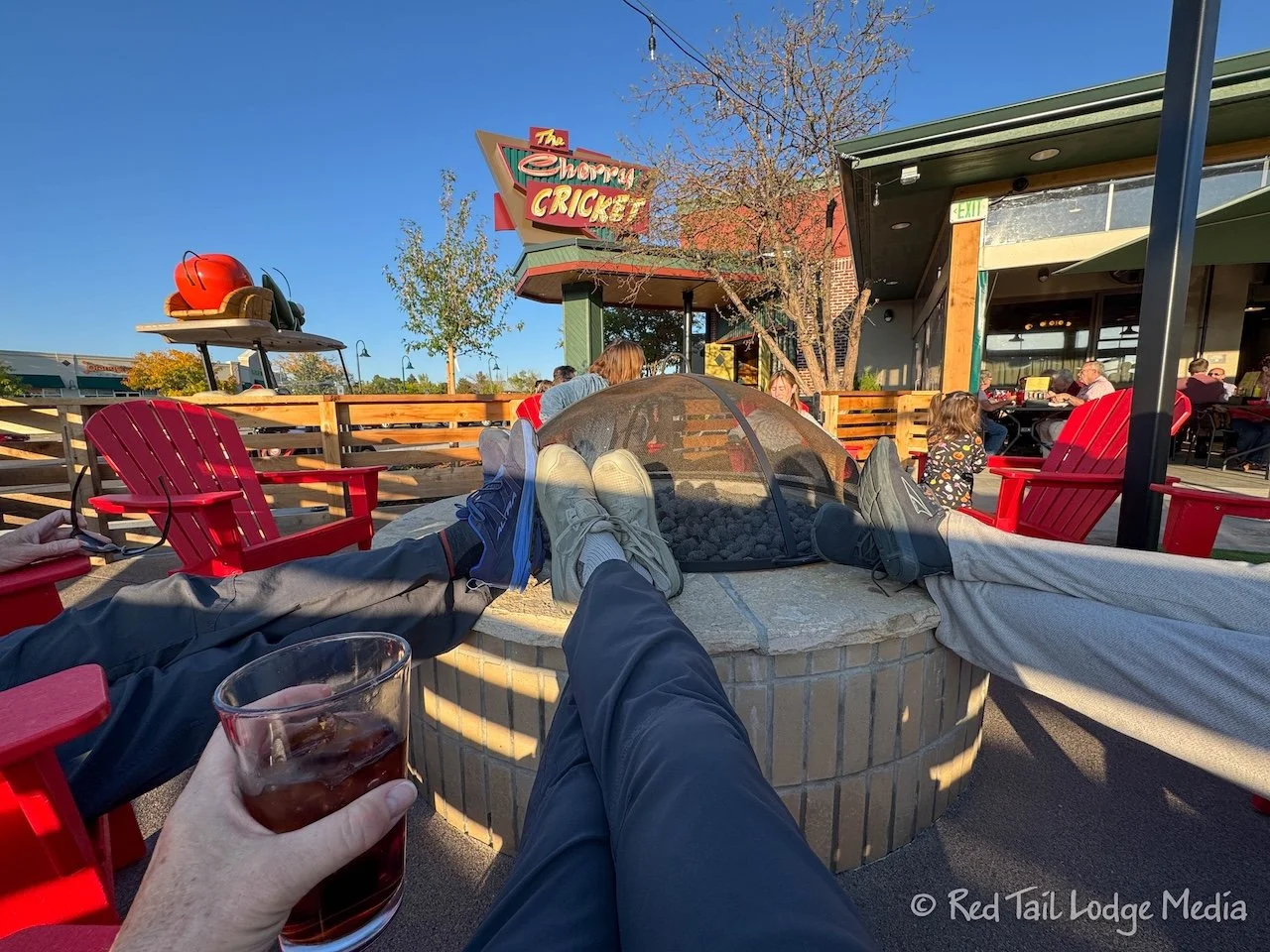
It was a little surreal to be home after being in Europe so long. Ann mustered up the courage to step on the scale and tried to put on a pair of jeans. It did not go well. She only gained 7 pounds, which she thought wasn’t bad for seven months of eating out, but she couldn’t get any of her pairs of jeans on. Her diet started the following day. It was a small price to pay for such a wonderful experience abroad. Keith had to rub it in the following day that he lost 7 pounds.
And that wrapped up Season Seven for us. Munich and Oktoberfest was a great way to end our trip. And sharing it with people we love made it all the more special.
Check out our related video: Munich & Oktoberfest, Germany
(Ann)